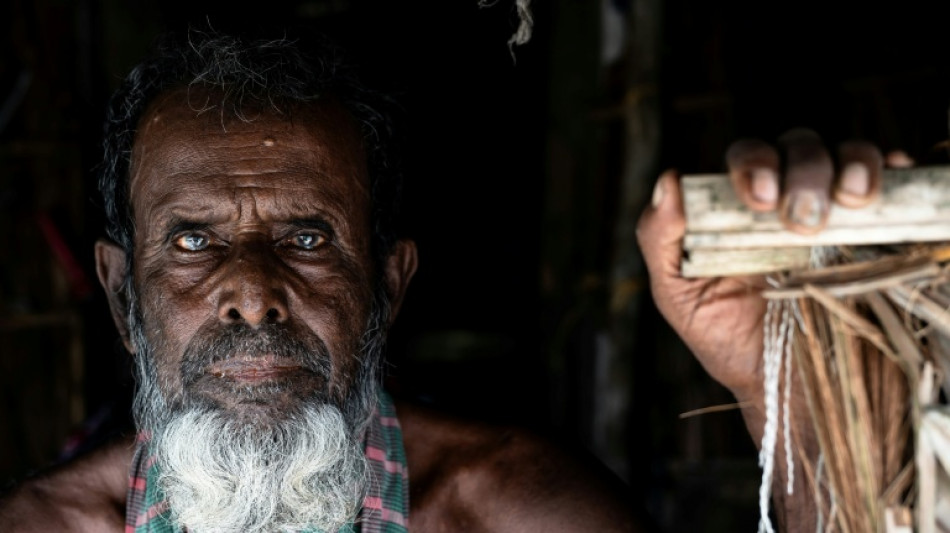
Rivers of salt: life on Bangladesh's climate frontline / Photo: © AFP

 AI startup urges optimism from Europe despite safety fears

 'Godlike, invincible': Japan hails 11-year-old Games history-maker

 Nepal's hydropower ambitions face climate reality check

 Power cuts, rubble: millions come home to find Sudan's capital unlivable

 Internationals keep Presidents Cup lead with late fightbacks

 Tuchel to 'keep pushing' England to reach Spain's level

 Alcaraz saves match points to keep Europe ahead in Laver Cup

 Spain success driven by hunger to improve, says De La Fuente

 Lyon collapse at Stade Francais to suffer first Top 14 loss
 Oyarzabal and Spain sink England again as Modric shines for Croatia

 Housing protesters camp in central Madrid after mass demonstration

 Louise Trotter expands her palette at Bottega Veneta

 Pope prays at Lourdes after huge Paris mass

 USA trims International lead after Presidents Cup four-balls

 Russia accuses Europe of blocking Ukraine talks, as strikes drag on

 'He said hello': Families pray with pope on Paris avenue

 Pope celebrates giant Paris mass, flies to Lourdes

 Thousands march in Madrid over eviction of 87-year-old woman

 England women back to winning ways with last-gasp defeat of New Zealand

 Trump rejects Iran proposal for deal to reopen Hormuz

 England's Cox says injured Buttler leaves 'big shoes to fill'
 Ruthless Perpignan upset sloppy Bordeaux-Begles
 Deadly abbey attack feeds anti-Ukrainian sentiment in Poland
 Antonelli says he drove 'safety-first' on his worst weekend of season

 Fernandez fights back to reach Singapore Open final

On Bangladesh's coast, where mighty Himalayan rivers meet the sea, water defines every rhythm of life, and every struggle.
Rising seas driven by climate change are swallowing low-lying areas, while stronger storms push saltwater further inland, turning wells and lakes brackish, according to government scientists.
For the millions living in the ecologically sensitive deltas of mudflats and mangrove forests, finding clean drinking water has become an escalating challenge.
Cyclone Aila in 2009 was a turning point.
Embankments broke and saltwater swept inland, flooding not only homes, but seeping into once-fertile land.
The water that once sustained communities became undrinkable, and the land began to crack under layers of salt.
The people of Khulna and Satkhira districts today live in a fragile balancing act between land and sea.
Many families live in houses built on bamboo stilts to escape tidal floods.
Children bathe in yellow, saline water and grow up in a landscape of constant change, where rivers erode their homes and schools, and displacement has become the norm.
Men migrate for months seeking work.
Women and children walk for hours across parched, cracked soil to fetch water from distant ponds, or harvest rainwater, and store it in tanks supplied by charities.
Each household stores a few thousand litres, rationed carefully until the next monsoon arrives.
The daily act of collecting and storing water has become a quiet ritual of endurance.
This reporting accompanies a photography series carried out by Muhammad Amdad Hossain for AFP's 2025 Marai Photo Grant, an award open to photographers from South Asia aged 25 or under.
The theme for 2025 was "climate change" and its impact on daily life and the community of the photographers who enter.
The award is organised by Agence France-Presse in honour of Shah Marai, the former photo chief at AFP's Kabul bureau.
Shah Marai, who was an inspiration for Afghan photographers throughout his career, was killed in the line of duty at the age of 41 in a suicide attack on April 30, 2018 in Kabul.
A.Gasser--BTB


