
Ghostwriters, polo shirts, and the fall of a landmark pesticide study
/ Photo: © AFP/File

 AI startup urges optimism from Europe despite safety fears

 'Godlike, invincible': Japan hails 11-year-old Games history-maker

 Nepal's hydropower ambitions face climate reality check

 Power cuts, rubble: millions come home to find Sudan's capital unlivable

 Internationals keep Presidents Cup lead with late fightbacks

 Tuchel to 'keep pushing' England to reach Spain's level

 Alcaraz saves match points to keep Europe ahead in Laver Cup
 Spain success driven by hunger to improve, says De La Fuente

 Lyon collapse at Stade Francais to suffer first Top 14 loss

 Oyarzabal and Spain sink England again as Modric shines for Croatia
 Housing protesters camp in central Madrid after mass demonstration

 Louise Trotter expands her palette at Bottega Veneta

 Pope prays at Lourdes after huge Paris mass

 USA trims International lead after Presidents Cup four-balls

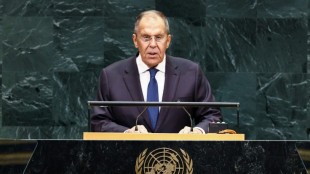 Russia accuses Europe of blocking Ukraine talks, as strikes drag on

 'He said hello': Families pray with pope on Paris avenue

 Pope celebrates giant Paris mass, flies to Lourdes

 Thousands march in Madrid over eviction of 87-year-old woman
 England women back to winning ways with last-gasp defeat of New Zealand

 Trump rejects Iran proposal for deal to reopen Hormuz

 England's Cox says injured Buttler leaves 'big shoes to fill'

 Ruthless Perpignan upset sloppy Bordeaux-Begles

 Deadly abbey attack feeds anti-Ukrainian sentiment in Poland

 Antonelli says he drove 'safety-first' on his worst weekend of season

 Fernandez fights back to reach Singapore Open final

A flagship study that declared the weedkiller Roundup posed no serious health risks has been retracted with little fanfare, ending a 25-year saga that exposed how corporate interests can distort scientific research and influence government decision-making.
Published in Regulatory Toxicology and Pharmacology in 2000, the paper ranks in the top 0.1 percent of citations among studies on glyphosate -- the key ingredient in Roundup, owned by agri-giant Monsanto and at the center of cancer lawsuits worth billions of dollars.
In his retraction note last week, the journal's editor-in-chief, Martin van den Berg, cited a litany of serious flaws from failing to include carcinogenicity studies available at the time to undisclosed contributions by Monsanto employees and even questions around financial compensation.
Elsevier, the journal's Dutch publisher, told AFP in a statement that it upholds the "highest standards of rigor and ethics" and that "as soon as the current editor became aware of concerns regarding this paper a matter of months ago, due process began."
But it did not address the fact that concerns date back to 2002, when critics wrote to Elsevier about "conflicts of interest, lack of transparency, and the absence of editorial independence" at the journal, including specific worries about Monsanto.
The matter exploded into public view in 2017, when internal corporate documents released during litigation showed one of Monsanto's own scientists admitting to "ghostwriting."
Harvard University science historian Naomi Oreskes, who co-authored a paper this September detailing the extent of the "fraud" in the 2000 study, told AFP that while she was "very gratified" at the "long overdue" action, but warned that "the scientific community needs better mechanisms to identify and retract fraudulent papers."
"This is completely in alignment with what we were calling them out for at the time," Lynn Goldman, a pediatrician and epidemiologist at GWU who co-signed the 2002 letter, added to AFP.
- Polo shirts -
Two of the paper's three original authors have since died, while first author Gary Williams, a professor at New York Medical College, did not respond to AFP's request for comment.
Monsanto maintains it acted appropriately, and that its product is safe. "Monsanto's involvement with the Williams et al paper did not rise to the level of authorship and was appropriately disclosed in the acknowledgments."
The company declined to comment on internal emails that suggested otherwise, including one in which a Monsanto scientist asked a colleague whether "the team of people" who worked on the Williams paper and another study "could receive Roundup polo shorts as a token of appreciation for a job well done."
Glyphosate was brought to market as a herbicide in the 1970s and initially welcomed as less toxic than DDT.
But its soaring use -- especially after Monsanto introduced glyphosate-tolerant seeds that allowed it to be sprayed widely over crops -- drew increasing scrutiny in the 1990s, making the 2000 paper hugely influential.
According to Oreskes's research, it was cited as supporting evidence for glyphosate's safety by groups ranging from the Canadian Forest Service to the International Court of Justice, the US Congress and the European Parliamentary Research Service.
- Legal interest -
In 2015, the World Health Organization's International Agency for Research on Cancer classified glyphosate as "probably carcinogenic to humans."
Several countries have since moved to restrict or ban its use, including France, which has prohibited household applications. Bayer, which acquired Monsanto, said it would phase out Roundup for US residential use in 2023 in response to growing lawsuits.
Nathan Donley, a scientist with the Center for Biological Diversity, told AFP he does not expect the retraction to sway the US Environmental Protection Agency, now under the pro-agricultural-industry Donald Trump administration, which has thrown its weight behind Bayer in an ongoing Supreme Court case.
But "it could play a role in litigation that is moving forward in the US against the EPA's proposed decision to renew glyphosate," Donley told AFP, adding that European regulators might also take note.
For Donley and others, the deeper concern is that the case may be far from unique.
"I am sure there (are a) lot (of) such ghost-written and undeclared conflict papers in the literature, but they are very difficult to unearth unless one goes really deep in litigation cases," John Ioannidis, a Stanford University professor who founded the field of meta-research told AFP.
D.Schneider--BTB