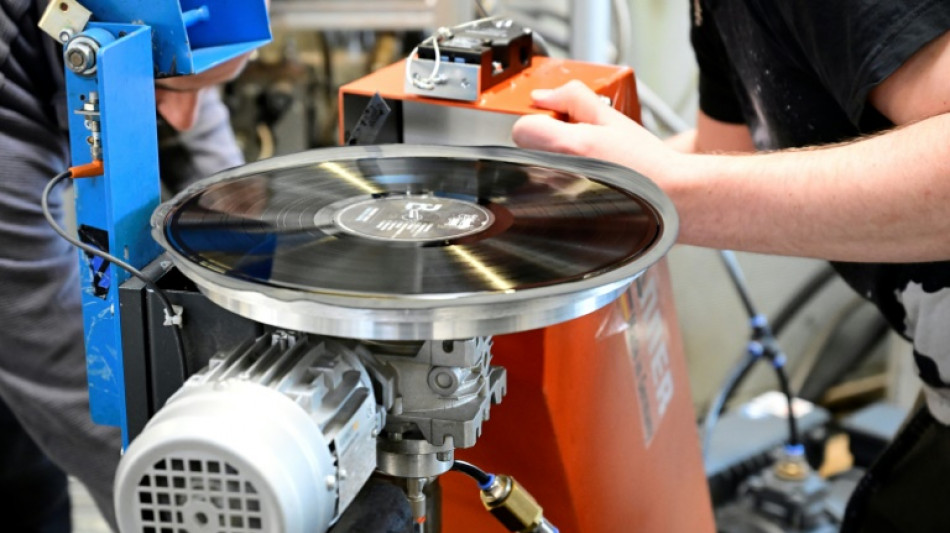
World's first bioplastic vinyl record launched in the UK / Photo: © AFP

 Far-Right Extremists Claim Opportunity to Seize Control of GOP After Midterms

 New Campaign Highlights Knowledge Gaps on Carbon Monoxide Safety Among Americans

 JR East Launches 'teppay' to Integrate Suica Balance with Mobile Payments

 Phil Spencer on Housing Market Fairness: How Buyers and Sellers Navigate Falling Prices

 Beirut Cinema Festival Draws Thousands Despite War Fatigue

 AMD Forecasts First-Ever Revenue Lead Over Intel on AI Chip Surge

 GoodData.AI Launches the Agentic Serving Plane, a New Category of Enterprise Data Infrastructure for AI Agents

 Abu Dhabi Demand Response Project Achieves 401 MW Peak Reduction in 2025

 Panthers expected to begin 2027 NRL season away from new stadium
A British firm says it has produced the world's first bioplastic vinyl record, which it hopes will reduce the need for highly toxic PVC.
Bioplastics are derived from sources such as sugars and starches -- rather than oil or gas -- and do not create any toxic waste in their production.
The new bioplastic vinyl by UK firm Evolution has been endorsed by NGO Music Declares Emergency, a climate change campaign group set up in 2019 by artists and music industry professionals.
"If Evolution can deliver an alternative guilt-free vinyl, it could get rid of one of the key polluting elements of the music industry completely," the NGO's co-founder Lewis Jamieson told AFP.
Currently, all vinyl records are made from Polyvinyl chloride, or PVC -- described by Greenpeace as "the most environmentally damaging plastic", whose production releases toxic, chlorine-based chemicals that are "building up in the water, air and food chain".
The issue has come to the fore thanks to the recent boom in vinyl sales -- which surpassed $1 billion last year in the United States alone (a first since the mid-1980s).
Few anticipated the vinyl revival that began in the mid-2000s, so record companies found themselves scrambling to secure PVC -- often relying on foreign firms with poor safety records.
Kyle Devine, who wrote a book on the environmental impact of the music industry, "Decomposed", said the PVC for 90 percent of US vinyls in 2015 came from a Thai company that was "pouring pollution into the Bangkok river".
"PVC is an especially nasty plastic to make. It's a difficult one to dispose of, to recycle or decompose," he told AFP.
He added that it would be wrong to see the current dominance of streaming and digital music as an answer to the industry's climate impact.
"Digital data still takes up space and uses energy. In fact, given the current size and spread of the music industry, it's likely more environmentally-taxing than ever before," Devine said.
Evolution released the first 20 records made with the bioplastic via a prize draw -- a compilation of young artists including electro duo Bicep and US singer Angel Olsen.
It has taken almost five years of testing due to delays caused by the Covid pandemic, but the firm says they are close to matching regular records.
"It presses the same as PVC," said co-founder Marc Carey. "The final piece of the puzzle is there is a little bit of surface noise when you play the record so we are working on that. We think we are two weeks away from finalising the recipe."
Music Declares Emergency is clear that changing the production of vinyl records will do little for the bigger picture on climate change, but Jamieson said such innovations were symbolically important.
"It reminds people that thinking sustainability doesn’t mean you have to live in a mud hut and have no fun," he said.
Y.Bouchard--BTB