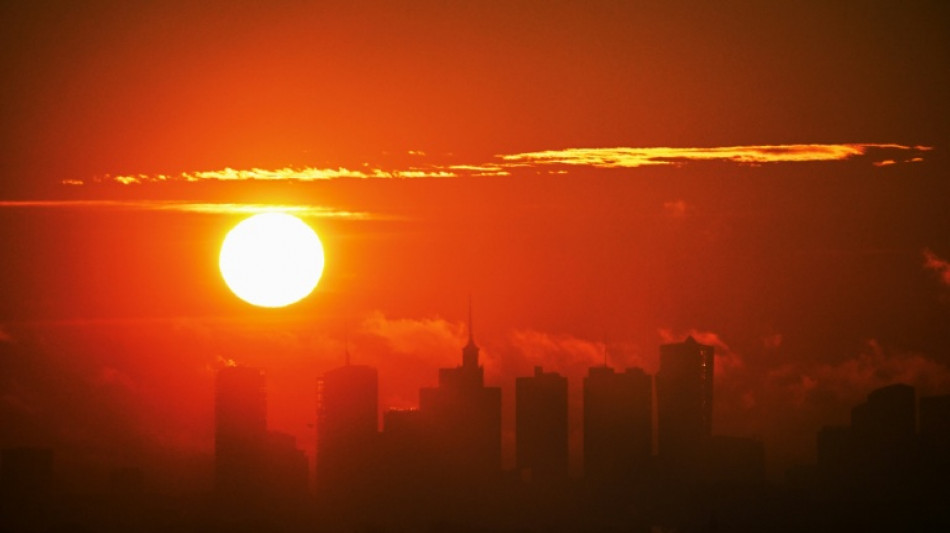
Regional temperature records broken across the world in 2025 / Photo: © AFP

 Japanese anime actor fights TikTok over AI voice cloning

 Curtain falls on the romance of India's single-screen cinemas

 Smells like teen spirit as US thrash Peru 4-1

 Cavy chaos: Hundreds attend New Zealand's biggest guinea pig show

 Venezuela releases more political prisoners after opposition talks

 England's best 'for a long time' despite Spain defeat, says Kane

 Powerful storm pummels northeast US with rain, high winds

 Filmmaker Mike Leigh wins top prize at Spain festival with 'last film'

 Spain beat England in Nations League to extend unbeaten run

 Ireland squad vote to play Israel tie despite Gaza unease

 Gutsy Vollering wins cycling road race world title

 Vollering wins cycling road race world title
 Man City's meteoric rise clouded by dark shadow

 Mbappe out for two weeks or more with knee injury say Real

 Lyon collapse away to Stade and suffer first Top 14 loss

 Russia accuses Europe of seeking to thwart Ukraine talks

 Man City chairman defiant over reported Premier League charges

 Germany ready to 'walk through fire' for Klopp, says Tah

 At least 16 killed in Russian and Ukrainian strikes

 Powerful storm pummels US Northeast

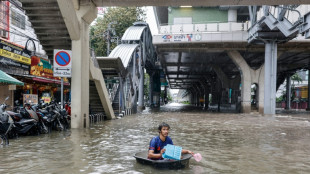 Bangkok declares disaster after homes flooded, roads submerged by heavy rain

 Norris calls for errant Colapinto to be banned for causing Baku crash

 Russell finds himself again and prepares to heap pressure on Antonelli

 South Korea hold nerve to win Asian Games basketball gold

 Russell holds off Verstappen to claim imperious victory in Baku

Central Asia, the Sahel region and northern Europe experienced their hottest year on record in 2025, according to AFP analysis based on data from the European Copernicus programme.
Globally, the last 12 months are expected to be the third hottest ever recorded after 2024 and 2023, according to the provisional data, which will be confirmed by Copernicus in its annual report in early January.
But the average, which includes land and oceans, masks overall records for certain parts of the world.
Many poorer nations do not publish detailed climate data, so AFP has completed the global picture by independently analysing Copernicus data from climate models, measurements from about 20 satellites, and weather stations.
The data spans the whole world, hour by hour, since 1970.
Here is what the detailed analysis revealed for 2025, during which 120 monthly temperature records were broken in more than 70 countries.
- Records shattered in C.Asia -
Every country in Central Asia broke its annual temperature records.
Landlocked, mountainous Tajikistan, where only 41 percent of the population has access to safe drinking water, saw the highest abnormal temperatures in the world, at more than 3C above its seasonal averages from 1981 to 2010.
Monthly temperature records have been broken every month since May, with the exception of November.
Neighbouring countries such as Kazakhstan, Iran and Uzbekistan experienced temperatures 2C to 3C above the seasonal average.
- Up to 1.5C hotter in the Sahel -
Temperature records were beaten in several countries in the Sahel and west Africa.
Mali, Niger, Nigeria, Burkina Faso and Chad saw a rare divergence in temperatures, notching 0.7C to 1.5C above their seasonal average.
The last 12 months were the hottest ever recorded in Nigeria, and one of the fourth hottest in the other countries.
Scientists from the World Weather Attribution (WWA) network, who assess the role of human-induced climate change in extreme weather events, wrote in their annual report published on Monday that extreme heat events "have become almost 10 times more likely since 2015".
Countries in the Sahel -- the semi-arid region of west and north-central Africa stretching from Senegal to Sudan -- are among the most vulnerable to rising temperatures, with many already facing armed conflict, food insecurity and widespread poverty.
- Scorching summer in Europe-
Around 10 European countries are on the verge of, or coming close to, breaking their annual temperature record, notably due to an exceptional summer.
In Switzerland and several Balkan countries, summer temperatures were 2C and even 3C above their seasonal average.
Spain, Portugal and Britain also recorded their worst summer on record, with extreme heat fuelling massive wildfires.
The driest spring in more than a century led to a UK water shortage.
Northern Europe was largely spared the heatwave that hit Europe at the end of June but it instead experienced an abnormally warm autumn.
The last 12 months are expected to be one of the two warmest years on record in Norway, Sweden, Finland and Iceland.
A.Gasser--BTB


