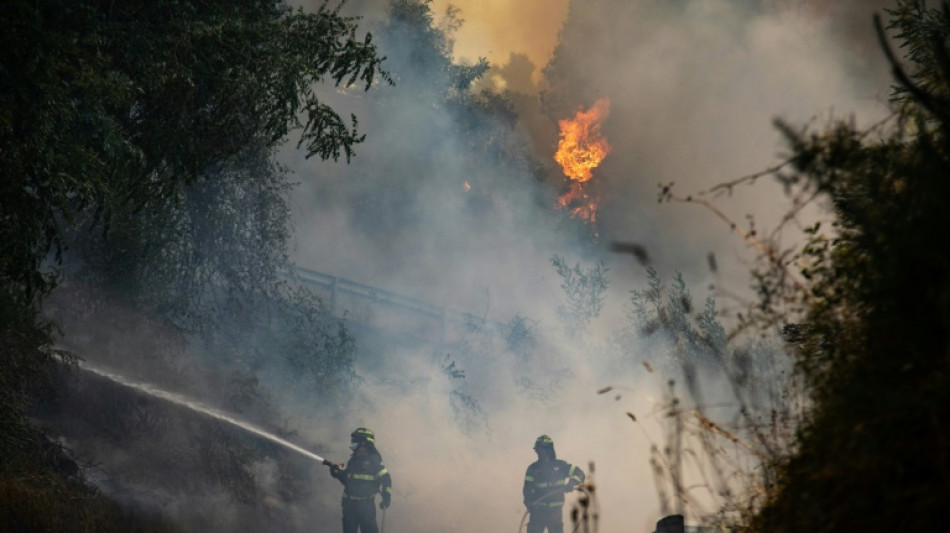
Climate change drives Europe towards record fire year / Photo: © AFP

 Ireland squad vote to play Israel tie despite Gaza unease
 Gutsy Vollering wins cycling road race world title

 Vollering wins cycling road race world title
 Man City's meteoric rise clouded by dark shadow
 Mbappe out for two weeks or more with knee injury say Real
 Lyon collapse away to Stade and suffer first Top 14 loss
 Russia accuses Europe of seeking to thwart Ukraine talks

 Man City chairman defiant over reported Premier League charges
 Germany ready to 'walk through fire' for Klopp, says Tah

 At least 16 killed in Russian and Ukrainian strikes

 Powerful storm pummels US Northeast
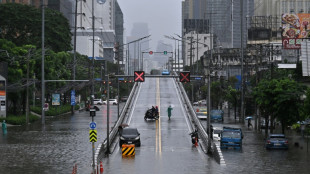
 Bangkok declares disaster after homes flooded, roads submerged by heavy rain
 Norris calls for errant Colapinto to be banned for causing Baku crash

 Russell finds himself again and prepares to heap pressure on Antonelli
 South Korea hold nerve to win Asian Games basketball gold

 Russell holds off Verstappen to claim imperious victory in Baku
 Russell holds off Verstappen to win Azerbaijan Grand Prix
 India's Kohli says 2027 ODI World Cup will be his last

 Huge crowds cheer Pope Leo along Champs-Elysees ahead of Paris mass
 Putellas wants to bring 'winning culture and mentality' to London City

 Rare Italian opera returns to Moscow after nearly 120-year hiatus

 Pope to celebrate giant Paris mass after 'peace' appeal
 Homes flooded, roads submerged: Bangkok declares disaster over heavy rains

 Ahead of Paris mass, pope urges life together in 'dignity and peace'

 Austria 'ghetto' language classes leave children to repeat school
The fires that have torched through Europe are on course to make 2022 a record year for forest loss on the continent, as scientists warn climate change is already contributing to ever fiercer blazes.
Fires in parts of France, Spain and Portugal have already burned more land so far this year than in all of 2021 -- some 517,881 hectares (5,000 km2), or the equivalent area of Trinidad and Tobago.
"The situation is much worse than expected, even if we were expecting temperature anomalies with our long-term forecasts," Jesus San Miguel, coordinator of the European Union's EFFIS satellite monitoring service, told AFP.
San Miguel said there could be worse to come, adding that the hallmarks of global heating were all over this year's fire season.
"Ignition is caused by people (but) the heatwave is critical, and clearly linked to climate change," he said.
"The fire season used to be concentrated from July to September. Now we are getting longer seasons and very intense fire. We expect climate change to create higher fire conditions in Europe."
Temperatures have warmed just over 1.1 degrees Celsius since the industrial era, and the United Nations Says Earth is currently on track to warm some 2.7C this century.
This additional heat is enough to make the kind of heatwaves that baked Europe this week more likely to occur and to last longer when they do.
- Rising fire risk -
EFFIS said close to 40,000 hectares of forest in France have been lost to fire so far this year, more than the 30,000 that burned there in 2021.
Spain -- where more than 500 people died during a 10-day heatwave this month -- has seen 190,000 hectares go up in smoke this year, compared with 85,000 last year.
EFFIS said that Europe could end 2022 with more land burned by area than 2017, currently the worst recorded year for wildfires with nearly 1,000,000 hectares lost.
In all of 2021, 470,359 hectares of forest were lost to fires in Europe, mainly in Italy and Greece.
Yet those two countries have had a relatively good year in terms of wildfires: Italy has lost 25,000 hectares compared with more than 150,000 in 2021 and Greece has lost 7,800 compared with 130,000 a year ago.
This week temperatures topped 40C for the first time on record in Britain, where a relatively high 20,000 hectares have burned since January.
A study in February found that the proportion of July and August days of extreme fire risk in Britain would increase from 9 percent currently to 26 percent with 2C of warming.
Mark Parrington, head scientist at the EU's Copernicus atmospheric monitoring service, said climate change had already contributed to how long wildfires last when they break out.
"What is remarkable is just how long they burn," he told AFP. "This is not the kind of thing we typically see in Europe.
Hotter temperatures combined with near-unprecedented drought conditions across much of Europe contribute to making forests tinder dry, providing the ideal conditions for wildfires to start and then spread.
"There is a lot of fuel," said Parrington. "In central and southern Europe there is a clear upward trend for fire risk."
As well as damaging ecosystems and removing carbon-absorbing vegetation from the land, wildfires themselves contribute to climate change by emitting greenhouse gases such as carbon dioxide.
Copernicus this week said fires in June and July in Spain and Morocco had produced some 1.3 million tonnes of CO2 -- the highest of any equivalent period since records began in 2003.
The blazes also affect air quality for nearby populations. In southwest France, elevated levels of nitrogen dioxide have been noted for days over the city of Bordeaux, just north of two major burn areas, and even in Paris, some 500 kilometres (310 miles) northeast.
A.Gasser--BTB