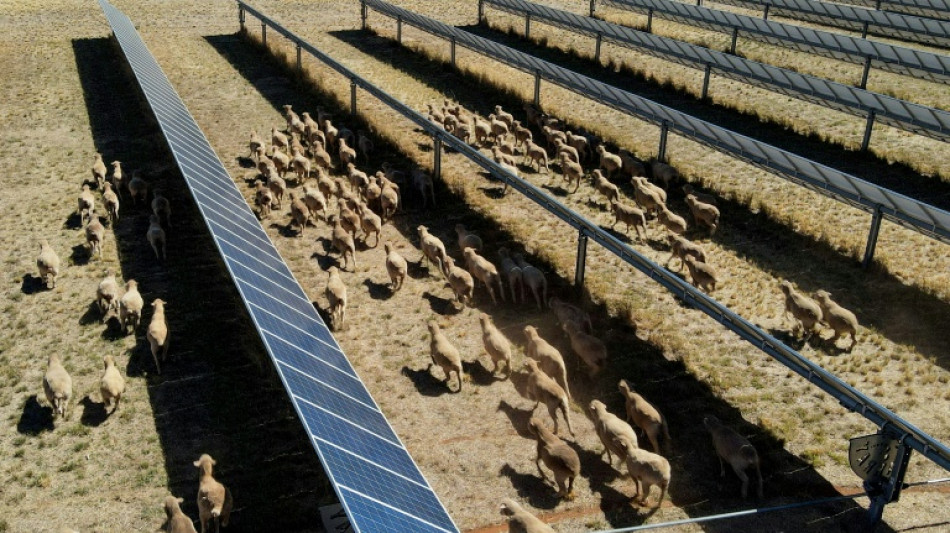
'Solar sheep' help rural Australia go green, one panel at a time / Photo: © AFP

 Internationals keep Presidents Cup lead with late fightbacks

 Tuchel to 'keep pushing' England to reach Spain's level

 Alcaraz saves match points to keep Europe ahead in Laver Cup

 Spain success driven by hunger to improve, says De La Fuente

 Lyon collapse at Stade Francais to suffer first Top 14 loss
 Oyarzabal and Spain sink England again as Modric shines for Croatia
 Housing protesters camp in central Madrid after mass demonstration

 Louise Trotter expands her palette at Bottega Veneta

 Pope prays at Lourdes after huge Paris mass

 USA trims International lead after Presidents Cup four-balls

 Russia accuses Europe of blocking Ukraine talks, as strikes drag on

 'He said hello': Families pray with pope on Paris avenue

 Pope celebrates giant Paris mass, flies to Lourdes

 Thousands march in Madrid over eviction of 87-year-old woman

 England women back to winning ways with last-gasp defeat of New Zealand

 Trump rejects Iran proposal for deal to reopen Hormuz

 England's Cox says injured Buttler leaves 'big shoes to fill'
 Ruthless Perpignan upset sloppy Bordeaux-Begles
 Deadly abbey attack feeds anti-Ukrainian sentiment in Poland
 Antonelli says he drove 'safety-first' on his worst weekend of season

 Fernandez fights back to reach Singapore Open final

 Giant statue of Pope Leo XIV takes shape in Peru workshop

 Ukraine crush holders Italy to reach first BJK Cup final

 Pope celebrates giant Paris mass in landmark visit

 Germany selects Munich for Olympics host bid

Australian farmer Tom Warren's solar panels look like any other -- until you spot the dozens of sheep grazing and napping, helping the country transition to green energy and earning him a decent income while doing it.
More than 30,000 solar panels are deployed across approximately 50 hectares at Warren's farm on the outskirts of Dubbo, around 400 kilometres (250 miles) west of Sydney.
The farmer and landowner has been working with renewables firm Neoen for more than a decade and said he was initially worried the panels would restrict his sheep's grazing.
It quickly became clear those fears were unfounded.
"Normally they would seek out trees and camp under the trees, but you can see that the sheep are seeking out the shade of the panels," he told AFP at the farm in Dubbo.
"So, it's a much better environment for them as well."
The farm produces about 20 megawatts of power, he said -- a "substantial amount" of the energy needs of the local area.
While he can't disclose how much he earns from the panels, he said he's taking in much more than he would from just farming.
"The solar farm income is greater than I would ever get off agriculture in this area -- regardless of whether I have sheep running under the panels or not," he said.
- Grass is greener -
The panels have had another surprising side effect: because the grass is shielded from the elements, it's of more consistent quality.
That, in turn, has improved the wool produced by the sheep.
"The wool is actually better and cleaner," Warren said.
"All over, we've had about a 15 percent increase in the gross revenue coming from the sheep running under the solar farm."
Fellow farmer Tony Inder, based around 50 kilometres south in the town of Wellington, agrees.
His flock is much larger -- 6,000 sheep grazing on two plots of land covering 4,000 hectares.
"If you want to grow wool, you just need one constant diet and then the wool will grow evenly," he said.
"Under the panels, because it's constant shade and it's constant green, we're supplying a more constant feed, which in turn gives it a better quality wool."
Unlike Warren, Inder doesn't own the land where the solar panels are installed, but the landowners let him use it for free.
In exchange, "they don't have to mow as often", to ensure the panels function properly, but also, and more importantly, to comply with bushfire prevention regulations.
- Renewables boom -
Sheep, and in particular wool, were a mainstay of the Australian economy for much of the past 150 years, feeding into the notion by the 1950s that Australia "rode on the sheep's back".
The Dubbo farm, however, was a pioneer in the field of agrivoltaics and many others are following its example.
"All of our solar farms in New South Wales now have sheep grazing on them," said Emily Walker, the company's director for the state.
"The industry is moving very quickly into a world where it's not really possible anymore to decouple the historical-agricultural land use from the solar."
Australia remains heavily dependent on its fossil fuel economy for growth despite heavy investment in the renewable sector.
Canberra has pledged to slash planet-warming greenhouse gas emissions by up to 70 percent from 2005 levels over the next decade.
It has also poured billions into solar power, wind turbines and green manufacturing and pledged to make Australia a renewable energy superpower.
Karin Stark, director of the consulting firm Farm Renewables, told AFP that more funding to incentivise this combined use of farmland was needed.
She said the benefits were clear.
"As more farmers are starting to adopt renewable or host large-scale renewable on their land and continuing to farm... the more visible it is in the community," she said.
"Farmers can see that you can continue to farm and be productive."
Y.Bouchard--BTB


