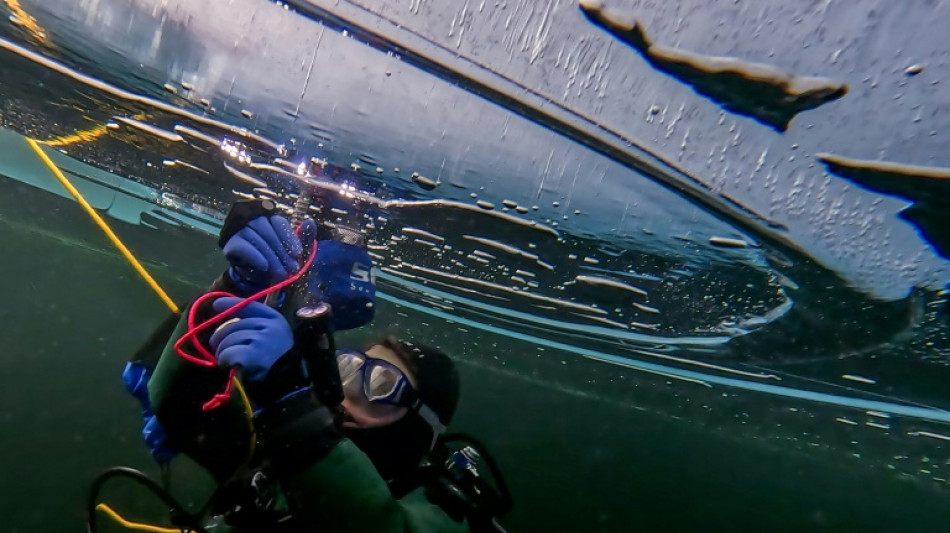
In Finland, divers learn to explore icy polar waters / Photo: © AFP

 Internationals keep Presidents Cup lead with late fightbacks

 Tuchel to 'keep pushing' England to reach Spain's level

 Alcaraz saves match points to keep Europe ahead in Laver Cup

 Spain success driven by hunger to improve, says De La Fuente

 Lyon collapse at Stade Francais to suffer first Top 14 loss
 Oyarzabal and Spain sink England again as Modric shines for Croatia
 Housing protesters camp in central Madrid after mass demonstration

 Louise Trotter expands her palette at Bottega Veneta

 Pope prays at Lourdes after huge Paris mass

 USA trims International lead after Presidents Cup four-balls

 Russia accuses Europe of blocking Ukraine talks, as strikes drag on

 'He said hello': Families pray with pope on Paris avenue

 Pope celebrates giant Paris mass, flies to Lourdes

 Thousands march in Madrid over eviction of 87-year-old woman

 England women back to winning ways with last-gasp defeat of New Zealand

 Trump rejects Iran proposal for deal to reopen Hormuz

 England's Cox says injured Buttler leaves 'big shoes to fill'

 Ruthless Perpignan upset sloppy Bordeaux-Begles
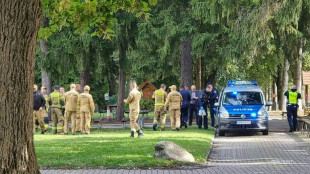 Deadly abbey attack feeds anti-Ukrainian sentiment in Poland
 Antonelli says he drove 'safety-first' on his worst weekend of season

 Fernandez fights back to reach Singapore Open final

 Giant statue of Pope Leo XIV takes shape in Peru workshop

 Ukraine crush holders Italy to reach first BJK Cup final

 Pope celebrates giant Paris mass in landmark visit

 Germany selects Munich for Olympics host bid
In a square hole carved out of the thick ice, two divers vanished into the depths of an Arctic lake, leaving nothing but bubbles at the surface.
Returning 45 minutes later, Marta Lukasik tapped her fist on the top of her head -- a diver's signal that means "I'm ok".
On the frozen Lake Kilpisjarvi, just below the tree line at the intersection of the Finnish, Swedish and Norwegian borders, 12 divers were taking a course to learn how to dive in polar regions so they could carry out scientific research.
"Just wow, every small thing you see in the water... Just wow," said Lukasik, a 41-year-old oceanology PhD student who works as a diving inspector on fish farms in Norway, mesmerised by the experience.
For 10 days, the international group from different professions and backgrounds learnt vital skills below the 80 centimetres (30 inches) of ice covering the lake.
According to Erik Wurz, coordinator of the programme run by the Finnish Scientific Diving Academy which is part of the University of Helsinki, there is a critical need for skilled people who can conduct research in demanding polar environments.
Climate change is warming and transforming the Arctic and Antarctic at a faster rate than the rest of the planet.
"There's still a lot of questions to be covered in the polar regions and access is very limited," said Wurz, stood next to two large holes cut into the ice and a pitched wind shelter.
"The number of scientific divers that can go under the ice is even more limited," he added, estimating there to be only around 100 to 200 people globally.
- Teamwork -
Wearing dry suits to fend off the 2 degrees Celsius cold in the water, the divers arrived on snowmobiles at the site, located close to the University of Helsinki's biological station at the foot of the Saana mountains.
Ruari Buijs, 21, checked his course mates at the "base Alpha" hole to make sure they were ready to dive, before helping them slide into the water with steel gas cylinders on their backs and torches attached to their arms.
"I think the most important thing is definitely teamwork," noted Buijs, who studied marine biology and oceanography at the University of Plymouth in Britain, as the divers disappeared.
"For instance... if there's low visibility, there's always a line back," he said, indicating a yellow, 50-metre (165-foot) safety line in his hand, the other end tethered to the diver underwater.
A light attached to a steel tank flickered in the clear water -- a sign post for the divers if they become disoriented.
With only two holes for entry and exit, the biggest challenge for the divers was "the overhead environment they are getting into", Wurz said.
"They are going into an ice cave."
- 'Critical point' -
The day's task was to practice drilling a sample of the ice sheet, so-called "ice coring", explained Caroline Chen, 23 -- a Canadian trained scientific diver and research assistant at the University of Hamburg.
"Sometimes you bump your head, I'm still getting used to this," she said.
In this "safe setting", the divers were training to be "confident when they are deployed to Antarctica" or any polar expedition where they would not have the luxury of warm buildings and showers nearby, Wurz said.
Have finished the course, Wurz joined an expedition to the Antarctic research station Scott base, 1,350 kilometres (840 miles) from the South Pole.
"We are at a really critical point in time because the polar regions are changing very fast," Wurz said.
"There are huge areas of shelf ice breaking off...that has not happened before at such a fast rate," he added.
An AFP review of US data showed in March that Arctic sea ice is headed for one of its smallest winter peaks on record due to human-induced warming.
"We need to get samples and reliable data from these regions because they are the fastest changing on the planet in the warming ocean," Wurz said.
Still beaming after her dive, Lukasik described how the sun piercing through layers of snow and ice had created rays in the water.
"You need to be a little crazy to go into that environment," Buijs said with a smile.
"I think it's the second most hostile environment known to man, apart from the vacuum of space," he said, adding that he hopes to work as a marine biologist on the islands around Antarctica.
"It's like a whole new world, and I would love to explore that."
H.Seidel--BTB


