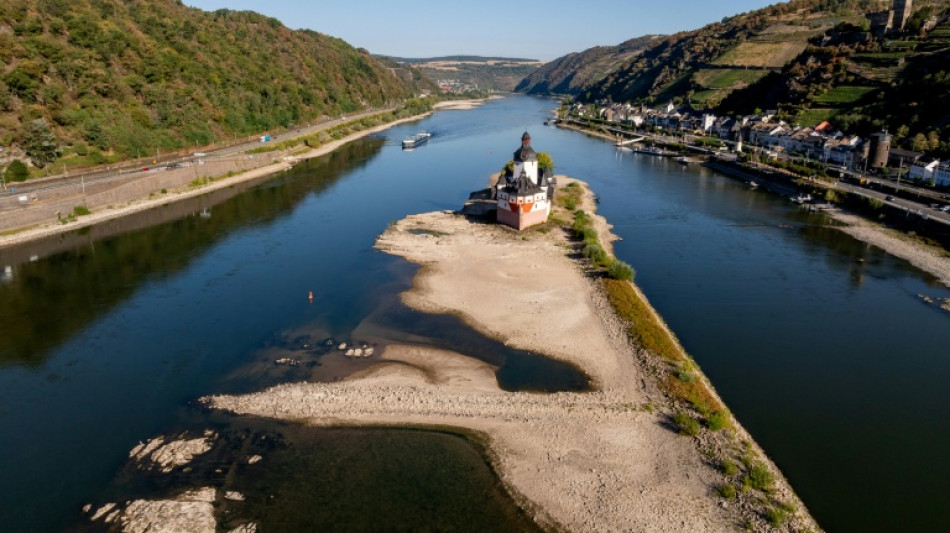
Low Rhine weighed on German growth: central bank / Photo: © afp/AFP

 Malta Stuns Sweden with Late Penalty Comeback in Rugby Europe Trophy

 BingX: Major Announcement of Far-Reaching Significance

 Élan Opens as Late-Night Wine Bar in Honolulu

 Shiv Sena (UBT) Criticizes NCP Merger Talks as 'Ridiculous Laughing Stock'

 Dell Announces AI-Integrated PC Lineup for 2026 with Wi-Fi 7 Support

 Rocky Fans Break Guinness World Record at Philadelphia Museum Steps

 FAA Grounds All US Flights Amid Nationwide Air Traffic Control Communication Failure

 Argentina vs Uruguay Kick-off Time, TV Channels & Free Streaming Guide

The German economy likely contracted in the third quarter as record low levels on the Rhine river caused by heatwaves and drought hampered goods shipments, the central bank said Wednesday.
Like elsewhere in Europe, Germany endured an exceptionally hot summer with little rainfall.
The Rhine, which flows through the country's industrial heartland and is a key transport route for goods ranging from steel to chemicals, became unnavigable in places as water levels sank to record lows.
After a strong performance in the first half of the year, the Bundesbank predicted that the recovery of the long-stagnant Germany economy had been "interrupted" in the July-September period.
"In particular the low levels on the Rhine and the associated restrictions on inland water transport put pressure on industry," the central bank said in a regular report on the economy.
The low water levels hit the chemical sector and manufacture of coal and petroleum products particularly hard, the report said.
The statistics office will release a first estimate of third-quarter growth on Friday next week.
The economy logged solid growth in the first half of the year, withstanding the energy shock caused by the US-Israeli war on Iran better than expected.
This was in part due to its German exporters' "competitive edge" over foreign competitors, who were harder hit by supply chain problems related to the conflict, the central bank said.
But this "one-off effect" is likely to have faded by the third quarter of 2026, leading to weaker exports, it said.
The German economy is expected to grow at its fastest pace for some years in 2026, helped by a public spending blitz on defence and infrastructure pushed by Chancellor Friedrich Merz.
It has stagnated in recent times due to weakening demand for its exports, US tariffs and increasing competition from Chinese manufacturers in key markets.
C.Kovalenko--BTB