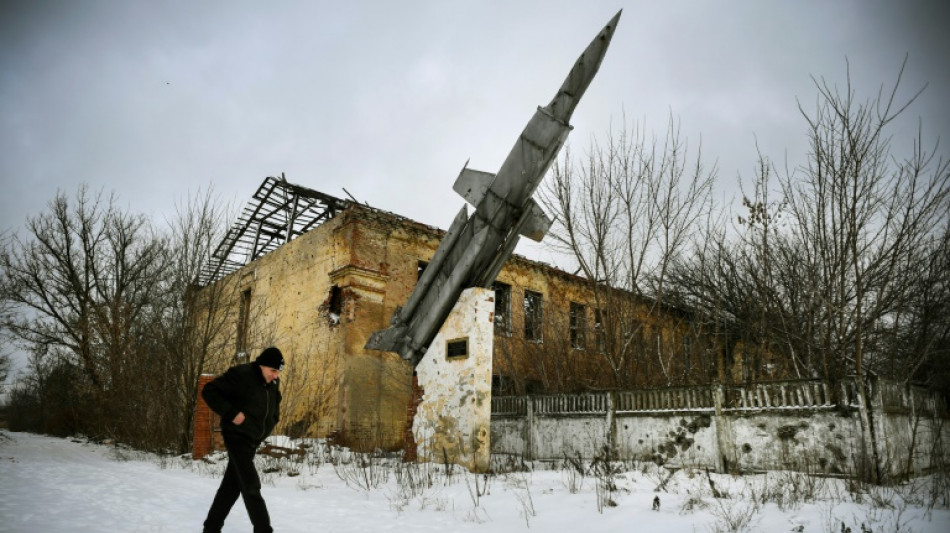
Ravaged by war, separatist east Ukraine fears new conflict / Photo: ©

 UK agrees support for Saudi in struggle with Houthis: reports
 EU foreign policy chief calls for continued sanctions on Russia

 Flights scrapped, evacuations urged as Typhoon Dujuan wallops Japan
 Fonseca to take break from tennis
 A Cuban zoo, and its animals, in epic battle for survival

 Infantino proposes consulting federations to reform FIFA
 El Nino weather pattern enters record territory: scientist
 OpenAI calls for US to lead global effort on AI standards
 South African ostriches plucked alive for luxury fashion: report
 US networks halt Trump coverage in revolt over White House ban
 Paramount settles with US states to clear Warner Bros. mega-merger
 Climate crisis a job for world leaders, not just activists: UK FM
 US networks halt Trump coverage over White House ban
 French singer accuses Miley Cyrus of plagiarism
 EU fines Google 403 mn euros for location data breach
 'Best is yet to come,' says De la Fuente after Spain extension

 Why diesel prices are rising more than crude oil

 COP31 host says AI's climate footprint to be a summit priority

 Renewables hit record in 2025, but world must move faster: report
 US media outlets to sue Trump administration after White House ban
 Global stocks rally on lower oil prices, US-China hopes

 EU proposes energy rating for data centres
 Schoolgirl Yu scorches to second gold as doping case rocks Games

 Putin's party secures record score in Russia election

 Haupt Koleksiyonu: Paranın Biz İnsanlar Hakkında Anlattıkları

Tears stream down Antonina Zaytseva's face as she considers the possibility of her separatist region of Ukraine again being engulfed by war.
"How can we kill each other?" asks the 72-year-old retiree who lives in Donetsk, one of two pro-Moscow separatist regions at the heart of a long conflict between Russia and Ukraine.
"We are afraid that the fighting will start up again. This is just a lull," says Zaytseva, her thick glasses fogging up in the winter air.
Eastern Ukraine has been dogged by fighting since 2014, when Moscow seized control of the Crimean peninsula and Russian-backed separatists launched insurgencies in regions around the eastern cities of Donetsk and Lugansk.
More than 13,000 people have died in the conflict, most at the peak of the fighting in 2014-15.
With tens of thousands of Russian troops now massed on Ukraine's borders, Kyiv and its Western allies are accusing Moscow of preparing a possible invasion of its neighbour.
Recent days have seen a flurry of diplomatic activity, with US Secretary of State Antony Blinken set for fresh talks with Russian counterpart Sergei Lavrov in Geneva on Friday.
But fears remain of a new war in Eastern Europe. Donetsk, where AFP journalists were able to travel this week, shows the scars -- physical and emotional -- that kind of conflict can leave behind.
In Zaytseva's neighbourhood on the outskirts of Donetsk, many houses have been turned into ruins, gutted by gunfire and riddled with shrapnel.
The front line between Ukrainian and separatist forces, where sporadic fighting and shelling continue, is less than two kilometres away.
- 'How can you forgive?' -
Locals hear the sound of artillery and machinegun fire nearly every day, usually at dawn or at dusk -- what some residents have dubbed "wake-up calls" and others "fireworks".
Many have left the area but Zaytseva says she will not abandon her home.
Like many others here, she wants the territory to become part of Russia and accuses Ukrainian forces of killing civilians in indiscriminate bombings.
"How can you forgive that?" she says, recalling a friend who died during clashes, her arm and leg ripped away by shelling.
At the peak of the fighting, Zaytseva would hide in a cellar as Chechen and Russian volunteers backing separatists took up positions outside.
"It was hell," she says. "How could they have started this?"
Near a small local market, a monument stands in memory of civilians who died in the fighting. Snow-covered teddy bears lie next to children's names.
Gas and electricity were restored to the neighbourhood in 2017 and the Red Cross has been helping people rebuild their homes and distributing food.
Many residents now also receive regular pensions from separatist authorities, who receive significant financial aid from Moscow.
"Thank god, Russia pays us our pensions," says Alexandra Lozovskaya, a 69-year-old whose husband was killed in 2015 when he went out to buy bread.
Sergei, who would not give his last name, says life has improved and accuses Ukrainian authorities of "theft and corruption".
"At the end of the day, we will unite with Russia, we have to go home," says the 47-year-old.
- 'Nobody wants us' -
Over the past few years, Moscow has distributed hundreds of thousands of Russian passports to people living in the two regions.
Residents of separatist-controlled areas can still receive Ukrainian pensions, but to collect them they need to cross into government-held territory, an ordeal for many retirees.
Pandemic-related restrictions have made travel even more complicated, and going to Russia can be difficult too.
"This is like an island," says 49-year-old Elena, whose son lives on the Ukrainian-controlled side.
"Nobody wants us in Russia or Ukraine. It's a dead end."
Refusing to give her last name for fear of reprisals, she wonders if local authorities are diverting the financial assistance that Moscow is supposed to be providing to help the local population.
"Where did the Russian humanitarian aid go? That's a good question," she says.
L.Janezki--BTB