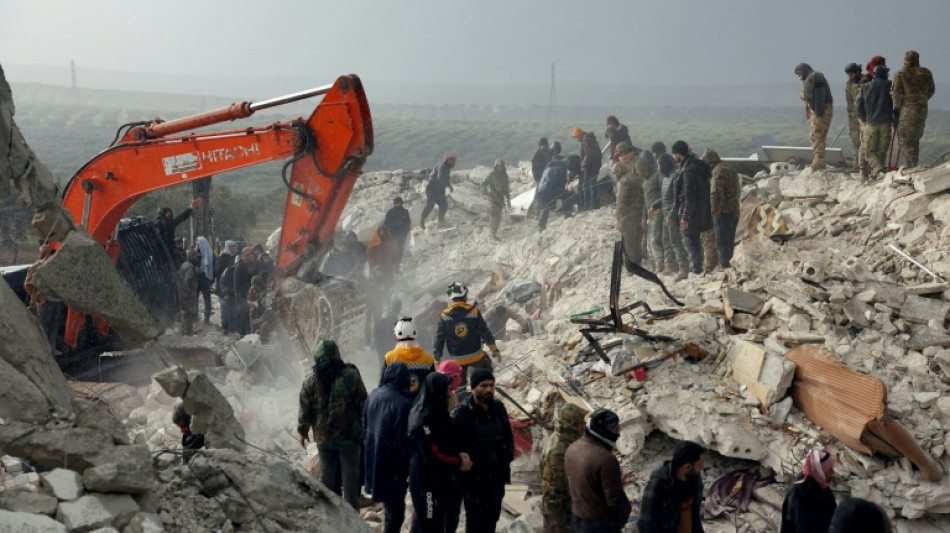
Syria quake relief a headache for Western nations and aid groups / Photo: © AFP

 Oil extends gains, stocks mostly down as Trump issues fresh Iran warning

 ThinkMarkets Expands Weekend Trading Offering, Launches Weekend League Competition

 Tibet activists accuse China of downplaying floods
 Afghanistan war victims left 'without justice', UN says

 Iran president offers US olive branch before Putin meeting

 China-Nepal flood toll tops 1,000 as tunnel rescue offers last hope
 Japan to relax overtime regulation under workaholic PM
 Thwarted Niger mutiny exposes junta's Russia dependence
 Illegal mining ravages S.Africa's economic hub

 Nepal's wall of missing offers last hope after Himalayan flood

 US to press G20 on light-touch AI regulation

 2 die in Grand Canyon flash flood, only 1 person unaccounted for

 US Army Secretary Driscoll submits resignation: White House
 Oil extends gains, stocks drop as Trump issues fresh Iran warning

 Tsitsipas says Kyrgios's positive cocaine test 'kind of expected'

 In Japan's mountains, a different way to manage bears

 Middle East war a boon for UAE defence giant with global ambitions
 Former gang member found guilty of murdering Tupac Shakur

 Top-seeded Zverev opens US Open campaign
 US regulator, 22 states accuse Amazon of 'manipulating' ad auctions: lawsuit

 TRON Founder Justin Sun Shares Outlook on Bitcoin, Stablecoins and Global Finance at Bitcoin Asia 2026

 Tributes to 'eternal' Messi on Argentina retirement

 Arteta hails Arsenal's 'finishers' after Saka kills off Villa

 Yamal, Raphinha bag braces as Barcelona rout Rayo

 Alcaraz makes winning return at US Open, Sabalenka safely through
An earthquake that has killed more than 5,000 people in Turkey and its southern neighbour Syria is proving a diplomatic headache for those seeking to channel aid to Syrians.
Still gripped by more than a decade of civil war, Syria is divided into areas controlled by the government under President Bashar al-Assad, for years a pariah for the West; rebel-held regions dominated by jihadists or pro-Turkish factions; and a swathe of land held by semi-autonomous Kurdish authorities.
France and Germany are among world powers that have rushed to pledge help after the massive 7.8-magnitude quake on early Monday.
While access to Turkey is not an issue, aid groups and Western nations are grappling with the complicated logistics of sending emergency assistance to Syria, especially the rebel areas outside government control.
"Syria is still a grey zone from a legal and diplomatic standpoint," said Marc Schakal, in charge of Syria operations for the French charity Doctors Without Borders (MSF).
Around half of the Syrians affected by the earthquake live in areas controlled by the Damascus regime, which is under Western sanctions.
The other half live in the Idlib region, the country's last major bastion of opposition, and adjacent parts of Aleppo province held by Turkey-backed rebels on the Turkish border.
Both areas are home to some four million people, many dependant on humanitarian handouts after being displaced by the conflict.
Raphael Pitti, a doctor with the French non-governmental organisation Mehad, said aid for Idlib was now more crucial than ever as "the situation of the population was already dramatic" before the quake.
- Aid through Damascus? -
International assistance trickles into the Idlib region through a single Turkey-Syria border crossing called Bab al-Hawa, operated under a special UN authorisation that expires in July.
UN aid previously arrived through four such frontier posts earlier in the conflict, but Russia -- a major ally of the Damascus regime -- has managed to limit them to one.
Aid via Bab al-Hawa already supplies the Idlib region with 80 percent of its needs, from nappies and blankets to chickpeas, and aid groups now fear that it could fast become congested with extra shipments after the earthquake.
But Syria's envoy to the United Nations, Bassam Sabbagh, on Monday appeared to rule out reopening any other border crossings into rebel-held areas, insisting that all aid should instead transit "from inside Syria".
"If anyone would like to help Syria, they can coordinate with the government," he said.
Pitti, of the French charity, said he highly doubted that any aid passing through Damascus would make it to rebel-held territory -- "just like it's been the case for the past ten years", he said.
- France 'embarrassed' -
Berlin and Paris do not seem enthralled by the option either.
Germany would for the moment use its "usual channels" of non-governmental organisations to reach those affected by the earthquake, a German governmental source said. Such aid has previously passed through Turkey.
Foreign Minister Annalena Baerbock on Tuesday urged Moscow to facilitate the opening of other border crossings into northwest Syria.
"All international actors, including Russia, should use their influence on the Syrian regime to ensure humanitarian aid for victims arrives," she said.
Emmanuel Dupuy, head of the Paris-based Institute for European Perspective and Security, said France would likely be too "embarrassed" to be seen coordinating aid deliveries with a country whose government it does not recognise as legitimate.
Western nations withdrew their diplomats from Damascus and imposed sanctions on Assad's regime after he launched a brutal crackdown on anti-government protests in 2011, and the Arab League also suspended the country's membership.
But the United Arab Emirates has in recent years sought to ease the isolation of the Syrian regime, reopening its Damascus embassy in 2018 and welcoming Assad to Abu Dhabi last year.
The UAE on Monday pledged assistance worth around $13.6 million to Syria, aid which is likely to reach the country immediately.
Dupuy said the aid signalled "a sort of normalisation at the Arab League level".
"What was a foregone conclusion -- Syria returning to the fold of the Arab League after its suspension in 2011 -- seems now to have become reality through humanitarian aid," he said.
burs-dt/ah/sjw/js
N.Fournier--BTB