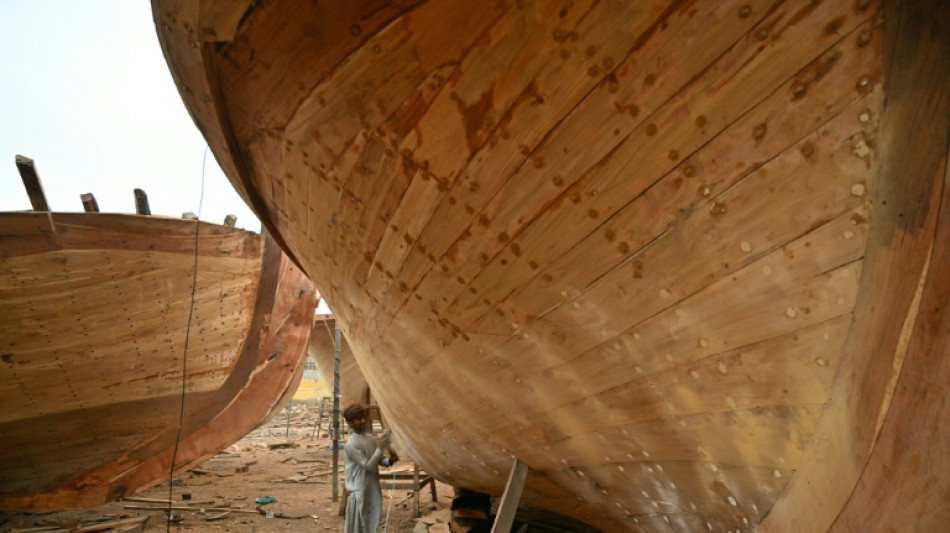
Boat builders keep Pakistan's fishing heritage afloat / Photo: © AFP

 Far-Right Extremists Claim Opportunity to Seize Control of GOP After Midterms

 New Campaign Highlights Knowledge Gaps on Carbon Monoxide Safety Among Americans

 JR East Launches 'teppay' to Integrate Suica Balance with Mobile Payments

 Phil Spencer on Housing Market Fairness: How Buyers and Sellers Navigate Falling Prices

 Beirut Cinema Festival Draws Thousands Despite War Fatigue

 AMD Forecasts First-Ever Revenue Lead Over Intel on AI Chip Surge

 GoodData.AI Launches the Agentic Serving Plane, a New Category of Enterprise Data Infrastructure for AI Agents

 Abu Dhabi Demand Response Project Achieves 401 MW Peak Reduction in 2025

 Panthers expected to begin 2027 NRL season away from new stadium
The rhythmic hammering of nails and the whine of saws echo around a coastal Karachi neighbourhood, where small figures of men work atop massive wooden fishing hulls that loom beneath a pale summer sky.
Ibrahim Hyderi, a maritime town on the outskirts of the port city believed to date back centuries, is renowned for the construction of traditional fishing boats.
"This is the area that gave birth to Karachi, and that provided Karachi with its fishing sector," said Mehran Ali Shah of the Pakistan Fisherfolk Forum, which advocates for the local community.
Despite the rise of industrial shipbuilding, such practices -- where handcrafted vessels are assembled timber by timber -- have stood their ground.
Boat-builder Muhammad Asif, 22, learnt the craft from his father as a teenager, and is now proud that he can work on his own.
"I was drawn to this work, so I work at it with great dedication," Asif tells AFP as sawdust coats his face and sun-bleached hair.
"It has always been my passion, that is why I chose this line of work."
Asif, like other workers, starts at 7:00 am every day and heads home for dinner around 7:00 pm, only putting down his tools during a two-hour lunch break.
He earns up to 2,500 Pakistani rupees ($9) a day, working six days a week.
The workers brave the elements all year round, including the sweltering heat and humidity of summers and the soaking rains of the monsoon seasons.
The process begins with a fisherman selecting a boat design. A master craftsman drafts a template and the workers take it from there, drawing on their years of experience to painstakingly build the vessel.
The carpenters choose from different types of timber, such as local eucalyptus wood, or African teak for resilience against seawater.
The heavy blocks of wood are carefully cut using well-worn vertical and other saws, following hand-drawn pencil markings.
The boats are then assembled from the ground up, block by block and nail by nail, with the workers clambering up on rickety ladders as the hulls rise higher.
The time-consuming process means even a small boat measuring just several metres long could take up to three months to construct and cost one million Pakistani rupees ($3,600), Asif says.
Across the yard, the completed boats are given splashes of colour by painter Muhammad Ismail.
The weather-beaten 38-year-old, his hands and nails tinged with blue, is painting petals on the hull of a vessel -- one of many he has worked on over a decade.
"Most of our fishermen prefer floral designs rather than fish," he tells AFP, adding that he experiences "great satisfaction" when an owner appreciates his artwork.
"Some people ask me to create a design according to my own ideas, while others tell me exactly what they want."
At a nearby harbour, fisherman Qadir Bux sits in a small boat owned by his family for at least two decades as he mends fishing nets. The fisherman hopes to give the wooden vessel a facelift soon.
"It's like looking after something very precious, or even like caring for our own child," he says.
A.Gasser--BTB
