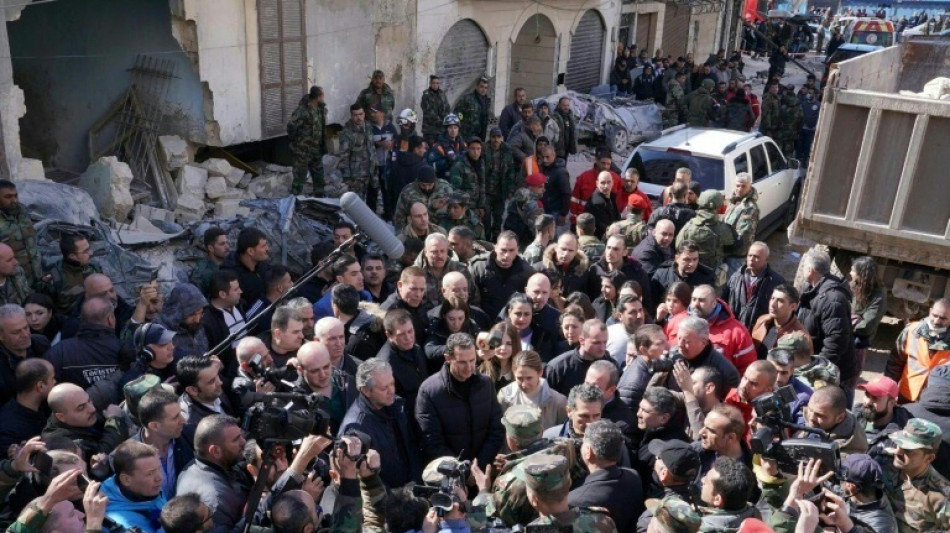
Syria's Assad may consider more border crossings for quake aid: WHO / Photo: © SANA/AFP

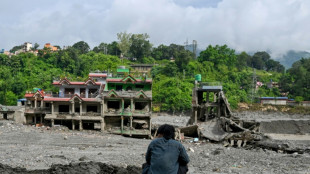
 Nepali families hold symbolic funerals for missing after floods
 Newcastle sign Lille forward Fernandez-Pardo

 Even at Elysee, phones are handed in, Macron tells French pupils
 Chelsea agree to sign Atalanta's Ahanor, with Palace loan for this season

 Chelsea sign Atalanta's Ahanor and loan him to Palace

 UK chalks up hottest summer on record for second year running

 China's Xi visits Egypt as US sanctions threat looms over Iran links

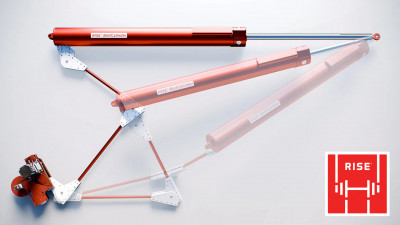 RISE Robotics Awarded $100,000 MassVentures Grant to Accelerate Commercialization of Beltdraulic Technology

 Global bond sell-off deepens on inflation concerns

 Germany's far-right AfD promises 'boom' but economists fear worst

 Former England captain Stokes signs for Adelaide Strikers

 Pakistan selector and ex-captain Misbah resigns after coach sacked

 Shein flattens on Hong Kong debut facing global headwinds

 Eurozone inflation hits three-year high at 3.3% in August
 Man City chase Fernandez, Arsenal eye Alvarez on deadline day
 El Nino hammering Peru anchovy fishing: industry officials

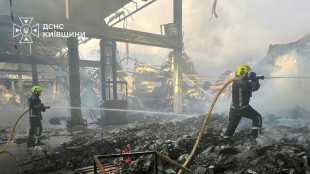
 Mass Russian barrage kills 12 in Kyiv

 PineX Capital Launches MetaTrader 5 as Prop Firm Expands Trading Platform Offering
 Women survivors face sanitation woes in Nepal relief camp
 Oil extends gains, stocks mixed as Trump issues fresh Iran warning
 Thai resort readies for US carrier's 5,000 sailors
 AI startup Manus says resumes independent operations
 'Massive' Russian missile, drone attack on Kyiv kills 8
 Defence tech hub Munich booms as Europe rearms
 Nigeria rethinks criminalisation of suicide
The WHO chief said Sunday that Syria's President Bashar al-Assad had voiced openness to more border crossings for aid to be brought to quake victims in the country's rebel-held northwest.
World Health Organization chief Tedros Adhanom Ghebreyesus met with the Syrian president in Damascus on Sunday afternoon to discuss the response to the devastating earthquake which has killed more than 33,000 people across Syria and Turkey.
Concerns have been running particularly high for how aid might reach all those in need in Syria, which has been devastated by more than a decade of civil war.
"The compounding crises of conflict, Covid, cholera, economic decline and now the earthquake have taken an unbearable toll," Tedros said after visiting Aleppo and witnessing the devastation first hand.
He said he was "waiting to move across lines to the northwest, where we've been told the impact is even worse".
The situation is particularly dire in the rebel-held area in the northwest, which cannot receive aid convoys from government-held parts of the country without Damascus's authorisation.
The single border crossing open to shuttle aid from Turkey also saw its operations disrupted by the quake.
Some pre-positioned aid has been delivered, and convoys began rolling through the border crossing again on Thursday, but there have been mounting calls to open more crossings to speed up the aid delivery.
"This afternoon I met with His Excellency President Assad, who indicated he was open to considering additional cross-border access points for this emergency," Tedros told a virtual press conference from the Syrian capital.
- 'Massive access' needed -
Humanitarian aid in rebel-held areas usually arrives through Turkey via a cross-border mechanism created in 2014 by a UN Security Council resolution.
But it has long been contested by Damascus and its ally Moscow, who see it as a violation of Syrian sovereignty.
Under pressure from Russia and China, the number of crossing points has been reduced over time from four to one.
Equally vital for Syria's quake-hit northwest is speeding up aid from within the country.
Tedros hailed the "recent blanket approval by the government of Syria for the UN for cross-line conveys" to bring aid into the rebel-held northwest.
But while Damascus had given the all-clear for cross-line aid convoys to go ahead from government-held areas, Tedros said the WHO was still waiting for the green light from the rebel-held areas before going in.
"We're on standby" he said.
Richard Brennan, WHO's director for the Eastern Mediterranean region, told reporters that there had been "no cross-line deliveries since the earthquake struck".
"We did have one scheduled in the next couple of days. We are still negotiating for that to go ahead."
Before the quake, the UN typically had permission to bring in one aid convoy per month, he said, adding that even before the disaster, they had been trying to increase that to three or four.
"Now of course there's a greater sense of urgency," he said, suggesting that far more convoys were needed.
"What we need is massive access," agreed WHO's emergencies chief Michael Ryan.
"We need cross-lines access, we need cross-border access, and that needs to increase."
C.Meier--BTB