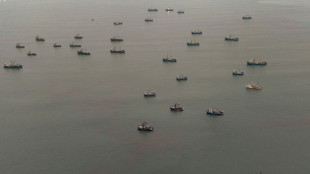
All hands on deck as UN meets to protect high seas / Photo: © AFP/File

 Germany blames Russia for airport drone incident, hits back with sanctions

 Iran president urges return to truce, hails Russian support

 Aster and World Liberty Financial Launch USD1 RWA Boost: Phase 1, Offering 125M $WLFI + 6.25M USD1 in Rewards

 Tronchon sprints to Vuelta stage 10 win, Mas keeps red jersey

 Germany defender Rudiger announces international retirement

 Musk defends AI data centers, slams EU rules at G20
 Activists blame Kenya for Ugandan opposition figure's plight
 Iran president offers US olive branch, hails Russian support

 TrustFinance Community Choice Awards 2026 Opens Global Voting

 Nepal disaster a climate 'warning signal': foreign minister

 France winger Diaby returns to Leverkusen until 2031

 Barcelona confirm Jesus arrival from Arsenal
 EU official says it's not time to 'normalize' Russia at G20 finance talks

 RedHill Announces Transformational Acquisition of Commercialization Rights to Ferring’s Rebyota® and Clenpiq®
 TrendEadvisor Launches Global Multi-Asset Platform Combining Online Investing with Social Trading
 India's top court drops criminal cases against protesters
 Philippine couple married in hip-deep floodwaters

 Villa sign Senegal winger Mbaye from PSG
 Former Peru minister last-minute contender for UN labour agency helm

 Messi legacy will 'live forever', says Beckham
 'Literally tasting the smoke': Malaysians suffer as haze worsens

 Kyiv's defences, 'hybrid' threat from Moscow headline EU talks
 Oil extends gains, stocks mostly down as Trump issues fresh Iran warning

 ThinkMarkets Expands Weekend Trading Offering, Launches Weekend League Competition

 Tibet activists accuse China of downplaying floods

UN member states are meeting in New York from Monday with the aim of launching a long-berthed high-seas treaty, a crucial step toward the goal of protecting 30 percent of the planet by 2030.
After more than 15 years of informal and formal talks, the meeting is the third time in less than a year that negotiators are gathering for what is due to be the last round.
Another two weeks of negotiations ended with no agreement in August last year, but advocates and officials have expressed cautious optimism ahead of the coming session.
"There are a lot of negotiations and discussions happening between delegations trying to find middle ground on some of the key sticky issues... at a level that we haven't seen before," Liz Karan, of the Pew Charitable Trusts non-profit, told AFP.
"That gives me a lot of hope that the delegations are taking this upcoming meeting to be the final final."
This hope was bolstered in January when the United States joined the EU-led High Ambition Coalition on Biodiversity Beyond National Jurisdiction in pushing for quick and robust finalized treaty.
The 51 countries in the coalition share "the goal of urgently protecting the world's oceans," said EU Commissioner for Environment Virginijus Sinkevicius, underscoring the new round of talks were "crucial."
The ocean's high seas start where nations' Exclusive Economic Zones (EEZ) end, at a maximum of 200 nautical miles (370 kilometers) from coastline, and are not under the jurisdiction of any country.
Even though these waters make up more than 60 percent of the oceans and nearly half the planet, they have long been ignored in favor of coastal areas and certain species.
But, said Nathalie Rey, the campaign lead for the High Seas Alliance non-profit, there is "just one ocean and a healthy ocean means a healthy planet."
Ocean ecosystems, threatened by pollution and overfishing, produce half the planet's oxygen and limit global warming by absorbing a large part of the CO2 emitted by human activities.
"You can't ensure a healthy ocean if you ignore two thirds of the ocean which make up the high seas," Rey said, underscoring that it would be "an absolute disaster if we ended up with nothing" from the treaty talks.
The future treaty "will be a key milestone in ensuring we achieve this 30x30 target," she added, referencing a historic agreement in December in which every nation committed to protecting 30 percent of all the planet's land and ocean by 2030.
- A deal at all costs? -
The 30x30 goal would be almost impossible without including the high seas, of which only around one percent is protected today.
One of the pillars of the future treaty on the "conservation and sustainable use of marine biodiversity in areas beyond national jurisdiction" is to allow the creation of marine protected areas in international waters.
This principle is included in the negotiating mandate voted by the UN General Assembly in 2017, but delegations are still divided on the process of creating the sanctuaries, as well as on the terms of obligations to assess the environmental impact of potential activities on the high seas.
Another contentious issue is the sharing of possible profits from use of genetic resources found in international waters, where the pharmaceutical, chemical and cosmetic industries hope to discover bankable resources.
Without the ability to carry out costly research, developing countries fear they will miss out on potential benefits of high seas resources.
At the August session, observers accused rich countries, including the EU, of resisting to offer compromises down to the wire.
With the complex and wide-ranging treaty, which will also have to contend with other organizations that have strangleholds on parts of the ocean, such as fishing and seabed mining, the devil is in the details, ocean advocates worry.
"It would be better to take more time and ensure a strong agreement with political momentum, rather than hurriedly adopt a subpar agreement," said Glen Wright, senior researcher at the Institute for Sustainable Development and International Relations.
Even if, he added, another delay "would be a huge disappointment."
R.Adler--BTB