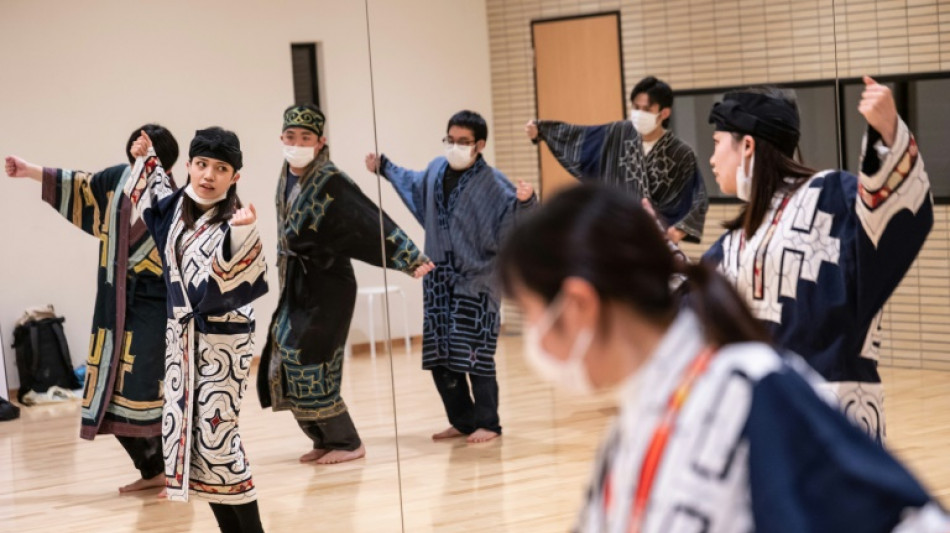
Tackling taboos: Japanese university club teaches Ainu traditions / Photo: © AFP

 Germany blames Russia for airport drone incident, hits back with sanctions

 Iran president urges return to truce, hails Russian support

 Aster and World Liberty Financial Launch USD1 RWA Boost: Phase 1, Offering 125M $WLFI + 6.25M USD1 in Rewards

 Tronchon sprints to Vuelta stage 10 win, Mas keeps red jersey

 Germany defender Rudiger announces international retirement

 Musk defends AI data centers, slams EU rules at G20

 Activists blame Kenya for Ugandan opposition figure's plight

 Iran president offers US olive branch, hails Russian support

 TrustFinance Community Choice Awards 2026 Opens Global Voting

 Nepal disaster a climate 'warning signal': foreign minister

 France winger Diaby returns to Leverkusen until 2031

 Barcelona confirm Jesus arrival from Arsenal

 EU official says it's not time to 'normalize' Russia at G20 finance talks

 RedHill Announces Transformational Acquisition of Commercialization Rights to Ferring’s Rebyota® and Clenpiq®

 TrendEadvisor Launches Global Multi-Asset Platform Combining Online Investing with Social Trading

 India's top court drops criminal cases against protesters

 Philippine couple married in hip-deep floodwaters

 Villa sign Senegal winger Mbaye from PSG

 Former Peru minister last-minute contender for UN labour agency helm

 Messi legacy will 'live forever', says Beckham

 'Literally tasting the smoke': Malaysians suffer as haze worsens

 Kyiv's defences, 'hybrid' threat from Moscow headline EU talks

 Oil extends gains, stocks mostly down as Trump issues fresh Iran warning

 ThinkMarkets Expands Weekend Trading Offering, Launches Weekend League Competition

 Tibet activists accuse China of downplaying floods
When Yuko Honda, a professor at Japan's Sapporo University, tried to start a scholarship for Ainu Indigenous students and a club to celebrate their culture, she ran into fierce resistance.
"We faced a terrible backlash," Honda, a professor of cultural studies at the university in the northern Hokkaido region, told AFP.
"The issue of the Ainu was seen as a taboo, something that should not be touched."
That was in 2009, just a year after Japan's parliament finally passed a resolution to recognise the Ainu as an Indigenous people, following decades of pressure.
Nearly 15 years later, the Urespa scholarship is going strong and the club has several dozen members each year, a mixture of Ainu and ethnic Japanese.
The students learn the Ainu language, dance and crafts, as well as about traditional food and hunting culture.
It's an example of changing attitudes towards the minority, whose land was annexed by imperial Japan in 1869 and named Hokkaido, laying the groundwork for an assimilation process that disrupted centuries of tradition.
Honda is ethnically Japanese but has lived in the Ainu community of Nibutani near Sapporo, where she was a teacher.
When she started the scholarship and club at Sapporo, only an estimated 20 percent of people with Ainu heritage received a university education, and Honda hoped recipients would learn about and teach their traditions through the new group.
"In this club, we are literally growing together," said Mizuki Orita, 20, an Ainu student majoring in history and cultural studies.
Orita grew up singing traditional Ainu songs with her siblings, but her mother and grandmother were discriminated against due to their heritage. She had similar experiences.
"I was told I stunk because I was Ainu."
- 'I want to stir things up' -
Manao Kanazawa, who is ethnically Japanese, joined the club because she was curious about traditional Ainu hunting methods.
But, as the student from central Shizuoka prefecture learned how the Ainu were treated by Japan, she wondered if it was appropriate for her to be there.
An Ainu friend reassured her it was alright, "because I'm interested in the Ainu and came to learn", the 23-year-old history and culture student said.
When Hokkaido was annexed, Ainu were forced to speak Japanese and abandon traditions, including facial tattoos for women.
Such stigma was attached to their heritage that it remains hard to know how many Ainu there are in Japan, as many prefer to conceal Indigenous origins. The last survey in Hokkaido, in 2017, put the figure at 13,000.
In 2019, Japan passed legislation financing efforts to protect Ainu culture, and the following year, the massive Upopoy National Ainu Museum and Park in Shiraoi, Hokkaido opened as a "symbolic space for ethnic harmony".
Still, critics say the efforts are too little, too late.
Japan provides "subsidies to certain Ainu groups so people can study the culture, but doesn't necessarily help individuals through affirmative action," historical sociologist Eiji Oguma told AFP.
What support is provided can be controversial, with some arguing the Urespa scholarship discriminates against ethnic Japanese.
"But the Ainu people's traditions were severed by forced assimilation," said Honda.
"The world for them would have been different... if their traditions had not been severed, and Ainu youth need help reconstructing what they might have had."
To qualify for the Urespa scholarship, students must declare their Ainu heritage, which some fear doing, said Honda.
She believes the club has helped, and says Ainu students are "less scared now" to discuss their heritage, especially after holding exchanges with Indigenous counterparts in Canada and New Zealand.
Orita said she still sometimes faces mockery when introducing herself as Ainu, but now she considers it "a chance for me to talk about the Ainu".
"I want the Ainu to lead the Indigenous movement in Japan," she said.
"I want to stir things up and make waves."
S.Keller--BTB