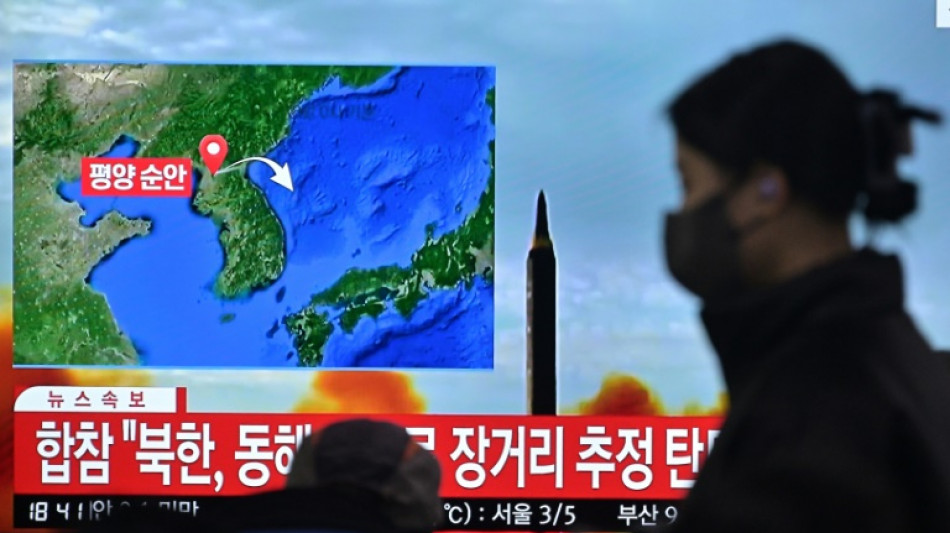
North Korea fires ICBM missile that lands in Japan's EEZ / Photo: © AFP

 Back-to-school in Cuba a grim day with shortages of everything

 Canadian minister says Russia's G20 presence sparked 'discomfort'

 IMF reaches agreement with Senegal on new $2.2 bn loan programme

 Germany blames Russia for airport drone incident, hits back with sanctions

 Iran president urges return to truce, hails Russian support

 Aster and World Liberty Financial Launch USD1 RWA Boost: Phase 1, Offering 125M $WLFI + 6.25M USD1 in Rewards

 Tronchon sprints to Vuelta stage 10 win, Mas keeps red jersey

 Germany defender Rudiger announces international retirement
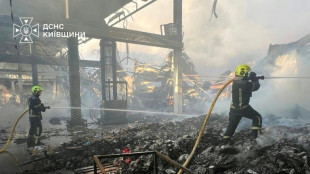
 Musk defends AI data centers, slams EU rules at G20
 Activists blame Kenya for Ugandan opposition figure's plight

 Iran president offers US olive branch, hails Russian support

 TrustFinance Community Choice Awards 2026 Opens Global Voting

 Nepal disaster a climate 'warning signal': foreign minister

 France winger Diaby returns to Leverkusen until 2031

 Barcelona confirm Jesus arrival from Arsenal

 EU official says it's not time to 'normalize' Russia at G20 finance talks

 RedHill Announces Transformational Acquisition of Commercialization Rights to Ferring’s Rebyota® and Clenpiq®
 TrendEadvisor Launches Global Multi-Asset Platform Combining Online Investing with Social Trading

 India's top court drops criminal cases against protesters

 Philippine couple married in hip-deep floodwaters

 Villa sign Senegal winger Mbaye from PSG

 Former Peru minister last-minute contender for UN labour agency helm

 Messi legacy will 'live forever', says Beckham

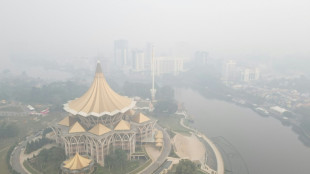 'Literally tasting the smoke': Malaysians suffer as haze worsens

 Kyiv's defences, 'hybrid' threat from Moscow headline EU talks
North Korea fired an intercontinental ballistic missile Saturday which landed in Japan's exclusive economic zone, Seoul and Tokyo said, after Pyongyang warned of a strong response to upcoming US-South Korean military drills.
The launch, Pyongyang's first in seven weeks, comes days before Seoul and Washington are due to start joint tabletop exercises aimed at improving their response in the event of a North Korean nuclear attack.
Japan said North Korea "fired one ICBM-class ballistic missile" which flew for some 66 minutes before landing in the country's exclusive economic zone, chief government spokesman Hirokazu Matsuno told reporters.
Tokyo's defence minister Yasukazu Hamada said the missile could have had the capacity to fly 14,000 km (8,700 miles) -- which would mean it was capable of hitting anywhere on the mainland United States.
Seoul's military told AFP it had detected the launch of an ICBM, which was fired on a lofted trajectory -- up instead of out, typically done to avoid overflying neighbouring countries -- and flew some 900 kilometres (560 miles).
"Detailed specifications are being closely analysed by South Korea-US intelligence authorities," it added in a statement.
The South's presidential office said it held a National Security Council meeting to discuss the launch, and that its participants decided to "take stern measures against any attempts to threaten our people".
The estimated flight time of just over an hour is similar to that of the Hwasong-17 intercontinental ballistic missile Pyongyang tested last November, Seoul-based specialist site NK News reported.
The United States said on Saturday that it "strongly condemns" the launch and it would "take all necessary measures" to protect itself and its allies South Korea and Japan.
"This launch needlessly raises tensions and risks destabilizing the security situation in the region," White House National Security Council spokesperson Adrienne Watson said in a statement.
The launch was "another step in the efforts of North Korea to perfect its long-range strike capabilities," Chun In-bum, a retired South Korean army general, told AFP.
"The message of North Korea is clear: we are steadily progressing with the aim to perfect long-range nuclear weapons."
- 'Tit-for-tat' -
Military tensions have risen on the Korean peninsula after a year in which North Korea declared itself an "irreversible" nuclear state and carried out sanctions-busting weapons tests nearly every month.
In response, Seoul has ramped up joint military drills and cooperation with key security ally Washington, in a bid to convince the increasingly nervous South Korean public of America's commitment to deter nuclear-armed Pyongyang.
North Korea on Friday threatened an "unprecedentedly" strong response to upcoming US-South Korea drills -- which it described as preparations for war.
An Chan-il, a defector-turned-researcher who runs the World Institute for North Korea Studies, said the latest launch indicated North Korean leader Kim Jong Un "has finally pulled out his sword."
"Kim Jong Un seems to want to confront the issue with a tit-for-tat approach," he said.
The launch "can be read as a threat that Kim Jong Un is capable of attacking the US mainland with strategic nuclear weapons, not just tactical nuclear weapons."
- Solid-fuel ICBM? -
South Korea's hawkish President Yoon Suk Yeol, who took office in May 2022, has vowed to get tough on North Korea.
Earlier this week, South Korea called Pyongyang its "enemy" in a defence document -- the first time in six years it has used the term, signalling a further hardening of Seoul's position.
North Korea has also ramped up its testing, including firing a ballistic missile last year that landed near South Korea's territorial waters for the first time since the end of the Korean War in 1953.
Pyongyang has repeatedly said it is not interested in further talks, and Kim recently called for an "exponential" increase in his country's nuclear arsenal.
At a military parade in Pyongyang last week, North Korea showed off a record number of what it said were nuclear and intercontinental ballistic missiles, including what analysts said was possibly a new solid-fuelled ICBM.
Joseph Dempsey from the International Institute for Strategic Studies told AFP Saturday's test could have been a second successful test of a Hwasong-17 or even "the as yet unseen solid-fuel ICBM in development".
North Korea has long sought to develop a solid-fuel ICBM because such missiles are easier to store and transport, as well as being more stable and quicker to prepare for launch -- and thus harder for the United States to detect and destroy preemptively.
"North Korean missile firings are often tests of technologies under development, and it will be notable if Pyongyang claims progress with a long-range solid-fuel missile," said Leif-Eric Easley, a professor at Ewha University in Seoul.
T.Bondarenko--BTB