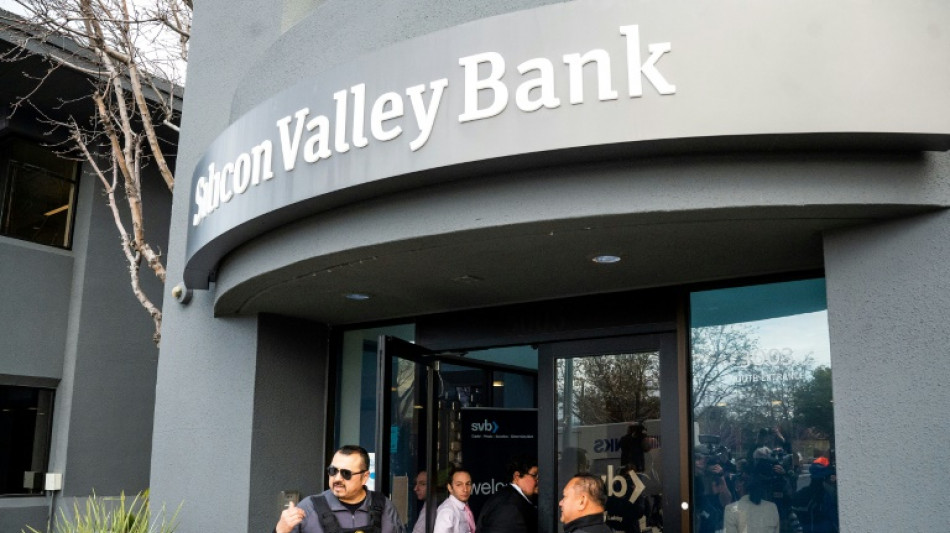
SVB's demise: Why didn't US bank regulators see it coming? / Photo: © AFP

 Nvidia boss presses G20 ministers to build AI infrastructure
 Liminal Launches Liminal Prime for Institutional OTC and Stablecoin Liquidity

 10 missing as cargo ship sinks after collision off Istanbul

 30 years on, 'Tomb Raider' reboot sees Lara Croft through a 'modern lens'
 King Charles, Macron to view Bayeux Tapestry as French leader starts UK visit

 George Clooney says US run by 'least qualified people'

 China's Xi urges against Mideast interference in rare Egypt visit

 Venice to roll out red carpet for 'lucky' Clooney on opening night

 'Humiliated' Aubameyang quits Gabon national team

 France sees limited economic hit from drought, heatwaves

 Bus crash in Egypt's Sinai kills 22, including 10 Jordanians

 UN says world must navigate 'reality' of 1.5C overshoot

 Taliban govt defends ban on protest, citing Islamic law

 10 missing as Turkish cargo ship sinks after collision off Istanbul

 easyMarkets Expands Commodity Offering with 24/7 Gold, Silver and Oil Trading

 Australia defends Pacific climate meeting despite doubts on attendance
 Iran attacks US sites after American strikes, wedding deaths

 Stocks drop, yields at three-decade highs on Mideast flare-up

 EU summons Russian envoy, eyes sanctions after Germany drone 'attack'
 Stocks drop as yields and oil prices spike on Mideast flare-up
 Cricketers to get best rooms at Asian Games, says Japan chief

 Zverev out-lasts Sonego in wild five-setter to advance at US Open

 Amid war, Ukrainian soldiers celebrate love at ritual wedding
 Venice to roll out red carpet for Clooney on opening night
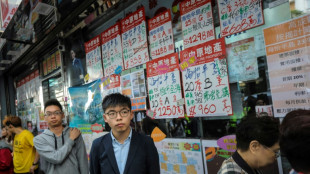 Hong Kong democracy activist Wong pleads guilty to foreign collusion: AFP

With hindsight, there were warning signs ahead of last week's spectacular collapse of Silicon Valley Bank, missed not only by investors, but by bank regulators.
Just why the oversight failed remained a hot question among banking experts Monday, with some focusing on the weakness of US rules.
The Federal Reserve announced Monday plans for a "thorough, transparent and swift" review of the supervision of SVB that will be publicly released on May 1, effectively acknowledging that it could have done better.
President Joe Biden promised a "full accounting of what happened," adding that he would ask regulators and banking regulators to tighten rules on the sector.
Banking experts have been among those alarmed at the rapid collapse of SVB, the country's 16th biggest bank by assets and how its demise became a harbinger of Sunday's failure of another lender, Signature Bank.
The failures have "exposed the inadequacy of regulatory reforms that have been made since the global financial crisis," said Arthur Wilmarth, a law professor at George Washington University.
A once-over of the bank would have pointed to clear potential red flags in SVB's disproportionate exposure to tech startups, a risky area that can be likened to commercial real estate or emerging markets -- areas that have plagued lenders in the past.
Wilmarth noted that SVB grew very fast between 2020 and 2022 and that its exposure to long-date fixed interest bonds made it especially vulnerable to the a shift in monetary policy by the Fed.
"That's almost a sure proof formula for failure. If the economy turns you begin to have trouble," Wilmarth said.
"None of those would have been a mystery to the regulators."
- No excuses -
Experts pointed as well to the eventual easing of US laws enacted soon after the 2008 crisis.
The original Dodd-Frank law of 2010 imposed higher capital, liquidity and other requirements on banks with at least $50 billion in assets.
In 2018, with support from former President Donald Trump, this requirement was raised to $250 billion, affecting fewer banks.
But that shift in law does not excuse regulators for these failures, according to Anna Gelpern, a law professor at Georgetown University.
"When regulatory requirement are relaxed either by the premise that those institutions don't pose a risk to the system because of their size or that they are easier to supervise, that puts much more pressure on old-fashioned supervision because you don't have the automatic alarm that goes off with the requirements," she said.
"If this was clearly unsafe and unsound behavior," the banks' official designation in the law "does not excuse a failure of supervision," she said.
Michael Ohlrogge, an associate professor of law at New York University, said regulators as a matter of course assign "very little to zero-risk weight" in terms of bank capital requirements for Treasury-linked securities because they are considered safe.
At the same time, regulators are also lenient with banks with regard to depositors with more than $250,000 -- the threshold for federally insured deposits -- believing the bank has a meaningful business relationship with such clients.
"That's probably going to warrant revisiting and thinking more seriously about the run risk of uninsured deposits," Ohlrogge said.
K.Thomson--BTB