'No need to worry': Odds drop newly-found asteroid will hit Earth / Photo: © AFP

 Nvidia boss presses G20 ministers to build AI infrastructure

 Liminal Launches Liminal Prime for Institutional OTC and Stablecoin Liquidity
 10 missing as cargo ship sinks after collision off Istanbul
 30 years on, 'Tomb Raider' reboot sees Lara Croft through a 'modern lens'

 King Charles, Macron to view Bayeux Tapestry as French leader starts UK visit

 George Clooney says US run by 'least qualified people'

 China's Xi urges against Mideast interference in rare Egypt visit

 Venice to roll out red carpet for 'lucky' Clooney on opening night

 'Humiliated' Aubameyang quits Gabon national team
 France sees limited economic hit from drought, heatwaves

 Bus crash in Egypt's Sinai kills 22, including 10 Jordanians
 UN says world must navigate 'reality' of 1.5C overshoot

 Taliban govt defends ban on protest, citing Islamic law

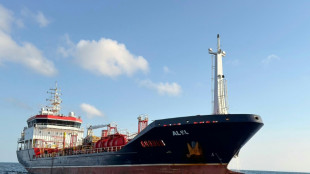 10 missing as Turkish cargo ship sinks after collision off Istanbul

 easyMarkets Expands Commodity Offering with 24/7 Gold, Silver and Oil Trading

 Australia defends Pacific climate meeting despite doubts on attendance

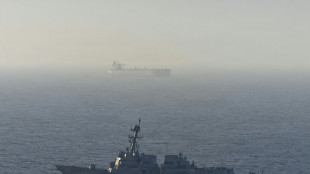 Iran attacks US sites after American strikes, wedding deaths

 Stocks drop, yields at three-decade highs on Mideast flare-up

 EU summons Russian envoy, eyes sanctions after Germany drone 'attack'

 Stocks drop as yields and oil prices spike on Mideast flare-up

 Cricketers to get best rooms at Asian Games, says Japan chief

 Zverev out-lasts Sonego in wild five-setter to advance at US Open

 Amid war, Ukrainian soldiers celebrate love at ritual wedding

 Venice to roll out red carpet for Clooney on opening night

 Hong Kong democracy activist Wong pleads guilty to foreign collusion: AFP

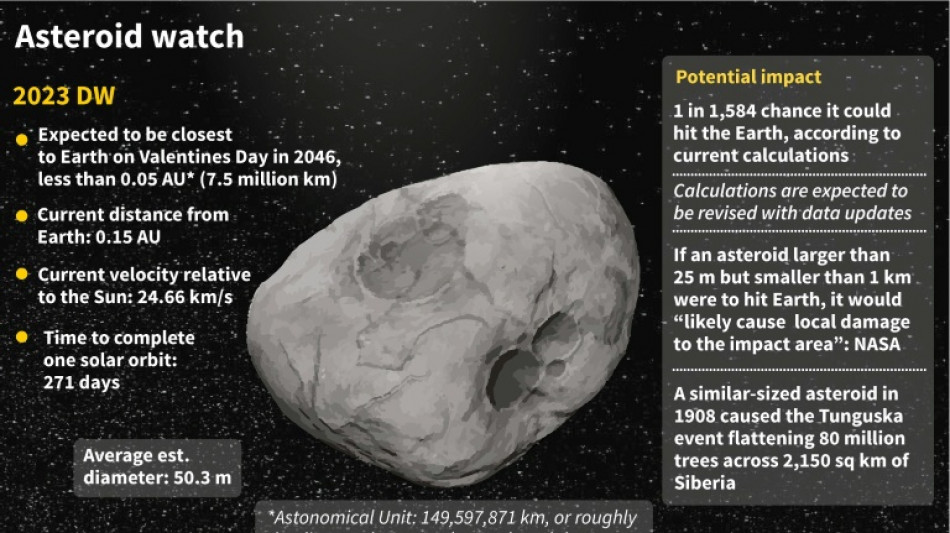
The chances have plummeted that a newly-discovered asteroid with the potential to wipe out a city will hit Earth on Valentine's Day 2046, the European Space Agency said on Tuesday.
The asteroid, which is named 2023 DW and is estimated to be around the size of a 50-metre Olympic swimming pool, was first spotted by a small Chilean observatory on February 26.
It swiftly shot to the top of NASA and ESA lists of asteroids that pose a danger to Earth, leading to a raft of alarming news headlines, some warning lovers to cancel their Valentine's plans on February 14, 2046.
Late last month the asteroid was given a one in 847 chance of hitting Earth -- but the odds rose to one in 432 on Sunday, according to the ESA's risk list. NASA has had similar but not identical estimations.
However Richard Moissl, the head of the ESA's planetary defence office, told AFP on Tuesday that overnight the probability fell to one in 1,584.
"It will go down now with every observation until it reaches zero in a couple of days at the latest," he said.
"No one needs to be worried about this guy."
NASA's planetary defence officer Lindley Johnson agreed, telling AFP that "at this point, no one should be concerned at all".
He said it was normal for the impact odds of newly discovered asteroids to briefly rise before rapidly falling.
This is because new observations shrink the "uncertainty region" where the asteroid will travel to on its closest point to Earth, he said.
While the Earth is still inside that uncertainty region, the odds temporarily increase -- until further observations exclude Earth and the probability drops down to zero, as is expected to happen with 2023 DW.
- What if it does hit Earth? -
But what would happen in the increasingly unlikely event that the asteroid does strike Earth?
Davide Farnocchia, a scientist at NASA's Center for Near-Earth Object Studies, said a good comparison was the Tunguska event, in which a similarly-sized asteroid is believed to have exploded in the atmosphere above a sparsely populated area in Siberia in 1908.
"The resulting explosion flattened trees over an area of about 2,000 square kilometres," Farnocchia said. London covers an area of around 1,600 square kilometres.
Moissl said that an asteroid the size of 2023 DW would create "regionalised destruction" and not have a major effect on the rest of the world.
The asteroid, which is orbiting the Sun, came around nine million kilometres from Earth during its most recent closest approach on February 18 -- a week before it was discovered.
If it was to strike Earth in 2046, it would be speeding along at around 15 kilometres (nine miles) a second, according to estimations.
There would be a roughly 70 percent chance it lands in the Pacific Ocean, but the potential strike zone would also include the United States, Australia or Southeast Asia, Moissl said.
- Deflection plan -
Even if the asteroid is heading our way, the experts emphasised that the world is no longer defenceless against such a threat.
Last year, NASA's DART spacecraft deliberately slammed into the pyramid-sized asteroid Dimorphos, significantly knocking it off course in the first such test of our planetary defences.
Farnocchia said the "DART mission gives us confidence that such a mission would be successful" against 2023 DW, if required.
With 23 years to prepare, there is "ample time" for such a mission to be planned, Moissl said.
The ESA's Hera mission, scheduled to launch next year to inspect the damage DART had on Dimorphos, could even be repurposed for reconnaissance if necessary, he added.
Such plans would not be considered until the probability of an impact passes one in 100, when it would get the attention of UN-endorsed bodies like the International Asteroid Warning Network and the Space Mission Planning Advisory Group (SMPAG), Moissl said.
The aim of SMPAG is to "have everyone on the same page and avoid what happened in the movie 'Don't Look Up'," in which "stupid stuff" happened because nations did not coordinate with each other, Moissl added.
However such defence mechanisms look unlikely to be required for 2023 DW.
"Everyone should relax, ignore the sensationalist headlines and stories, and watch how this situation plays out," NASA's Johnson said, adding that any threat was likely to "evaporate" soon.
"Nevertheless, the planetary defence community will keep looking up!"
D.Schneider--BTB