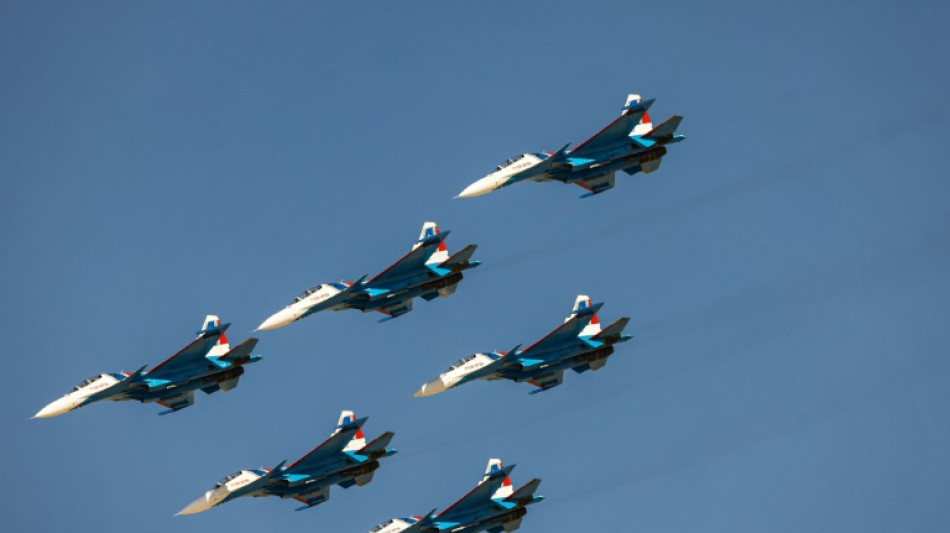
NATO, Russia in high risk aerial cat-and-mouse game / Photo: © AFP

 US judge rejects bid to break up Google's ad business
 Rupert Murdoch 'very happy' to be played by Guy Pearce in new film

 Wall Street stocks rise despite bond yields, oil rising
 Brennan claims third Vuelta victory in stage 11 sprint

 Nepal flood survivors cling to zipline to cross treacherous river

 US Treasury issues $1 coin with Trump's face on it

 Fernandez 'didn't hesitate' over record Man City move
 Dutch shift 86 tonnes of gold from US, Canada to UK

 Nepal floods should mobilise climate action: UN green fund chief

 Nvidia boss presses G20 ministers to build AI infrastructure

 Liminal Launches Liminal Prime for Institutional OTC and Stablecoin Liquidity

 10 missing as cargo ship sinks after collision off Istanbul
 30 years on, 'Tomb Raider' reboot sees Lara Croft through a 'modern lens'

 King Charles, Macron to view Bayeux Tapestry as French leader starts UK visit
 George Clooney says US run by 'least qualified people'

 China's Xi urges against Mideast interference in rare Egypt visit

 Venice to roll out red carpet for 'lucky' Clooney on opening night

 'Humiliated' Aubameyang quits Gabon national team
 France sees limited economic hit from drought, heatwaves

 Bus crash in Egypt's Sinai kills 22, including 10 Jordanians
 UN says world must navigate 'reality' of 1.5C overshoot

 Taliban govt defends ban on protest, citing Islamic law

 10 missing as Turkish cargo ship sinks after collision off Istanbul

 easyMarkets Expands Commodity Offering with 24/7 Gold, Silver and Oil Trading

 Australia defends Pacific climate meeting despite doubts on attendance

The loss of a US drone in the Black Sea after an alleged collision with a Russian war plane has exposed the high-risk cat-and-mouse game in European skies between NATO and Russian aircraft.
The US on Tuesday accused Russia of forcing down one of its Reaper surveillance drones over the Black Sea through a collision with a Russian Sukhoi-27 war plane.
Russia denied that it had deliberately brought the drone down. But it was the first such incident between Moscow and Washington since Russia invaded Ukraine in February.
"This event is unusual and remains exceptional. It remains too isolated to highlight a clear change in posture," said a French expert who requested anonymity due to the sensitivity of the issue.
"On the other hand, it is a return to the situation at the end of the Cold War when Western air equipment was destroyed occasionally," he added.
The expert pointed to the frequent Soviet fire against American stratospheric balloons in the 1980s.
Since the start of the invasion of Ukraine, NATO member states have been sending aircraft over the Black Sea on a daily basis while taking care not to violate Russia's sovereign airspace, which extends up to 12 nautical miles from the coast.
These missions are partly aimed at collecting intelligence, but also sending a message to Russia that NATO is on guard as the conflict rages on its eastern flank.
"NATO monitors everything that happens in the Black Sea, nothing happens there without our knowledge," Italian Colonel Michele Morelli told AFP in December.
"We are making sure that the Russians are well aware of our presence along the borders, just as we are well aware of theirs," said Morelli who oversees a detachment of four Eurofighter jets backing Romania.
- Risk to civilian airliners -
Moscow has not hesitated to send "messages" in recent years by sending its military planes not far from the sovereign airspace of European countries.
Since the annexation of Crimea by Russia in 2014, NATO eastern flank members including the three Baltic States, Poland, Bulgaria and Romania, benefit from a reinforced so-called "sky police" from NATO.
In 2022, NATO air forces across Europe scrambled around 570 times to intercept Russian military aircraft approaching Alliance airspace, according to NATO.
Most intercepts took place over the Baltic, rather than Black, Sea.
"The vast majority of aerial encounters were safe and professional," said a NATO official, asking not to be named.
"On a few occasions, Russian military aircraft conducted risky manoeuvres near unarmed allied reconnaissance flying in international airspace," the official added.
These alert flights, called "Alpha Scramble", see planes take off with minutes notice on the orders of NATO command headquarters.
They take place when an aircraft is spotted that has not revealed its plan and identity in the usual fashion.
"Russian military aircraft often do not transmit a transponder code indicating their position and altitude, do not file a flight plan, or do not communicate with air traffic controllers, posing a potential risk to civilian airliners," according to NATO.
- 'Frequent transits' -
The Russian aircraft is then intercepted by NATO fighter planes which establish a visual contact and escort it if needed.
Most of the time, the Russian incursions remain highly calibrated, even if they present risks.
But the invasion of Ukraine, which has led to a significant concentration of armed forces in regional airspace, has increased the risk of incidents that could spark a major escalation.
A few months before the incident on Tuesday, Britain accused the Russian air force of firing a missile at the end of September near a British Royal Air Force plane patrolling over the Black Sea.
The NATO official added Russian military aircraft also overflew NATO ships on routine patrol in the Baltic Sea in an unsafe manner in November.
"It is extremely rare for an aircraft to fly over national territory," said a French air force officer, who asked not to be named.
"What is frequent are transits over international waters, outside sovereign territory, but in the airspace in which Baltic controllers operate to ensure the safety of flights."
H.Seidel--BTB