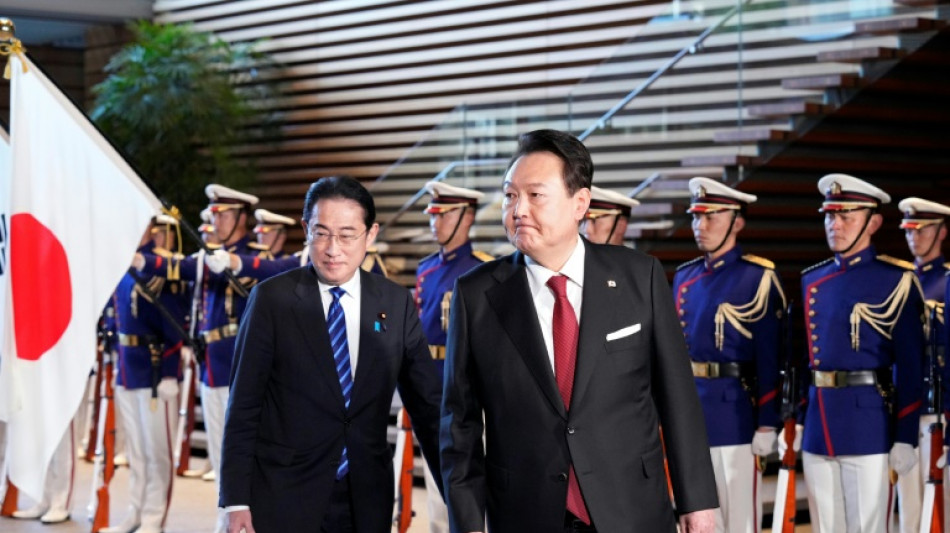
Japan, South Korea thaw ties to tackle regional threats / Photo: © POOL/AFP

 US judge rejects bid to break up Google's ad business

 Rupert Murdoch 'very happy' to be played by Guy Pearce in new film

 Wall Street stocks rise despite bond yields, oil rising

 Brennan claims third Vuelta victory in stage 11 sprint

 Nepal flood survivors cling to zipline to cross treacherous river

 US Treasury issues $1 coin with Trump's face on it

 Fernandez 'didn't hesitate' over record Man City move

 Dutch shift 86 tonnes of gold from US, Canada to UK

 Nepal floods should mobilise climate action: UN green fund chief
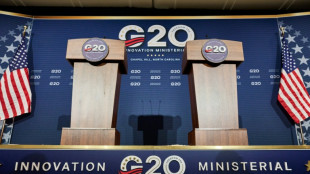 Nvidia boss presses G20 ministers to build AI infrastructure

 Liminal Launches Liminal Prime for Institutional OTC and Stablecoin Liquidity
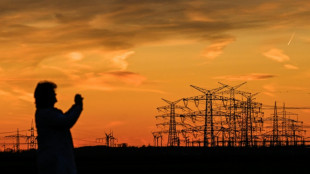
 10 missing as cargo ship sinks after collision off Istanbul

 30 years on, 'Tomb Raider' reboot sees Lara Croft through a 'modern lens'

 King Charles, Macron to view Bayeux Tapestry as French leader starts UK visit

 George Clooney says US run by 'least qualified people'

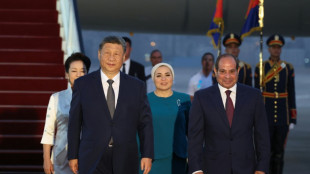 China's Xi urges against Mideast interference in rare Egypt visit
 Venice to roll out red carpet for 'lucky' Clooney on opening night

 'Humiliated' Aubameyang quits Gabon national team

 France sees limited economic hit from drought, heatwaves

 Bus crash in Egypt's Sinai kills 22, including 10 Jordanians

 UN says world must navigate 'reality' of 1.5C overshoot
 Taliban govt defends ban on protest, citing Islamic law

 10 missing as Turkish cargo ship sinks after collision off Istanbul

 easyMarkets Expands Commodity Offering with 24/7 Gold, Silver and Oil Trading

 Australia defends Pacific climate meeting despite doubts on attendance
Japan and South Korea announced the end of tit-for-tat trade measures and pledged renewed diplomacy as leaders of the two countries met in Tokyo Thursday for a summit to thaw long-frozen ties.
The neighbours, both key US partners in the region, have for years been locked in a bitter dispute over Japan's use of wartime forced labour.
Relations deteriorated after South Korea's Supreme Court in 2018 ordered Japanese firms to compensate victims of forced labour, but this month Seoul announced a plan to pay those affected without Tokyo's involvement.
President Yoon Suk Yeol has been keen to end the spat and form a united front against regional challenges including North Korea, which launched a long-range missile just hours before Yoon's arrival in Tokyo.
After talks, he and Japan's Prime Minister Fumio Kishida announced the resumption of "shuttle diplomacy," with the leaders agreeing to regular reciprocal visits to build confidence.
Japanese media said this could include Kishida inviting Yoon to the G7 summit in Hiroshima in May, and then visiting Seoul.
"Strengthening Japan-South Korea ties in the current strategic environment is urgent," Kishida told reporters at a joint press conference with Yoon after talks.
"I hope this visit will nurture trust and friendship and significantly elevate Japan-South Korea relations."
Tokyo's trade ministry said earlier on Thursday it would end restrictions on exports to South Korea of key industrial materials needed for semiconductors, and Seoul said it would withdraw a complaint filed with the World Trade Organization.
Kishida said both countries wanted stronger deterrence capacities, and that suspended security and ministerial talks would now resume, along with trilateral meetings with China.
- North Korean missile -
In a potent reminder of the security challenges that have pushed Seoul and Tokyo closer together, North Korea fired a long-range ballistic missile just hours before Yoon's arrival.
"As seen from North Korea's long-range ballistic missile launch this morning before I left for Tokyo, North Korea's ever-increasing nuclear missile threat poses a great threat to peace and stability," he said.
"Korea and Japan must closely cooperate in solidarity to wisely deal with these illegal threats."
The two neighbours are US allies and economically developed democracies, but their relations have long been poisoned by history, particularly atrocities committed during Japan's 35-year colonial rule, including the use of wartime sex slaves -- euphemistically termed "comfort women" -- and forced labour.
Japan rejected the 2018 Supreme Court ruling, arguing that colonial-era disputes had been settled in 1965, when diplomatic ties were normalised and Tokyo gave Seoul loans and economic aid equivalent to several billion dollars today.
However, Yoon's election, and growing concerns about North Korean sabre-rattling as well as Chinese military power, have driven momentum for reconciliation.
"South Korea can no longer afford to keep squabbling over specific bilateral issues," Yuki Asaba, a professor of Korean studies at Doshisha University, told AFP.
- 'A bit complicated' -
Following their summit and press conference, Kishida will host a dinner for Yoon, who reportedly made a specific menu request: omurice, a Western-inspired Japanese comfort food featuring an omelette over rice.
For all the outward signs of warmer ties, the countries still face significant challenges, warned Park Won-gon, professor of North Korean studies at Seoul's Ewha University.
"It is meaningful that Korea-Japan relations are finally starting to normalise, but it becomes a bit complicated in terms of outcome," he told AFP.
"It all breaks down to at what level Prime Minister Kishida will be willing to apologise for the history."
Japan has said it continues to endorse its historic apologies for wartime acts, but many in South Korea feel that falls short and oppose Yoon's compensation plan.
Internationally, however, the rapprochement has been welcomed, particularly in Washington, which is keen to see two key Asian allies make up.
And a desire to draw nearer to Washington, ahead of a US visit next month, may be partly motivating Yoon's diplomatic overtures to Tokyo, said Asaba.
"He is aware that South Korea fighting with Japan over bilateral issues will hamper enhancing Seoul's relations with Washington," he said.
burs-sah/mca
O.Bulka--BTB