From bad to worse: key IPCC findings on climate impacts / Photo: ©

 Bezos consortium bought nearly 40 percent of Liverpool: report

 Trump says no Iran talks planned, claims Hormuz 'new US territory'
 Canada seeks to avert new US tariffs as deadline looms

 US primaries test Democrat comeback hopes in Trump stronghold
 Scientists discover how narwhals grow nature's only straight tusk

 DR Congo Ebola outbreak 'far from being under control': WHO chief

 Firefighters in 'decisive' push to encircle Belgian wildfire

 Tribal Partners with ServiceNow to Empower Enterprise Teams to Build and Deploy Apps & Agents

 Fusion Markets Extends Negative Balance Protection to Clients Globally

 India close on victory in first Test against Sri Lanka

 Three lightly injured as new quake hits Spain's Granada

 Syria, US say Israel struck military air base in Idlib province
 France probes Russian disinfo campaign against centrist candidates

 Stocks mostly drop as Mideast hopes dim, interest rates rise

 Bayern's Musiala returns to training after on-field collapse

 China's Baidu, betting on AI, posts fifth straight quarterly revenue drop

 German farmers warn of drought toll on grain harvest

 Pant fastest to 100 sixes as India set Sri Lanka 372 to win first Test

 Russia rebukes Japan ambassador over disputed islands row
 Crude extends gains, most stocks drop as Mideast hopes dim
 Rift deepens as Asia football chief hits back at Qatar in Infantino saga

 India extend lead to 294 in first Sri Lanka Test

 Asian allies stress 'critical cooperation' as Trump slashes Korea drills

 Williams sisters fall at Cincinnati while Zverev advances

 Transylvania's fortified churches face fragile future

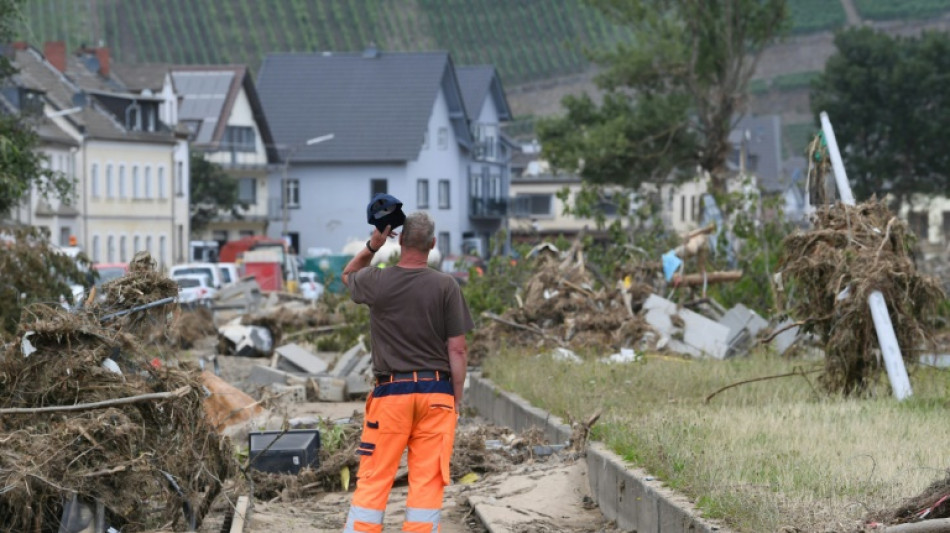
With nearly half the world population "highly vulnerable" to severe climate shocks and nature facing in some cases irreversible threats, UN experts unveiled Monday a harrowing picture of global warming impacts.
Here is a rundown on some of the major findings in the Intergovernmental Panel on Climate Change's report from the key Summary for Policymakers:
- A here-&-now reality -
Severe climate impacts -- once seen as a problem on the horizon -- have become a here-and-now reality.
Global warming has already contributed to species decline and extinction; an increase in vector-borne disease; more deaths due to heat and drought; reduced yields in staple crops; water scarcity; and a decline in fisheries and aquaculture.
Climate change has adversely affected physical health worldwide, and mental health in regions where data is available. Even as needs increase, health services have been disrupted by extreme events such as flooding.
The rise in weather and climate extremes has already led to "irreversible impacts" in both human society and the natural world, the report concludes.
And it makes clear that this is only the beginning.
Impacts will intensify with every fraction of a degree of warming.
At 1.5 degrees Celsius above preindustrial temperatures, 14 percent of terrestrial species will face an extinction risk.
Meanwhile, billions more people will be exposed to dengue fever, and climate-driven extreme events "will significantly increase ill health and premature deaths".
- High tide = high risk -
No matter how quickly carbon pollution driving global warming is drawn down, a billion people will be at risk from coastal climate hazards such as increasingly powerful storms amplified by rising seas.
The population exposed to once-a-century coastal flooding will double if oceans rise 75 centimetres (30 inches), well within the range of 2100 projections. Currently, some 900 million people live within 10 metres (33 feet) of sea level.
By 2100, the value of global assets within future 1-in-100-year coastal floodplains will be about $10 trillion in a moderate greenhouse gas emissions scenario.
- 1.5C overshoot (not OK) -
In the first instalment of its trilogy of reports, the IPCC's August 2021 assessment on physical science kept alive the Paris Agreement goal of capping global warming at 1.5C.
But even then, it said temperatures would temporarily exceed that threshold, potentially within a decade.
In its latest report the IPCC outlines the stiff penalty involved in this so-called "overshoot".
Additional warming above 1.5C "will result in irreversible impacts" on ecosystems such as coral reefs, mountain glaciers and ice sheets with enough frozen water to lift ocean tens of metres.
Permafrost stocked with twice the carbon in the atmosphere could become destabilised.
"The risk of severe impacts increases with every additional increment of global warming during overshoot," the IPCC says with "high confidence".
- 'Adapt or die' -
Adaptation barely figured in the IPCC's equivalent report from 2007. By comparison, the new assessment -- the sixth since 1990 -- highlights the need to cope with unavoidable climate impacts on almost every page.
Overall, the IPCC warns, global warming is outpacing our preparations for a climate-addled world: "At current rates of adaptation planning and implementation, the adaptation gap will continue to grow."
Whether it's reducing food waste or promoting sustainable farming; restoring protective mangrove forests or building sea dams; planting urban green corridors or installing air conditioners -- the search for ways to live with climate change has become urgent.
- 'Maladaptation' & trade-offs -
The IPCC also highlights the dangers of getting it wrong at a time when there's no margin for error.
"There is increased evidence of maladaptation across many sectors and regions," the report cautions.
Building a seawall to protect against storm surges made more destructive by sea level rise, for example, may result in further development in precisely the areas most exposed to danger, creating "lock-ins" and increased exposure over the long-term.
- Tipping points & compound impacts -
The report trains a spotlight on irreversible and potentially catastrophic changes in the climate system known as tipping points that would be triggered at different thresholds of global warming.
These include the melting of ice sheets atop Greenland and the West Antarctic, which have enough frozen water to lift oceans 13 metres.
In a more immediate future, some regions -- north-eastern Brazil, Southeast Asia, the Mediterranean, central China -- and coastlines almost everywhere could be battered by multiple climate calamities: drought, heatwaves, cyclones, wildfires, flooding.
Scientists have only begun to study the impact of such compound calamites.
S.Keller--BTB