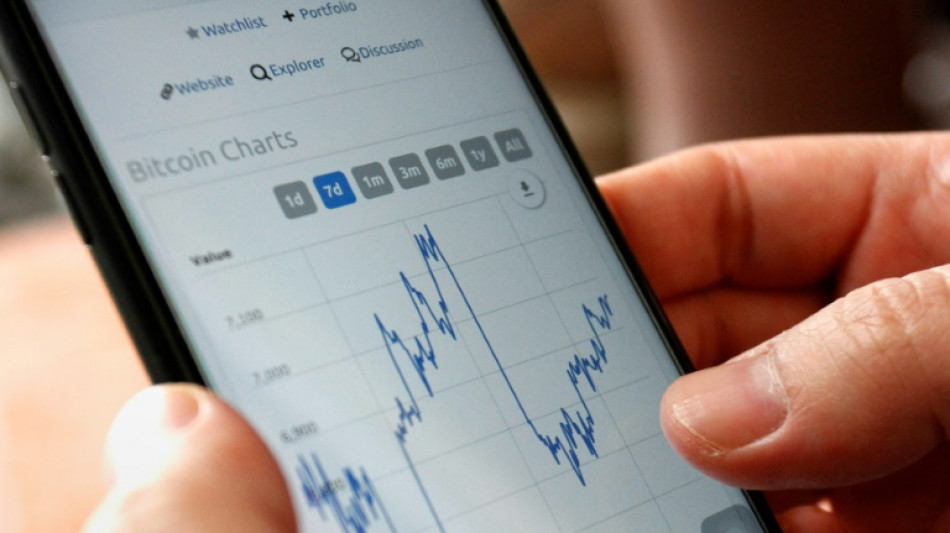
Could Russia get round sanctions with cryptocurrency? / Photo: ©

 Venus, Stephens, Monfils named among US Open wild cards

 Rodri joins La Liga champions Barcelona from Manchester City

 Disney, ABC sue US regulator over threat to broadcast licenses

 Trump, Carney hold talks as new US tariffs on Canada loom

 Germany opens new drone research centre as security threats mount
 How only a few tree species drive Amazon forest recovery

 Ivonne A-Baki enters race to be next UN chief
 Ukraine says Russian strike kills 10 in northeast region

 Meta in court over child social media addiction

 Vieira appointed Senegal head coach after World Cup disappointment

 F1's Albon re-signs with Williams for 2027

 Borderless.xyz Deepens Africa Coverage as CrissCross Goes Live on Its Network
 Pakistan court orders ex-PM Khan moved from jail to hospital

 'Lonely place': Black UK academics slam racism after Arday's death

 UK PM says not embarrassed by hoax messages with fake Trump aide

 West Bank siege exposes Israel army inaction on settler violence

 Four-time champion Roglic to ride Vuelta after training crash

 Ukrainian convicted in Germany over Russian sabotage plot

 Beleaguered FIFA chief Infantino rids himself of critic Lamour

 Kane confirms Bayern extension talks set to start

 Asian allies stress 'critical' US cooperation as Trump slashes Korea drills

 Pakistan Supreme Court orders ex-PM Khan moved from jail to hospital

 Firefighters push to 'encircle' Belgian wildfire

 ISS to host first spacewalk by Frenchwoman

 Philippine student killed in livestreamed school shooting

Cryptocurrency purchases in rubles are at a record high following Russia's invasion of Ukraine, raising questions about whether piling into the likes of bitcoin can help Moscow get around sanctions.
- Why crypto is attracting Russians? -
The United States and Western allies have sought to cripple Russia's banking sector and currency with a barrage of sanctions.
They include cutting selected Russian banks from the SWIFT messaging system, rendering them isolated from the rest of the world.
SWIFT's system allows banks to communicate rapidly and securely about transactions -- cutting Russia off is aimed at preventing it trading with most of the world.
Western measures that prohibit transactions with Russia's central bank have also helped plunge the country's economy into turmoil.
The ruble is down 27 percent against the dollar since the start of the year and is trading at more than 100 rubles per US unit, its weakest level on record.
Russians are consequently flocking to cryptocurrencies that operate on a decentralised network and therefore are not directly affected by sanctions.
Crypto data-provider Kaiko has reported record-high purchasing volumes of bitcoin in rubles since last week's invasion.
Another type of digital currency to have benefitted hugely from Russia's assault on its neighbour is tether, a "stablecoin" that is seen as less volatile than cryptocurrencies since it is pegged to the dollar.
"What we saw... looking at tether (is) the average trade size has increased" in Russia, Clara Medalie, head of research at Kaiko, told AFP.
"However it's still relatively low, which shows an interest split between institutional and retail buyers."
- Is crypto a long-term solution against sanctions? -
Governments can, if they wish, order shopping platforms to place restrictions on purchases made using cryptocurrencies as a way of blocking attempts to get round sanctions.
Ukraine's deputy prime minister Mykhailo Fedorov, who is also minister of the country's digital transformation, demanded via Twitter that crypto platforms block Russian accounts, a request reportedly being considered by US authorities.
Analysis group Chainalysis said in a statement that it was "optimistic that the cryptocurrency industry can counter attempts by Russian actors to evade sanctions".
It pointed out that blockchains, or the registers of transactions made by digital currencies, allow Western governments to identify violations.
At the same time, North Korea and Iran have succeeded in getting round sanctions thanks to cryptocurrencies.
North Korea has earned billions of dollars thanks to cyber attacks, while Iran has used low-cost energy to mine bitcoin, according to Caroline Malcolm of Chainalysis.
However, using crypto to sell key Russian export commodities wheat, oil and gas is unlikely, with one veteran broker stressing that trading volumes of bitcoin and its rivals remain insufficient to support large-scale trades.
- Crypto reactions to invasion? -
Bitcoin and other cryptocurrency prices have jumped since the invasion but not simply because of Russian investment.
The Ukranian government since Saturday has received $17.1 million worth of crypto following a call for donations, according to analysts Elliptic.
"We didn't get to choose the time or manner of our little industry becoming geopolitically critical overnight, but it is upon us," tweeted Nic Carter, partner at crypto fund Castle Island.
But Medalie cautioned that the "ruble is not a large cryptomarket. There is not a lot of influence on the rest of the market", she said.
W.Lapointe--BTB