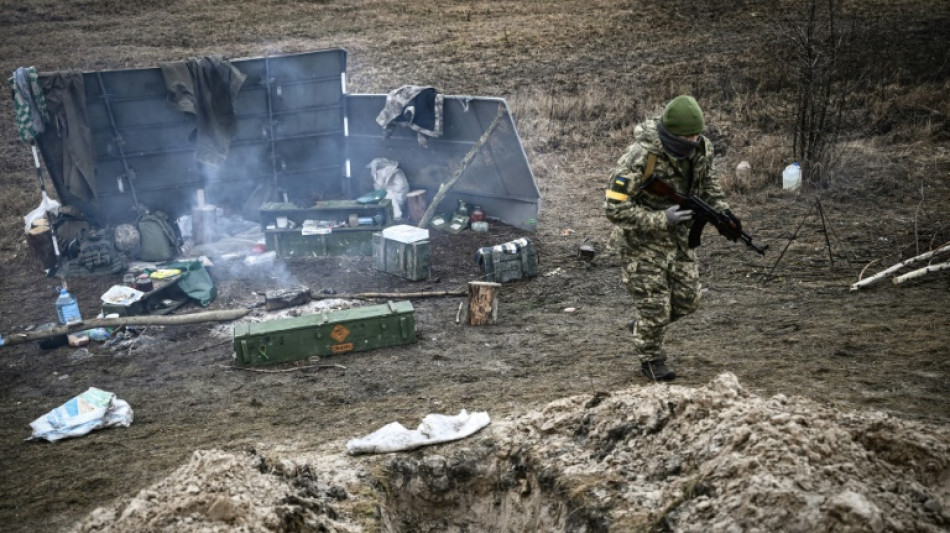
Mine warfare on Kyiv's eastern front / Photo: ©

 Ecuadoran diplomat enters race to be next UN chief

 US sanctions ICC chief Tomoko Akane of Japan

 US moves to open vast tracts of pristine forests to logging
 US sanctions International Criminal Court chief Tomoko Akane of Japan
 Meta hooked children and misled public: prosecutors

 France's first women's rights minister Yvette Roudy dies, aged 97

 French producer Nicolas Altmayer, Dior PR chief Favier die in car crash
 Bezos consortium bought nearly 40 percent of Liverpool: report

 Trump says no Iran talks planned, claims Hormuz 'new US territory'

 Canada seeks to avert new US tariffs as deadline looms

 US primaries test Democrat comeback hopes in Trump stronghold
 Scientists discover how narwhals grow nature's only straight tusk

 DR Congo Ebola outbreak 'far from being under control': WHO chief

 Firefighters in 'decisive' push to encircle Belgian wildfire
 Tribal Partners with ServiceNow to Empower Enterprise Teams to Build and Deploy Apps & Agents

 Fusion Markets Extends Negative Balance Protection to Clients Globally
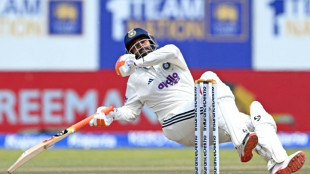 India close on victory in first Test against Sri Lanka

 Three lightly injured as new quake hits Spain's Granada

 Syria, US say Israel struck military air base in Idlib province
 France probes Russian disinfo campaign against centrist candidates

 Stocks mostly drop as Mideast hopes dim, interest rates rise
 Bayern's Musiala returns to training after on-field collapse
 China's Baidu, betting on AI, posts fifth straight quarterly revenue drop

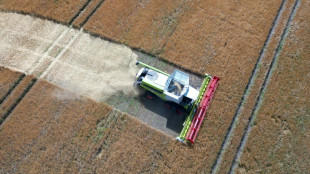 German farmers warn of drought toll on grain harvest
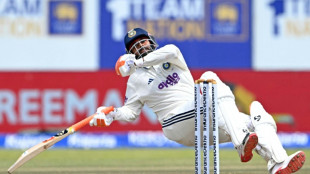 Pant fastest to 100 sixes as India set Sri Lanka 372 to win first Test
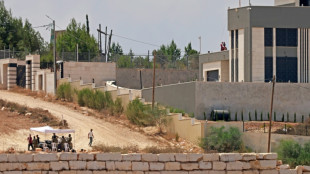
The Ukrainian army battalion commander is not sure who laid the mines scattered across fields on Kyiv's eastern front that his men hit while seeking intelligence on Russian forces.
Maksym Kyrychuk is just grateful that only one of his men was injured and none died –- this time around.
"Someone laid them," he reasoned, standing at the edge of one of the minefields on farmland 130 kilometres (80 miles) northeast of the Ukrainian capital.
"It wasn't the Ukrainian armed forces, that I can tell you for sure," he said with a resolute shake of the head.
"It could have been Ukrainian territorial defence units," he added, referring to mostly untrained volunteer forces.
"The Russians? I am sure they also do it. But that our intelligence team went out and hit one yesterday, that is a fact."
Russia's week-long assault on Kyiv appears to have, at least temporarily, stalled after reaching a web of villages on the city's northwest edge.
But more and more Russian forces are now approaching the historic city from the northeast, on the eastern side of the Dnipro river.
There they will confront various Ukrainian defence units that are trying to protect what remains Kyiv's more exposed flank.
Regular units are interspersed with the eager volunteer forces who often man checkpoints with little more than hunting rifles and knives.
Kyrychuk suspected that one of these volunteer units scattered a cache of anti-tank mines across the fields encircling the town of Nizhyn before his own units moved in this week.
"Or it could have been the Russians," he added. "Maybe they are trying to make people think that we're engaging in mine warfare."
- 'I worry about them' -
A UN treaty agreed in Ottawa in 1997 and which went into force two years later banned anti-personnel mines. Ukraine signed the deal, but Russia and the United States did not.
Mines like those in Nizhyn are aimed at destroying tanks and are often frowned upon but permitted under internationally accepted warfare rules.
Locals appear to have a love-hate relationship with the anti-tank mines lurking in the fields where they once grew wheat and corn.
"I worry about them. The entire war worries me," said 40-year-old bricklayer Artem Kurylenko.
"But I think the soldiers know better whether this is the right thing to do or not," Kurylenko added.
Local mayor Oleksandr Kodola is upfront about his support for mine-laying.
Kodola said he would do anything to stop the Russians from assaulting his working-class town of about 80,000.
"Everyone is coming out to defend our city and our country," the mayor said.
"So among other things, we are conducting certain mining operations around the approaches to the city. We ask residents to stay at home and to avoid the fields."
- 'Welcome to hell' -
A local checkpoint commander who goes by the nom de guerre Serpent appeared to have more pressing worries than the mines that might be lurking around his roadside camp.
A Russian war plane that had made several circles over Serpent's command post was making another run.
It had already delivered an air strike that left a two-metre (seven-foot) crater in the ground at another checkpoint.
It then scared a group of locals walking down the edge of the road, forcing them to scramble into a foxhole for safety while it buzzed ominously overhead.
Serpent said the mines might slow down the Russians, but not make the ones already here go away.
"The front is everywhere," he said with a wave of the hand. "The saboteurs are already shooting at us from the woods and from the fields."
Yet the Ukrainians are not sitting idle.
Some of the armoured vehicles at Kyrychuk's outpost fly a red-and-white flag that once represented Ukrainian resistance that fought both the Soviets and the Nazis during World War II.
"When we pick up the Russians' equipment, we plant that flag on it to make sure that our own guys don't shoot at us," he said.
That resolve is spelt out in black spray paint on a bedsheet hanging off one of the bridges on the road from Nizhyn to Kyiv.
"Russians -– welcome to hell," the makeshift banner declares.
C.Kovalenko--BTB