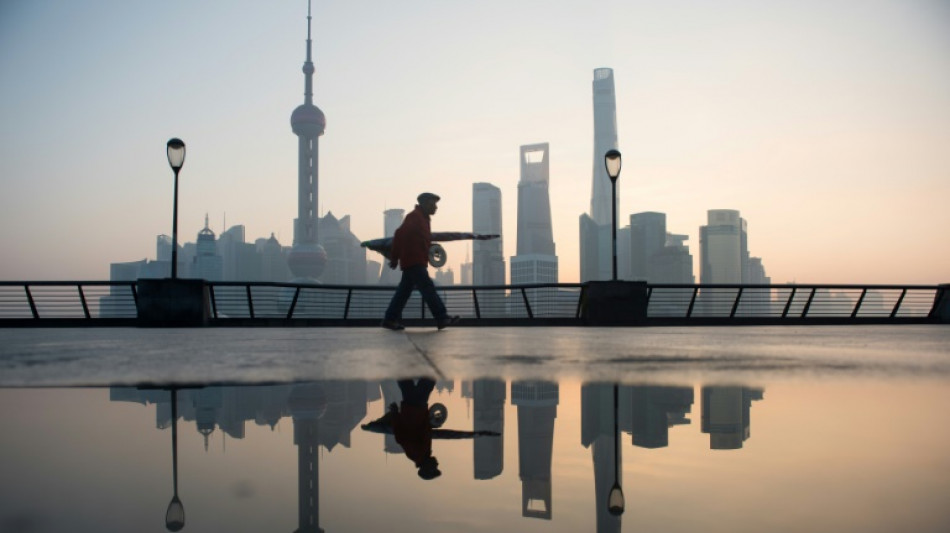
Business tough in China as national security trumps all / Photo: © AFP

 Jovic 'loses sanity five times over' to oust friend Eala in US Open epic

 China's memories of Mao fade to nostalgia 50 years after his death

 US envoys discuss with Putin 'substantive' plans for steps to end Ukraine war

 Zheng stuns Keys as US Open upsets dim American hopes

 Jovic 'loses sanity five times over' to oust Eala and book Gauff clash

 'Like a jewel': Japan's luxury ice revered by bars worldwide

 'The flood is coming': How a Nepal principal saved 900 students

 Kiss's winning run ends as Argentina hold Australia to draw

 Alcaraz excited to face 'dangerous' Paul for US Open quarter-final berth

 Prince William to represent King Charles III at Norway late King Harald's funeral

 Inter and Roma roar back to win thrillers and share top spot

 Don't stop them now: fans party for Freddie Mercury's 80th birthday

 AFP photographer wins top prize for Madagascar protest coverage

 Keys: 'I felt like I couldn't play tennis'

 Simmonds stars as Pau upset Montpellier

 Inter roar back in five-goal thriller with Napoli

 Haaland keeps Man City perfect in Premier League, blunt Spurs held

 Hamilton worried by Ferrari pace while Antonelli prepares for a fight

 Vuelta stage 15 shortened due to extreme heat, Mas consolidates lead

 Putin meets US envoys for Ukraine war talks

 Modric available for Croatia in Nations League

 Potapova upsets 2025 US Open runner-up Anisimova

 Gasly a 'class act' says Alpine boss after Monza pole

 Athletic Bilbao crush Simeone's flat Atletico

 Stay far from battlefield, warns Japanese director in Vietnam War film

Doing business in China has become harder and potentially more perilous as the government prioritises an ever-widening definition of national security over all else, despite insisting the country has reopened for trading.
In late March, authorities hosted global executives in Beijing, telling them they were "not foreign visitors, but a family" and pledging to slash red tape.
But since pandemic restrictions were lifted in recent months, China has restricted overseas access to data and publicised raids on consulting firms.
Amendments to anti-espionage laws effective from July 1 will broaden the definition of spying and ban transferring information that relates to national security.
This has spooked foreign and domestic firms as they try to decipher authorities' intentions -- and crucially, pinpoint what is off-limits.
"Companies are scrambling to figure out protocols to protect their staff. But the definitions are so vague," an employee of a major international auditing firm told AFP.
"No one knows whether they have crossed a line or not, or where the red line is."
US due diligence firm Mintz Group was left in no doubt it had crossed one when police closed its Beijing office and arrested five local staff members in March.
The following month, US consulting giant Bain & Company said employees at its Shanghai office had been questioned.
And in a 15-minute segment on state television last week, authorities said multi-city raids on global expert network Capvision were part of a wider campaign to overhaul China's consulting sector.
The events "send a worrying signal and heighten the uncertainty felt by foreign companies operating in China", the EU Chamber of Commerce in Shanghai told AFP.
When "companies are looking for clear signs that China's business environment is becoming more predictable and reliable, the developments are not conducive to restoring business confidence and attracting foreign investment".
But Yale legal expert Jeremy Daum said the key was that "China believes there are legitimate threats to its national security, and will always prioritise addressing them over other interests".
"As international tensions continue to rise... the situation isn't likely to get better soon," he added.
- 'Pushing the boundaries' -
With US-China relations in particular riddled with explosive issues like trade, human rights and Taiwan, Beijing has tightly consolidated its control of sensitive information.
Many experts interpreted state TV coverage of the raids as an unambiguous warning to Chinese citizens about the risks of engaging with firms like Capvision.
Several industry analysts who spoke to AFP said it appeared Capvision, Mintz and Bain had been targeted for individual cases, rather than being a sign of an arbitrary campaign to attack foreign firms.
Capvision, though it has a regional headquarters in New York, is first and foremost a Chinese company.
The CCTV report said one of its sources had leaked information about "the manufacturers and quantities of some important military equipment".
"I think certain firms... have always engaged in research activities that push the boundaries –- and that, as has always been true for decades now, some of them will get caught," said Bob Guterma, a former Capvision chief compliance officer who now runs news and business intelligence site The China Project.
"People are waking up -- or it's more like the newest round of awakening to the dangers of doing business in China that have always existed."
Crackdowns on sectors where regulations were previously often lightly enforced -- like tech and private tutoring -- have been a feature of President Xi Jinping's time in office.
Beijing-based lawyer Lester Ross, who specialises in regulatory compliance, told AFP that state security forces had been pushing for tighter controls on data-gathering industries for some time.
China's upper echelons of power are stacked with Xi's allies after he secured a third term last year.
"It is the change in the balance of forces within the system, among competing bureaucracies, that has triggered the actual raids," Ross posited.
- 'Chilling effect' -
The full effect of the amended anti-spying law is still unknown.
Yale's Daum said the original definition of espionage was so broad, "it isn't immediately clear what the impact of the expanded definition will be".
The "open-endedness sometimes makes it difficult to fully assess the risk... (which) inevitably leads to a chilling effect", he told AFP.
"(Companies) have to be much more cautious about the gathering of information and who they gather the information from, and that will inhibit their ability to actually do business," said Ross.
"Even publicly available information becomes problematic because some of that is only available in China."
Access to Chinese data sources, including Shanghai-based Wind Information and academic database CNKI, has recently been tightened for overseas researchers.
The Wall Street Journal reported the move was partly triggered by a series of US think tank reports that made use of similar tools.
The government has also instructed state-owned companies to phase out contracts with the big four accounting firms -- Deloitte, KPMG, EY and PwC -- according to Bloomberg.
The dissonance between recent events and officials' attempts to entice foreign capital into China's Covid-battered economy has increased the sense of anxiety.
"The recent raids and the mixed messages they send have caused a lot of concern, and as that concern flows up into board rooms it is going to be even harder for many firms to approve additional investments" in China, analyst Bill Bishop wrote.
But authorities believe China is too big a market for firms to leave, journalist and author Lingling Wei said.
"They don't see the contradiction... They still believe they can keep foreign capital from leaving, while at the same time keeping the pressure on the foreign firms."
P.Anderson--BTB