BBC halts work in Russia over 'fake news' jail terms / Photo: ©

 Trump, Carney talk as Canada seeks to hold off new US tariffs
 NASA images reveal crater left by SpaceX rocket's Moon crash
 UN atomic watchdog says found tons of nuclear material at Syria site
 Ecuadoran diplomat enters race to be next UN chief

 US sanctions ICC chief Tomoko Akane of Japan
 US moves to open vast tracts of pristine forests to logging
 US sanctions International Criminal Court chief Tomoko Akane of Japan
 Meta hooked children and misled public: prosecutors

 France's first women's rights minister Yvette Roudy dies, aged 97
 French producer Nicolas Altmayer, Dior PR chief Favier die in car crash
 Bezos consortium bought nearly 40 percent of Liverpool: report
 Trump says no Iran talks planned, claims Hormuz 'new US territory'
 Canada seeks to avert new US tariffs as deadline looms
 US primaries test Democrat comeback hopes in Trump stronghold
 Scientists discover how narwhals grow nature's only straight tusk
 DR Congo Ebola outbreak 'far from being under control': WHO chief
 Firefighters in 'decisive' push to encircle Belgian wildfire
 Tribal Partners with ServiceNow to Empower Enterprise Teams to Build and Deploy Apps & Agents
 Fusion Markets Extends Negative Balance Protection to Clients Globally
 India close on victory in first Test against Sri Lanka
 Three lightly injured as new quake hits Spain's Granada
 Syria, US say Israel struck military air base in Idlib province
 France probes Russian disinfo campaign against centrist candidates
 Stocks mostly drop as Mideast hopes dim, interest rates rise
 Bayern's Musiala returns to training after on-field collapse
The BBC announced Friday that it was halting its journalists' work in Russia after lawmakers moved to impose harsh jail terms for publishing "fake news" about the army as part of efforts to muffle dissent over Moscow's invasion of Ukraine.
The BBC, which has a large bureau in Moscow and runs a Russian-language news website, reacted after lawmakers backed new legislation imposing jail terms and fines for publishing "knowingly false information" about the military.
"This legislation appears to criminalise the process of independent journalism," BBC Director-General Tim Davie said in a statement.
He warned that journalists could face "the risk of criminal prosecution simply for doing their jobs".
The legal crackdown leaves the broadcasting corporation with "no other option than to temporarily suspend the work of all BBC News journalists and their support staff within the Russian Federation," Davie said.
The lower house of parliament said in a statement that if fake news stories "led to serious consequences, (the legislation) threatens imprisonment of up to 15 years".
Amendments were also passed to fine or jail people calling for sanctions against Russia with jail terms.
Two Russian outlets, Nobel Prize-winning newspaper Novaya Gazeta and business news website The Bell, said Friday they will stop reporting on Russia's invasion of Ukraine to protect their journalists.
The past year has seen an unprecedented crackdown on independent and critical voices in Russia that has intensified since the invasion.
The chairman of parliament Vyacheslav Volodin railed against foreign social media after Facebook was briefly inaccessible in Russia on Friday.
"All these IT companies beginning with Instagram, and ending with the others, are based in the United States of America. It is clear they are used as weapons. They carry hatred and lies. We need to oppose this," he said.
Russia's media watchdog said Friday it had restricted access to the BBC and other independent media websites, further tightening controls over the internet.
- Foreign media restricted -
The independent news website Meduza, German broadcaster Deutsche Welle, and the Russian-language website of the US-funded Radio Free Europe/Radio Liberty, Svoboda, were "limited," said Roskomnadzor, following a request from prosecutors.
Valery Fadeyev, the head of the Kremlin's human rights council accused Western media of being behind "a huge flow of false information that comes from Ukraine" and said the council had set up a project to stop it.
In another attack on critical voices, Russian police on Friday were carrying out searches at the office of the country's most prominent rights group, Memorial, which was ordered to close late last year, sparking international outcry.
Russia's invasion has already claimed hundreds of lives, displaced more than a million people and spurred allegations of war crimes.
Western-led sanctions levelled against Russia in retaliation have sent the ruble into free-fall forcing the central bank to impose a 30-percent tax on sales of hard currency after a run on lenders.
- State-media narratives -
Moscow has few economic tools with which to respond but the Duma, or lower house, on Friday adopted a bill that would freeze any assets inside Russia of foreigners "violating rights of Russians".
Russian media have been instructed to publish only information provided by official sources, which describe the invasion as a military operation.
For the moment, it appears the invasion has marked the beginning of the end for what remains of Russia's independent media.
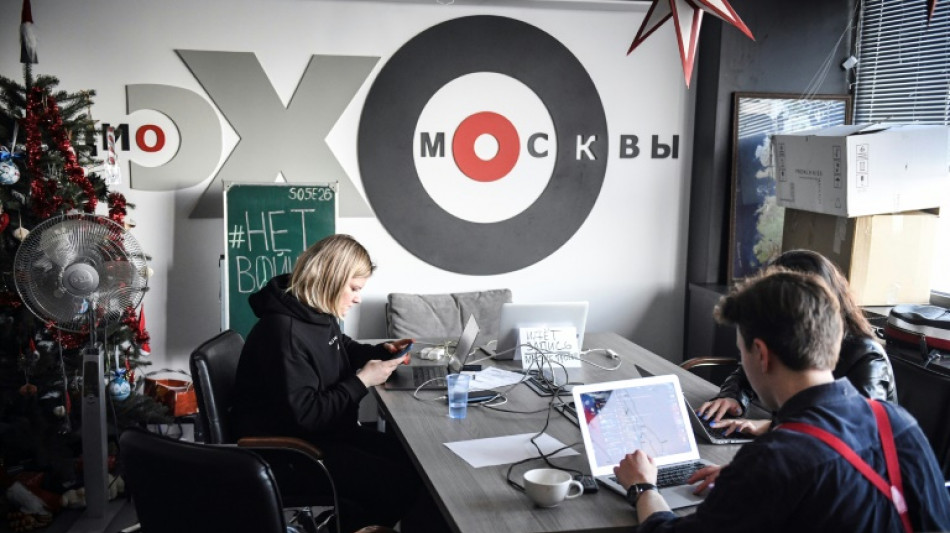
Ekho Mosvky -- a liberal-leaning radio station majority-owned by Russia's energy giant Gazprom -- said Thursday it would shut down after being taken off air over its Ukraine war coverage.
Authorities had on Tuesday blocked the Ekho Moskvy website and took the station off air as punishment for spreading "deliberately false information" about the conflict.
Its editor-in-chef Alexei Venediktov said on Telegram Friday that the station will be deleting its website and social media accounts.
Another independent outlet, Znak, said Friday it was ceasing work "due to the large number of restrictions that have recently appeared for the work of the media in Russia".
The BBC said this week that the audience of its Russian language news website had "more than tripled... with a record reach of 10.7 million people in the last week".
A BBC spokesperson said the company would "continue our efforts to make BBC News available in Russia, and across the rest of the world" despite the restrictions.
burs/har
R.Adler--BTB