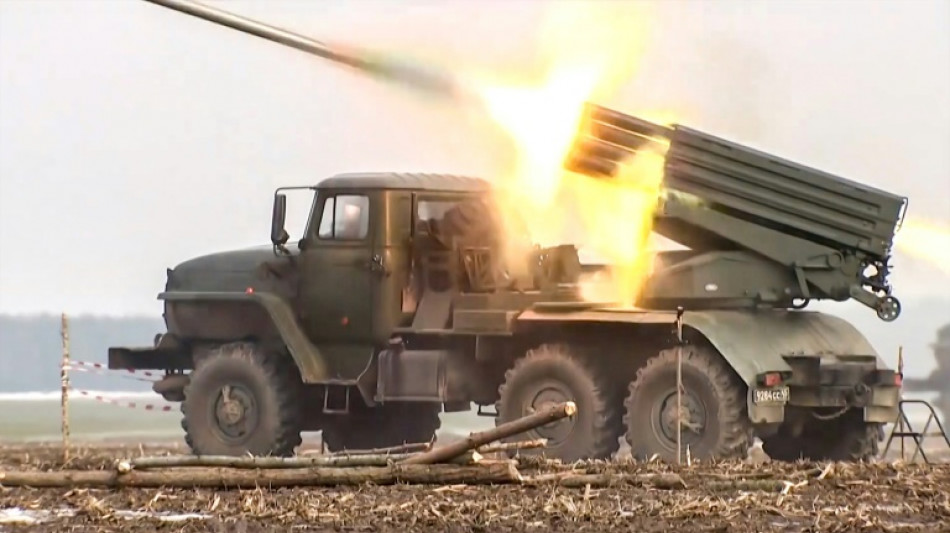
Five scenarios for Ukraine after Russia invasion / Photo: ©

 Trump, Carney talk as Canada seeks to hold off new US tariffs
 NASA images reveal crater left by SpaceX rocket's Moon crash
 UN atomic watchdog says found tons of nuclear material at Syria site
 Ecuadoran diplomat enters race to be next UN chief

 US sanctions ICC chief Tomoko Akane of Japan

 US moves to open vast tracts of pristine forests to logging
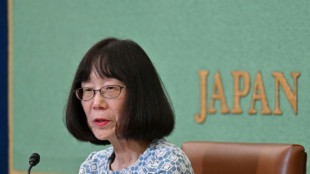 US sanctions International Criminal Court chief Tomoko Akane of Japan
 Meta hooked children and misled public: prosecutors

 France's first women's rights minister Yvette Roudy dies, aged 97
 French producer Nicolas Altmayer, Dior PR chief Favier die in car crash
 Bezos consortium bought nearly 40 percent of Liverpool: report

 Trump says no Iran talks planned, claims Hormuz 'new US territory'

 Canada seeks to avert new US tariffs as deadline looms

 US primaries test Democrat comeback hopes in Trump stronghold
 Scientists discover how narwhals grow nature's only straight tusk
 DR Congo Ebola outbreak 'far from being under control': WHO chief
 Firefighters in 'decisive' push to encircle Belgian wildfire
 Tribal Partners with ServiceNow to Empower Enterprise Teams to Build and Deploy Apps & Agents

 Fusion Markets Extends Negative Balance Protection to Clients Globally
 India close on victory in first Test against Sri Lanka
 Three lightly injured as new quake hits Spain's Granada
 Syria, US say Israel struck military air base in Idlib province
 France probes Russian disinfo campaign against centrist candidates

 Stocks mostly drop as Mideast hopes dim, interest rates rise
 Bayern's Musiala returns to training after on-field collapse
Russia's invasion of Ukraine on February 24 shocked the world but President Vladimir Putin shows no sign of pulling back.
Here are possible scenarios for the weeks and months ahead, according to Western government sources and think-tank experts.
1) Military quagmire
Ukrainian forces have resisted Russia's invasion so far, defeating an attempt by paratroopers to seize the capital in the opening days and keeping control over major cities such as Kharkiv and Mariupol.
Although Russia claims it has full air superiority, Ukraine's air defences around the capital Kyiv and in other areas appear to be degraded but still working, Western officials say.
"That's caused them so many problems," a European source told reporters on Friday on condition of anonymity.
Vast numbers of Ukrainians have also joined territorial defence units and there remain questions about the morale of the Russian army and its logistical support.
Backed by Western intelligence and a flow of anti-tank and surface-to-air missiles, Ukraine's troops might be able to hold out in the capital and force some sort of military stalemate.
Deepening Western sanctions that are strangling the Russian economy might force Putin to change his calculations.
"The West could leverage some sanctions to push Putin to abandon his core war aim of decapitating the Ukrainian government and installing a pro-Russian puppet," wrote Samuel Charap from the RAND Corporation, a US think-tank, this week.
Pressure from Beijing, increasingly a Kremlin ally under President Xi Jinping, might also be necessary.
2) Domestic Russian change
Russian President Vladimir Putin is keeping a close eye on domestic dissent.
A crackdown on independent media and foreign news providers has removed alternative sources of information about the war, cementing the grip of the ultra-loyal Russian state media.
Nevertheless, small anti-war demonstrations have taken place in cities from Saint Petersburg to Moscow, with at least 6,000 people arrested, according to local rights groups.
There are also signs of cracks in the ruling elite, with some oligarchs, MPs, and even private oil group Lukoil calling openly for a ceasefire or an end to fighting.
Though not seen as likely at this stage, the possibility of Putin being brought down in a popular backlash or even a palace coup is not being ruled out.
"His personal security is very good and it will be very good until the moment it isn't," said Eliot A. Cohen from the Center for Strategic and International Studies, a Washington-based think-tank.
"That's happened numerous times in Soviet and Russian history."
3) Russian military success
Given Russian troops' superior weapons, air power and devastating use of artillery, Western defence analysts expect them to continue grinding forward.
A huge convoy of vehicles has been assembled outside of Kyiv ahead of what is expected to be an assault on the capital.
French President Emmanuel Macron concluded that "the worst is still to come" after a call with Putin on Thursday morning.
Putin wants "to seize control of the whole of Ukraine", an aide told reporters afterwards.
But even if Russian troops depose Ukrainian President Volodymyr Zelensky and overrun Ukraine's resistance elsewhere, Putin would then face the challenge of occupying a nation of 40 million.
"Getting into a city is not the same as holding it," wrote British warfare historian and King's College London professor Lawrence Freedman on Substack this week.
4) Conflict spreads
Ukraine has a border with four former Soviet states that are now members of the US-led NATO military alliance, which considers an attack on one member to be an attack against all.
Putin's nostalgia for the Soviet Union and his pledge to protect Russian minorities -- which are found in the Baltic States -- has left an open question about his territorial ambitions.
After Ukraine, some speculate that Putin might also be eyeing Moldova, a former Soviet state wedged between Ukraine and Romania.
Few expect Putin to openly attack a NATO member, which would run the risk of nuclear war, but other provocations are possible.
"Neutral Sweden is keeping a watchful eye on Russia's intentions towards the Gotland island in the Baltic Sea," wrote analyst Bruno Tertrais for the Montaigne Institute, a French think-tank.
Charap warned of the "risks of an accident, incident, or miscalculation that spirals into a NATO-Russia war", with anything from a stray missile to cyberattacks providing the spark.
5) NATO confrontation
This was always thought to be impossible because of the nuclear weapons' mutual guarantee of destruction.
The US and Russia have opened up a so-called "deconfliction line" over which they can exchange military information quickly to reduce the chances of a misunderstanding.
The same method is employed in Syria, where US and Russian forces have been active on opposite sides of the country's civil war since 2015.
But Putin has ordered Russia's nuclear deterrent forces onto high alert and Foreign Minister Sergei Lavrov has warned that "World War Three can only be a nuclear war".
Western analysts say such warnings should be taken as posturing to deter the United States and Europe from considering ideas such as a "no-fly zone" over Ukraine.
"These announcements are predominately addressed to a Western audience to make us fear and our societies insecure," said Gustav Gressel, an expert on missile defence at the European Council on Foreign Relations.
"They use nuclear deterrence as a form of information operation. There's no substance."
O.Krause--BTB