In Spain's 'Little Ukraine', anguish over the war / Photo: ©

 Trump, Carney talk as Canada seeks to hold off new US tariffs
 NASA images reveal crater left by SpaceX rocket's Moon crash
 UN atomic watchdog says found tons of nuclear material at Syria site

 Ecuadoran diplomat enters race to be next UN chief

 US sanctions ICC chief Tomoko Akane of Japan

 US moves to open vast tracts of pristine forests to logging
 US sanctions International Criminal Court chief Tomoko Akane of Japan
 Meta hooked children and misled public: prosecutors

 France's first women's rights minister Yvette Roudy dies, aged 97

 French producer Nicolas Altmayer, Dior PR chief Favier die in car crash
 Bezos consortium bought nearly 40 percent of Liverpool: report

 Trump says no Iran talks planned, claims Hormuz 'new US territory'

 Canada seeks to avert new US tariffs as deadline looms
 US primaries test Democrat comeback hopes in Trump stronghold
 Scientists discover how narwhals grow nature's only straight tusk

 DR Congo Ebola outbreak 'far from being under control': WHO chief

 Firefighters in 'decisive' push to encircle Belgian wildfire

 Tribal Partners with ServiceNow to Empower Enterprise Teams to Build and Deploy Apps & Agents

 Fusion Markets Extends Negative Balance Protection to Clients Globally
 India close on victory in first Test against Sri Lanka
 Three lightly injured as new quake hits Spain's Granada

 Syria, US say Israel struck military air base in Idlib province
 France probes Russian disinfo campaign against centrist candidates

 Stocks mostly drop as Mideast hopes dim, interest rates rise
 Bayern's Musiala returns to training after on-field collapse
On the calendar in Mykola Grynkiv's internet cafe, every day since February 24 is ringed in black, Russia's war stopping time in this northern Spanish village where one in seven residents is Ukrainian.
Before the invasion, locals in Guissona -- which lies about 115 kilometres (70 miles) northwest of Barcelona -- would come to Grynkiv's business to go online, make photocopies or a phone call from one of the private booths at the back.
But since Russia invaded Ukraine, this internet cafe in the heart of Spain's northeastern Catalonia region has been transformed, its floor covered with boxes filled with donations that will be sent by truck to Poland.
Like millions of other Ukrainian expats, Grynkiv's priorities have totally changed within the space of a week.
"Now the business isn't running any more. I'm losing money but I don't want my country to lose" the war, says this stocky 48-year-old, who arrived in Guissona from western Ukraine more than 20 years ago.
"If I lose out and my country wins, no matter. I'll make up for it one day," he says in a rare moment when his mobile stops ringing.
Among the dozen or so volunteers filling boxes with medicines, clothes, blankets or women's sanitary products is Sofia Shchetbiy.
Until last week, she was working as a dermatologist in Ivano-Frankivsk, a city in western Ukraine.
But when the invasion began, she left, heading for Guissona where she spent part of her childhood and where her parents still live.
"My uncle told me to go to Poland because I didn't know what to do in Ukraine, I was really scared," admits the 24-year-old.
- 'The war's started' -
Of Guissona's 7,200 residents, 1,053 are Ukrainians, who make up the second-largest nationality group after Romanians, with many drawn to the area by the job opportunities offered by bonArea, a powerful agri-food business based there.
The growth of the company, which began taking on foreign labour in the 1990s, has transformed the town, which is now home to more than 43 nationalities.
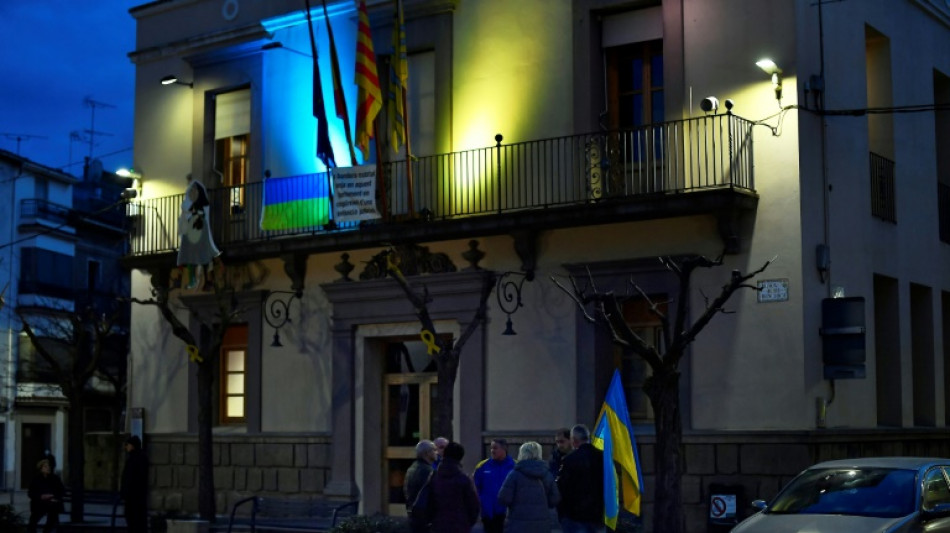
Many balconies, including that of the town hall, are draped with anti-war banners and posters or Ukraine's blue-and-yellow flag in a widespread show of support, for which Natalia Tvardovska is grateful.
When the war broke out, this 40-year-old waitress, who has been in Guissona since 2006, said she didn't need the media to tell her the Russians had invaded.
"My aunt called me from (the southern port city of) Kherson and said: 'The war's started'," she says, recalling the anguished early hours of February 24.
Since then, she's barely managed to sleep, her huge eyes dark with exhaustion.
Her husband, who had returned to his hometown in western Ukraine after a death in the family, had been trapped by the sudden outbreak of war, unable to leave with all men between 18 and 60 called up to fight.
"I hope all this is over quickly because I just don't know what to expect. I don't know when he'll get back," she says.
Also unable to drag himself away from the news is Leonid Komirenko, who fears the Russian army could at any moment enter the southern port city of Odessa, the hometown he left 13 years ago.
"I was really on edge for the first few days and wondered whether I should go back to help or what to do," admits Komirenko, 41, who works in the local slaughterhouse.
"But my wife just cried and told me: 'When you die in the war, I'll be left all alone'," he sighs, admitting he still hasn't quite made his mind up.
"If it gets worse for Ukraine, I'll think about going back."
- 12.5 tonnes of aid -
At the town hall, they only know of one case in which a resident has gone back to join the fighting, although some have gone to Poland to pick up family members.
So far, there are already 13 refugees in Guissona and the local authorities are preparing to take in around 100.
"The Ukrainians were the first to arrive and they have really helped us build this town," says mayor Jaume Ars.
Following hours of paperwork to obtain the necessary permits, a lorry carrying 12.5 tonnes (27,558 pounds) of humanitarian aid is soon ready to set off for Poland.
As the driver clambers up behind the wheel, Grynkiv and the mayor wave him goodbye.
It should take him three days to reach Pruszkow near the capital Warsaw, where different groups will distribute the goods among the thousands of Ukrainian refugees flooding into Poland.
As he pulls off, Guissona is already busy preparing its next shipment.
G.Schulte--BTB