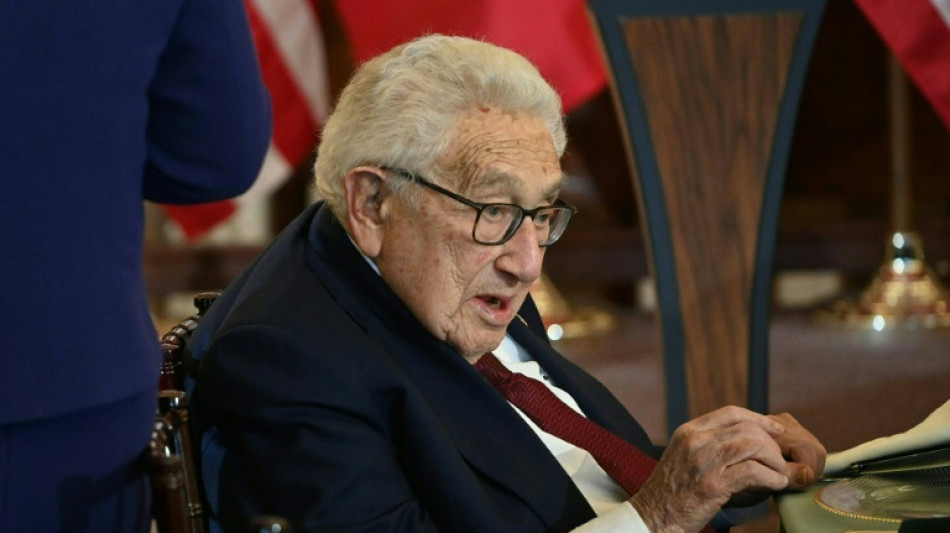
At 100, Kissinger basks in US praise with no accountability / Photo: © AFP/File

 Nepali rescuers buoyed by miracle finds but tough conditions persist
 At last: Straight sets win over Tabilo puts Zverev in US Open last 16
 Jovic 'loses sanity five times over' to oust friend Eala in US Open epic
 China's memories of Mao fade to nostalgia 50 years after his death

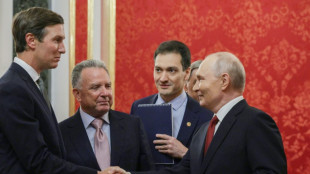 US envoys discuss with Putin 'substantive' plans for steps to end Ukraine war

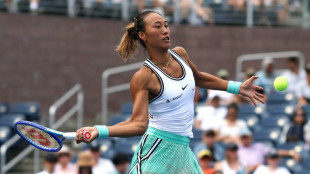 Zheng stuns Keys as US Open upsets dim American hopes

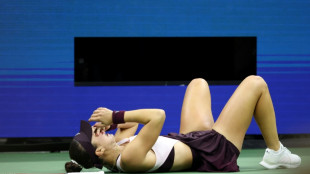 Jovic 'loses sanity five times over' to oust Eala and book Gauff clash
 'Like a jewel': Japan's luxury ice revered by bars worldwide
 'The flood is coming': How a Nepal principal saved 900 students
 Kiss's winning run ends as Argentina hold Australia to draw
 Alcaraz excited to face 'dangerous' Paul for US Open quarter-final berth
 Prince William to represent King Charles III at Norway late King Harald's funeral
 Inter and Roma roar back to win thrillers and share top spot
 Don't stop them now: fans party for Freddie Mercury's 80th birthday
 AFP photographer wins top prize for Madagascar protest coverage
 Keys: 'I felt like I couldn't play tennis'
 Simmonds stars as Pau upset Montpellier
 Inter roar back in five-goal thriller with Napoli
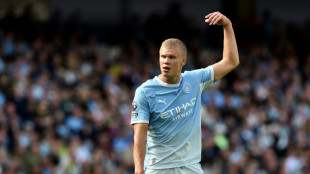 Haaland keeps Man City perfect in Premier League, blunt Spurs held
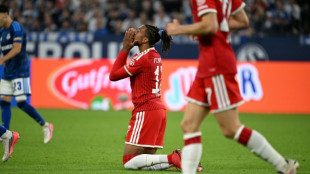
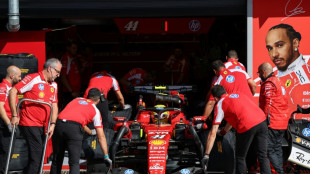 Hamilton worried by Ferrari pace while Antonelli prepares for a fight

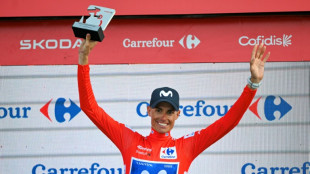 Vuelta stage 15 shortened due to extreme heat, Mas consolidates lead
 Putin meets US envoys for Ukraine war talks
 Modric available for Croatia in Nations League
 Potapova upsets 2025 US Open runner-up Anisimova
 Gasly a 'class act' says Alpine boss after Monza pole
Henry Kissinger, whose very name is synonymous with US diplomacy, turns 100 Saturday feted by the American elite as others seethe that the ruthless Cold Warrior has never faced accountability.
From opening the door to communist China to plotting an endgame to the Vietnam War to unapologetically backing dictators who were anti-Soviet, Kissinger wielded influence like few before or after him, serving as both top diplomat and security advisor to presidents Richard Nixon and Gerald Ford.
Instantly recognizable for his bookishly thick glasses and a sharp-witted monotone that never lost a touch of his native German, Kissinger was first an academic and his intellectual gifts are acknowledged begrudgingly even by some of his harshest critics.
Since leaving office in 1977, Kissinger's brand of realpolitik -- the coldly cynical championing of power and national interests -- has largely fallen out of favor as his successors preached moralism, but Kissinger himself has if anything enjoyed greater repute.
Ahead of his centennial, Kissinger blew candles on a cake at a celebratory luncheon at the Economic Club of New York, the city where he grew up after his Jewish family fled Nazi Germany.
Showing his worldview has not changed at the century mark, Kissinger cautioned for the United States to stay within the bounds of "vital interests," telling the guests, "We need to be always strong enough to resist any pressures."
Bucking the view of most US policymakers, Kissinger called for diplomacy with Russia on a ceasefire in Ukraine, arguing that Moscow has already suffered a strategic defeat.
- 'He has gotten away with it' -
An unlikely playboy in 1970s Washington, Kissinger lives in a tony apartment on New York's Park Avenue. He has grown wealthy consulting businesses through his relationships in China -- and has warned the United States against treating Beijing as a new Cold War-style adversary.
Long despised by the left, Kissinger has come into the good graces of the mainstream of the Democratic Party.
Hillary Clinton after serving as secretary of state called Kissinger "a friend" and said she "relied on his counsel," while the incumbent, Antony Blinken, teased Kissinger about his stylishness when the elder statesman attended a State Department luncheon last year.
But for many, Kissinger was seen as an unindicted war criminal for his role in, among other events, expanding the Vietnam War to Cambodia and Laos, supporting military coups in Chile and Argentina, green-lighting Indonesia's bloody invasion of East Timor in 1975 and turning a blind eye to Pakistan's mass atrocities during Bangladesh's 1971 war of independence.
"To me, there's no doubt that his policies have caused hundreds of thousands of deaths and have destroyed democracy in many countries," said Reed Kalman Brody, a veteran human rights lawyer whose cases have included working with victims of Chilean dictator Augusto Pinochet.
"I'm bewildered that he has gotten away with it," he said.
Kissinger has never faced serious legal jeopardy, with a US judge in 2004 throwing out a lawsuit related to the assassination of Chile's army chief and the United States boycotting the International Criminal Court.
But Brody said there would be a strong legal case on East Timor where Kissinger not only approved the invasion but ensured US weapons kept flowing to Indonesia's military.
Brody also pointed to a recording, released over Kissinger's objections, in which Kissinger tells Nixon that the air force had orders in Cambodia to hit "anything that moves." Indiscriminate bombing of civilians is a war crime.
Late writer Christopher Hitchens published a book calling for Kissinger to be tried on grounds including tacitly backing Turkey's 1974 invasion of Cyprus.
- Belief in larger goals -
For Kissinger, most important was always the larger goal. On Cyprus, he prioritized solid relations with Turkey. On Bangladesh, Kissinger wanted to preserve Pakistan as a secret channel between the United States and China.
Muntassir Mamoon, a prominent history professor at the University of Dhaka, said that Kissinger "actively supported genocide in Bangladesh."
"I don't find any reason to praise Kissinger," he said, adding that the view was shared in many other countries including Vietnam.
Kissinger was controversially co-awarded the Nobel Peace Prize for negotiating a ceasefire in Vietnam alongside Hanoi's Le Duc Tho, who refused to accept the award.
"The irony is that he gets remembered for making peace, but all the ways he contributed to an escalation of the war not only in Vietnam but in Cambodia and Laos get lost," said Carolyn Eisenberg, a historian at Hofstra University who wrote a book on Kissinger.
Eisenberg also played down Kissinger's public image as "some Machiavelian genius," saying that transcripts showed how China's premier Zhou Enlai played him through flattery.
"Zhou Enlai knows that this guy has a huge ego problem," she said.
Brody, despite his criticism of Kissinger, acknowledged that he had a "degree of gravitas and sophistication" that both overshadowed most US policymakers and endeared many to him.
"Perhaps the reward of being on the side of the powerful is that you're only resented and hated by the weak."
L.Dubois--BTB