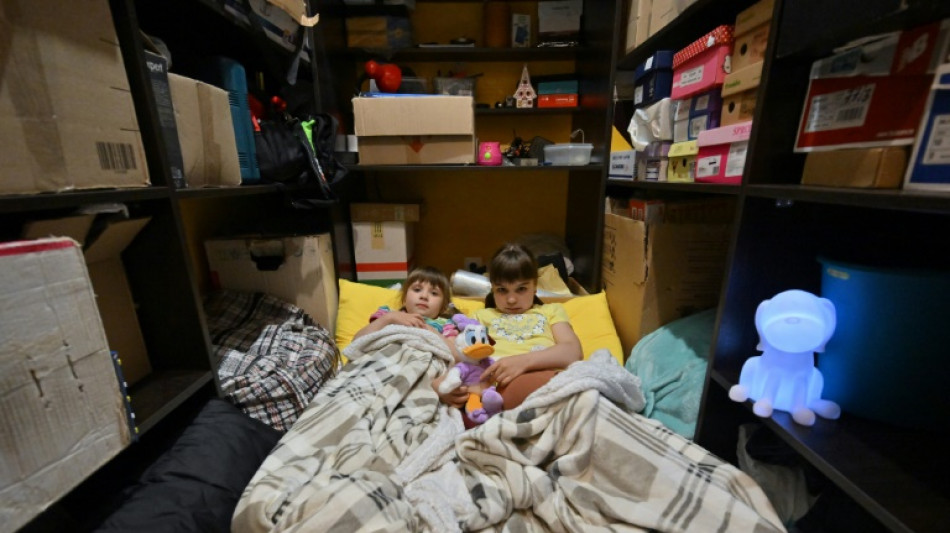
Sleeping in a closet: Kyiv adapts to Russian night strikes / Photo: © AFP

 Nepali rescuers buoyed by miracle finds but tough conditions persist

 At last: Straight sets win over Tabilo puts Zverev in US Open last 16

 Jovic 'loses sanity five times over' to oust friend Eala in US Open epic

 China's memories of Mao fade to nostalgia 50 years after his death

 US envoys discuss with Putin 'substantive' plans for steps to end Ukraine war

 Zheng stuns Keys as US Open upsets dim American hopes

 Jovic 'loses sanity five times over' to oust Eala and book Gauff clash

 'Like a jewel': Japan's luxury ice revered by bars worldwide
 'The flood is coming': How a Nepal principal saved 900 students

 Kiss's winning run ends as Argentina hold Australia to draw

 Alcaraz excited to face 'dangerous' Paul for US Open quarter-final berth

 Prince William to represent King Charles III at Norway late King Harald's funeral

 Inter and Roma roar back to win thrillers and share top spot

 Don't stop them now: fans party for Freddie Mercury's 80th birthday

 AFP photographer wins top prize for Madagascar protest coverage

 Keys: 'I felt like I couldn't play tennis'

 Simmonds stars as Pau upset Montpellier

 Inter roar back in five-goal thriller with Napoli

 Haaland keeps Man City perfect in Premier League, blunt Spurs held

 Hamilton worried by Ferrari pace while Antonelli prepares for a fight

 Vuelta stage 15 shortened due to extreme heat, Mas consolidates lead

 Putin meets US envoys for Ukraine war talks

 Modric available for Croatia in Nations League

 Potapova upsets 2025 US Open runner-up Anisimova

 Gasly a 'class act' says Alpine boss after Monza pole

At the sound of the air raid siren, two little girls quickly unroll a mattress on the ground as their mother takes her other daughter, still asleep, to a closet.
The scene is repeated in households across Kyiv on an almost nightly basis as Russian missile and drone attacks on the capital have intensified this month.
Lyudmyla Denysenko, 44, the mother of the three girls, said that at first when the siren went off, the whole family would shelter in a corner of their flat and do online activities like music classes.
But, as the night attacks became more frequent, the parents bought extra mattresses and prepared spaces where they could sleep far away from the windows.
"Everyone gets up, picks up their pillow and their blanket and goes to sleep" in a specific place, said Denysenko.
"Even if it is not very comfortable, at least the girls get enough sleep. Otherwise they could not study," she said.
The mother, who said she stops herself from being afraid for the sake of her children, sleeps in a closet with four-year-old Tusya.
Her husband shares the hallway with Katya, 10, and Tonya, seven.
The dogs sleep at their feet.
"The siren is when the missiles are flying," said Tusya. "We go to the closet. I take my toy with me."
- 'Like in Star Wars' -
Despite repeated requests from local authorities for people to use bomb shelters, Kyiv residents prefer to stay in their apartments -- usually seeking refuge in a corridor or bathroom.
Many buildings are not equipped with basements that can be used as shelters and metro stations may be too far away.
Sergiy Chuzavkov, a 52-year-old photographer, said one night he watched air defence hitting drones and missiles from his balcony "like in Star Wars".
Every night, he goes to bed very late because he monitors social media for the first signs of imminent Russian strikes.
He wakes up his wife and their 14-year-old daughter, Nastya, if he thinks the strike risk is significant.
One night this month, when Russian Kinzhal hypersonic missiles were shot down over Kyiv, the explosions were so powerful and close that Sergiy put his helmet and bullet-proof vest on his daughter as she hid in the corridor.
But Nastya said she is not afraid.
"The first night it was scary but after that I got used to it and I feel more angry at Russians than scared."
- Sedatives and heart attacks -
Every morning after the strikes, Ukrainian social media users praise air defences for downing most, if not all, the drones and missiles aimed at Kyiv.
In the first months of the invasion, only 20 to 30 percent of Russian missiles were intercepted but that number went up to 92 percent in May, according to the Ukrainian edition of Forbes magazine.
This success is due largely to donations of Western arms, including US Patriot missiles which have allowed Ukraine to intercept Kinzhal missiles.
While the destruction and losses have been minimal in Kyiv this month, the constant night-time stress is not insignificant.
"The more sirens there are, the more calls we get," said Sergiy Karas, a doctor at Kyiv's medical emergency centre.
He said the average of daily calls increased to 1,300-1,400 in May compared to around 1,000 in the preceding months.
The young suffer panic and anxiety attacks, while older people get hypertension and arythmia.
"Usually sedatives are enough but sometimes there are heart attacks or strokes," Karas said.
Each time there is a siren, single mother Olena Mazur and her five-year-old son Sasha go down to the underground car park of the building next to theirs.
They have followed this routine ever since the time their whole building shook from a series of explosions.
Sometimes they descend the stairs twice a night.
In the morning, whether they have slept or not, Olena goes to work and Sasha to kindergarten.
"We cope because we have to live," the 42-year-old accountant said, saying she wished Russians could spend "even just a week of nights like ours".
"It is not possible to hate them any more than we do already," she said.
J.Horn--BTB