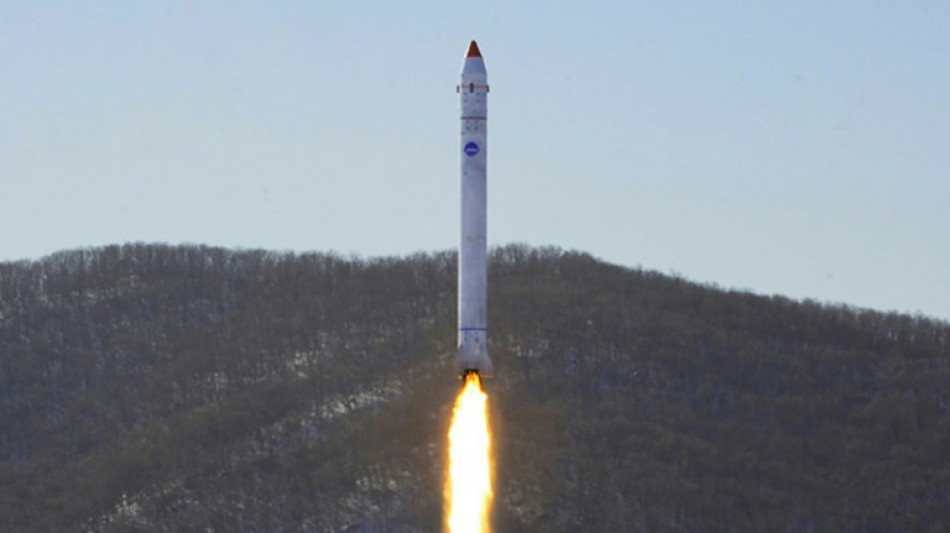
North Korea's military satellite launch: five things to know / Photo: © KCNA VIA KNS/AFP/File

 Nepali rescuers buoyed by miracle finds but tough conditions persist

 At last: Straight sets win over Tabilo puts Zverev in US Open last 16

 Jovic 'loses sanity five times over' to oust friend Eala in US Open epic

 China's memories of Mao fade to nostalgia 50 years after his death

 US envoys discuss with Putin 'substantive' plans for steps to end Ukraine war

 Zheng stuns Keys as US Open upsets dim American hopes

 Jovic 'loses sanity five times over' to oust Eala and book Gauff clash

 'Like a jewel': Japan's luxury ice revered by bars worldwide

 'The flood is coming': How a Nepal principal saved 900 students

 Kiss's winning run ends as Argentina hold Australia to draw

 Alcaraz excited to face 'dangerous' Paul for US Open quarter-final berth

 Prince William to represent King Charles III at Norway late King Harald's funeral

 Inter and Roma roar back to win thrillers and share top spot

 Don't stop them now: fans party for Freddie Mercury's 80th birthday

 AFP photographer wins top prize for Madagascar protest coverage

 Keys: 'I felt like I couldn't play tennis'

 Simmonds stars as Pau upset Montpellier

 Inter roar back in five-goal thriller with Napoli

 Haaland keeps Man City perfect in Premier League, blunt Spurs held

 Hamilton worried by Ferrari pace while Antonelli prepares for a fight

 Vuelta stage 15 shortened due to extreme heat, Mas consolidates lead

 Putin meets US envoys for Ukraine war talks

 Modric available for Croatia in Nations League

 Potapova upsets 2025 US Open runner-up Anisimova

 Gasly a 'class act' says Alpine boss after Monza pole

North Korea said Tuesday that it would launch a military reconnaissance satellite by June 11, prompting concern from Seoul, Tokyo and Washington, which claim the move would violate UN sanctions.
Kim Jong Un has made developing such a satellite a top military priority for his regime, and has personally inspected it, approving its future launch.
AFP takes a look at what we know:
Is it banned?
Kim Jong Un's regime is barred from using any ballistic missile technology by a raft of UN sanctions, including one which specifically demands North Korea "not conduct any further nuclear test or any launch using ballistic missile technology".
Pyongyang regularly flouts these restrictions -- which it describes as an infringement on its sovereignty -- and has test-fired multiple intercontinental ballistic missiles already this year.
It never gives advance warning of missile tests, but -- in line with its idea of itself as a law-abiding global power, experts say -- has previously notified international authorities of planned satellite launches.
It told Japan on Monday it would launch one between May 31 and June 11.
The issue is that the technology used for both satellite launches and ICBMs is "essentially the same," said Choi Gi-il, professor of military studies at Sangji University.
Missiles & satellites are the same?
Both satellite launches and ICBMs use rockets and "require highly advanced expertise" in similar ways, experts say.
Ballistic missiles have internal guidance systems, allowing them to exit and then re-enter the atmosphere to hit specific targets on Earth.
With a satellite launch, the rocket simply carries it to an intended height in space then separates, leaving the satellite in orbit and falling back to Earth in a shower of debris.
"For ICBMs, mastering re-entry expertise is a must to ensure a warhead isn't burnt out before hitting a target," Han Kwon-hee of the Missile Strategy Forum told AFP.
"But for satellite rockets such re-entry technology isn't necessary, as its goal is to launch a satellite above the stratosphere."
The risk of debris from the rocket is why the North informed Tokyo of its pending satellite launch, Han said.
Have they done it before?
North Korea does not have a functioning satellite in space, experts say.
Since 1998, Pyongyang has launched five satellites, three of which failed immediately and two of which appeared to have been put into orbit -- but signals from them have never been independently detected, indicating they may have malfunctioned.
The most recent satellite launch was in 2016. The following year, Pyongyang successfully test-fired its first ICBM.
"Satellites launched by North Korea in the past were effectively ICBM tests disguised as normal satellites," An Chan-il, a defector-turned-researcher who runs the World Institute for North Korea Studies, told AFP.
"The upcoming launch is being advertised by Pyongyang as a state-of-the-art satellite," he said, adding it showed the North was eager to enter "the so-called 'military space era' before Seoul does".
So it's a space race?
South Korea is yet to develop a satellite "specifically and solely for military purposes", Seoul's defence ministry told AFP, adding it plans to launch one later this year on a SpaceX rocket.
Seoul did this month successfully launch its homegrown Nuri rocket, placing working satellites into orbit for the first time.
In response, "Kim Jong Un has likely increased pressure on his scientists and engineers to launch a North Korean spy satellite," Leif-Eric Easley, a professor at Ewha University in Seoul, told AFP.
It is doubtful North Korea "has the remote sensing technologies for a proper reconnaissance satellite. However, even a rudimentary eye in the sky could have military uses and would offer domestic political value for the Kim regime".
Will it work?
"North Korea is known to have failed a number of times," Choi of Sangji University said about ICBM re-entry into the atmosphere.
However, "it is rumoured there was a transfer of know-how from Russia and China to the North, though it is not officially confirmed," he said.
Even a failed satellite launch -- like in 2016 -- shows North Korea's "capability and intentions to develop longer-range ballistic missiles", the Washington-based Center for Strategic and International Studies said at the time.
This time, Pyongyang wants to get a closer look at Seoul's defence posture, Han of the Missile Strategy Forum told AFP.
"It is an attempt by Pyongyang to show it has the capability to keep Seoul's nuclear deterrent in check with a spy satellite. They are sending this message: 'We can see you through and strike anytime.'"
B.Shevchenko--BTB