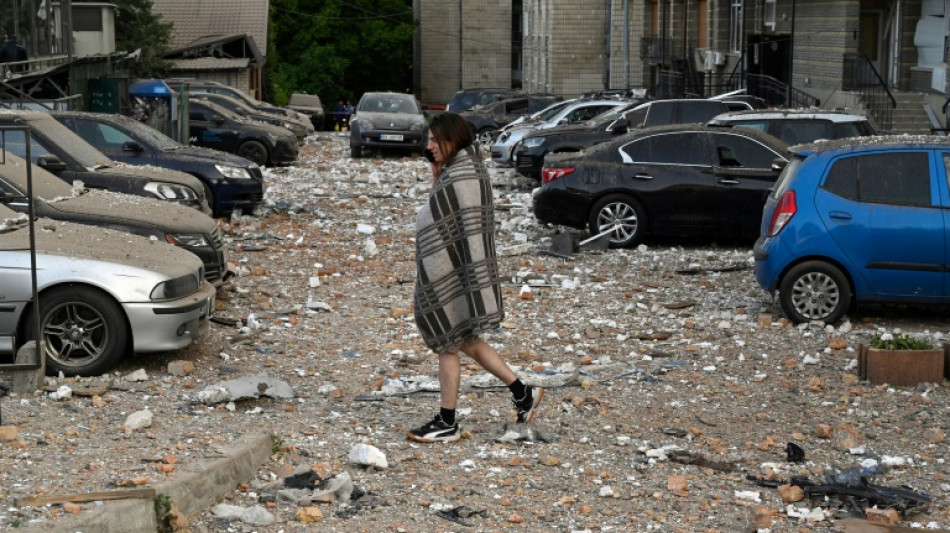
How drone warfare has evolved in Ukraine / Photo: © AFP

 US envoys hold talks with Zelensky on first Kyiv visit

 'Truly scared': Blazes outpace firefighters in Indonesian Borneo
 German director Wenders clarifies views on film and politics

 Nepali rescuers buoyed by miracle finds but tough conditions persist

 At last: Straight sets win over Tabilo puts Zverev in US Open last 16
 Jovic 'loses sanity five times over' to oust friend Eala in US Open epic
 China's memories of Mao fade to nostalgia 50 years after his death

 US envoys discuss with Putin 'substantive' plans for steps to end Ukraine war

 Zheng stuns Keys as US Open upsets dim American hopes

 Jovic 'loses sanity five times over' to oust Eala and book Gauff clash

 'Like a jewel': Japan's luxury ice revered by bars worldwide

 'The flood is coming': How a Nepal principal saved 900 students

 Kiss's winning run ends as Argentina hold Australia to draw
 Alcaraz excited to face 'dangerous' Paul for US Open quarter-final berth

 Prince William to represent King Charles III at Norway late King Harald's funeral

 Inter and Roma roar back to win thrillers and share top spot

 Don't stop them now: fans party for Freddie Mercury's 80th birthday

 AFP photographer wins top prize for Madagascar protest coverage

 Keys: 'I felt like I couldn't play tennis'

 Simmonds stars as Pau upset Montpellier
 Inter roar back in five-goal thriller with Napoli

 Haaland keeps Man City perfect in Premier League, blunt Spurs held

 Hamilton worried by Ferrari pace while Antonelli prepares for a fight

 Vuelta stage 15 shortened due to extreme heat, Mas consolidates lead

 Putin meets US envoys for Ukraine war talks

From tiny quadcopters buzzing over front-line trenches with cameras and grenades to flying bombs lugging warheads weighing dozens of kilogrammes (pounds) into Kyiv and Moscow, drones have marked the Ukraine war like none before it.
In recent months, invading Russian troops have sent waves of Iranian-made Shahed "kamikaze" drones at Kyiv and other major cities, while Ukraine has launched unmanned attacks of its own in Crimea and Russian border region Belgorod.
The Russian government even accused Ukraine on Tuesday of attacking Moscow with such devices.
Today's picture is a far cry from the hype surrounding Turkish-made Bayraktar TB2 drones in the early months of the war.
The aircraft made headlines and were praised in song for their role in smashing Moscow's armoured columns and the Black Sea fleet flagship, the Moskva.
But such models -- known as MALE, for Medium Altitude, Long Endurance -- have lost relevance as the conflict has dragged on.
"The front has stabilised and become impenetrable, as the Russians have deployed systems" to defend against attack from the air, an anonymous European defence industry source told AFP.
Now the drone war has become a numbers game.
Most suicide drones are downed by air defences, "used to force the defenders to fire their missiles and run down reserves", a senior French military source said.
"You also create terror and uncertainty at all times. Over the long term, that has value," the source added.
Eroding enemy air defence cheaply is especially vital for Russia, whose production of long-range missiles is limited to around 40 per month, analysts Jack Watling and Nick Reynolds of British defence think-tank RUSI wrote in a recent report.
Moscow's air force "launches large numbers of aircraft to increase the number of potential axes of threat... (and) to identify gaps in Ukrainian air defence" where traditional missiles could get through, they said.
Kyiv also uses "commercially available Chinese propeller-powered drones or old Soviet jet-powered reconnaissance drones" that can attack "well inside Russian territory", the European industrial source said.
- Front lines -
The vast majority of drones are smaller models used on the front lines for both reconnaissance and attack.
Ukrainian troops have published many videos on social media showing modified commercially available drones dropping bombs onto Russian soldiers' positions.
On any given 10-kilometre (six-mile) stretch of front line, "it is typical for there to be between 25 and 50 UAVs (unmanned aerial vehicles) from both sides", RUSI's Watling and Reynolds wrote.
Purpose-built Ukrainian Furia and Russian Eleron-3 drones range up to 50 kilometres, while modified commercial quadcopters -- many bought through crowdfunding -- can venture fewer than 10.
The swarms have pushed both sides into deploying electronic defences, lowering the cost of countering devices that are too cheap to be worth shooting down with pricey missiles.
Russian forces "now employ approximately one major electronic warfare system per 10km of frontage" according to RUSI, with "more specialised EW capabilities" further up the chain of command.
"The Russians have stepped up their electronic warfare game. It's a huge change," the senior French officer said.
Even individual Russian platoons are now equipped with anti-drone weapons, RUSI said, including "directional jammers and arrays for hijacking UAVs".
Anti-drone "rifles" that emit jamming signals are "the absolute basics of defence, what really works are non-portable jammers deployed close to the front line", the European industry source said.
But such "big spheres on tripods with generators" are "easily spotted and have a limited life expectancy", they added.
- High attrition -
Drone and anti-drone warfare were "a new form of combined arms combat", the French officer said.
"Just as we have infantry, cavalry and artillery, so we have drones, electronic warfare and connectivity."
With so much energy going into their destruction, most small drones "won't fly more than four or six times before being shot down", the officer added.
Ukraine has said they are losing around 10,000 drones per month across the large range of devices they use -- a figure impossible to verify that could be aimed at securing more Western aid.
If breakthroughs and counter-offensives see a return to rapidly shifting front lines, drones will remain relevant.
Ukraine could use drones to clear Russian defensive barriers in its widely trailed summer attack, for instance "to drop explosives into a minefield, literally blowing a path through", Vikram Mittal, a professor at US military academy West Point, wrote in Forbes.
Where highly mobile advancing troops get cut off, "drones could offer a method to resupply these units with the ammunition and other supplies necessary for them to continue their operations", he added.
R.Adler--BTB