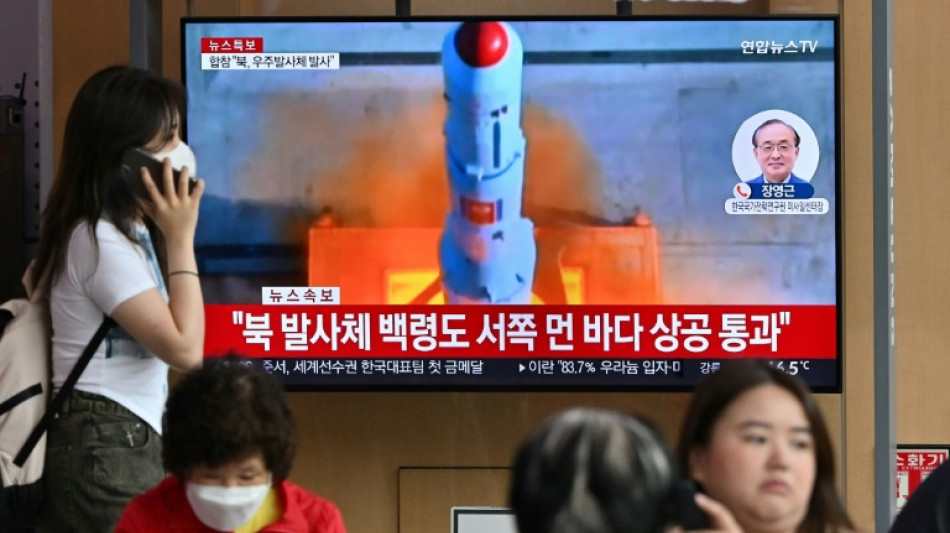
North Korea says spy satellite 'crashed into sea' / Photo: © AFP

 US envoys hold talks with Zelensky on first Kyiv visit

 'Truly scared': Blazes outpace firefighters in Indonesian Borneo

 German director Wenders clarifies views on film and politics

 Nepali rescuers buoyed by miracle finds but tough conditions persist

 At last: Straight sets win over Tabilo puts Zverev in US Open last 16

 Jovic 'loses sanity five times over' to oust friend Eala in US Open epic

 China's memories of Mao fade to nostalgia 50 years after his death

 US envoys discuss with Putin 'substantive' plans for steps to end Ukraine war

 Zheng stuns Keys as US Open upsets dim American hopes

 Jovic 'loses sanity five times over' to oust Eala and book Gauff clash

 'Like a jewel': Japan's luxury ice revered by bars worldwide

 'The flood is coming': How a Nepal principal saved 900 students

 Kiss's winning run ends as Argentina hold Australia to draw
 Alcaraz excited to face 'dangerous' Paul for US Open quarter-final berth

 Prince William to represent King Charles III at Norway late King Harald's funeral

 Inter and Roma roar back to win thrillers and share top spot

 Don't stop them now: fans party for Freddie Mercury's 80th birthday

 AFP photographer wins top prize for Madagascar protest coverage

 Keys: 'I felt like I couldn't play tennis'

 Simmonds stars as Pau upset Montpellier

 Inter roar back in five-goal thriller with Napoli

 Haaland keeps Man City perfect in Premier League, blunt Spurs held

 Hamilton worried by Ferrari pace while Antonelli prepares for a fight

 Vuelta stage 15 shortened due to extreme heat, Mas consolidates lead

 Putin meets US envoys for Ukraine war talks

North Korea launched a military spy satellite Wednesday, but it crashed into the sea soon after as an "accident occurred" during its flight, state media said.
Pyongyang does not have a functioning satellite in space and leader Kim Jong Un has made developing a military spy satellite a top priority for his regime, personally overseeing some launch preparations.
North Korean space authorities "launched a military reconnaissance satellite, 'Malligyong-1', mounted on a new-type carrier rocket, 'Chollima-1', at the Sohae Satellite Launching Ground in Cholsan County of North Phyongan Province at 6:27 on May 31," the official Korean Central News Agency reported.
But the rocket crashed into the sea "after losing thrust due to the abnormal starting of the second-stage engine after the separation of the first stage during the normal flight," it said.
Authorities will "thoroughly investigate the serious defects revealed in the satellite launch, take urgent scientific and technological measures to overcome them and conduct the second launch as soon as possible".
South Korea's military had detected the launch of the satellite, which it said disappeared from radar early and fell into the sea due to abnormal flight, the Joint Chiefs of Staff said.
North Korea on Tuesday confirmed it planned to launch what it called "military reconnaissance satellite No. 1" before June 11, having told Japan of its plans a day earlier.
Tokyo and Seoul strongly criticised the proposed launch, which they said would violate UN sanctions barring Pyongyang from any tests involving ballistic missile technology.
Because long-range rockets and space launchers share the same technology, analysts say developing the ability to put a satellite in orbit would provide Pyongyang with cover for testing banned intercontinental ballistic missiles (ICBMs).
Soon after the launch, Seoul city authorities sent an emergency text message alert to residents saying: "Citizens, please prepare to evacuate and allow children and the elderly to evacuate first" as an air raid siren sounded in central Seoul.
The alert prompted consternation and confusion on Twitter before Seoul's interior ministry minutes later said the alert had been "incorrectly issued".
- Monitoring US military -
"Kim stayed true to his word and launched the spy satellite today," Soo Kim, policy practice area lead at LMI Consulting and a former CIA analyst, told AFP.
"We know that Kim's determination does not end with this recent activity," she said, adding that the launch could be a "foreshadowing of greater provocations, including the nuclear test we have been speculating on for quite some time."
Since 1998, Pyongyang has launched five satellites, three of which failed immediately and two of which appeared to have been put into orbit -- but signals from those launches have never been independently detected, indicating they may have malfunctioned.
North Korea said Tuesday its new spy satellite would be "indispensable to tracking, monitoring... and coping with in advance in real time the dangerous military acts of the US and its vassal forces".
Criticising US-South Korea joint military exercises, including ongoing large-scale live-fire drills, a top North Korean military official said Pyongyang felt "the need to expand reconnaissance and information means and improve various defensive and offensive weapons", state media reported.
In 2012 and 2016, Pyongyang tested ballistic missiles that it called satellite launches. Both flew over Japan's southern Okinawa region.
Japan briefly activated its missile alert warning system for the Okinawa region early Wednesday, lifting it after about 30 minutes.
- 'Price and pain' -
Since diplomatic efforts collapsed in 2019, North Korea has doubled down on military development, conducting a string of banned weapons tests, including test-firing multiple ICBMs.
North Korean leader Kim Jong Un last year declared his country an "irreversible" nuclear power and called for an "exponential" increase in weapons production, including tactical nukes.
"Whether or not North Korea's current satellite mission is a success, Pyongyang can be expected to issue political propaganda about its space capabilities," Leif-Eric Easley, a professor at Ewha University in Seoul.
South Korea's foreign ministry earlier this week condemned the launch plan, saying the "so-called 'satellite launch' is a serious violation of UN Security Council resolutions banning all launches using ballistic missile technology".
F.Müller--BTB