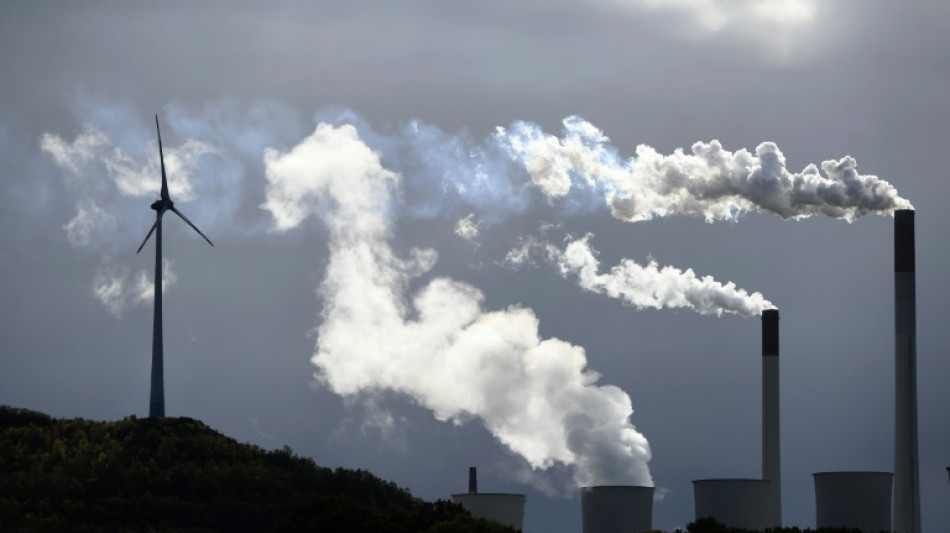
Climate: Battle lines harden over how to slash CO2 / Photo: © AFP/File

 Strasbourg hit Troyes for six as Amo-Ameyaw sparkles

 German far-right AfD landslide winner in eastern state vote

 Carrick defends Man Utd start despite defensive concerns

 More than 140 killed in latest Yemen clashes: military sources

 Van Aert claims shortened Vuelta stage 15 win in high heat

 Everton shrug off transfer window woes to hold Man Utd

 'Nothing has changed': FIFA confirms Infantino to run for re-election

 UN's Nepal chief makes emotional plea for flood-ravaged country

 Italian GP red-flagged after massive Leclerc crash

 US envoys hold talks with Zelensky on first Kyiv visit

 'Truly scared': Blazes outpace firefighters in Indonesian Borneo
 German director Wenders clarifies views on film and politics

 Nepali rescuers buoyed by miracle finds but tough conditions persist

 At last: Straight sets win over Tabilo puts Zverev in US Open last 16

 Jovic 'loses sanity five times over' to oust friend Eala in US Open epic
 China's memories of Mao fade to nostalgia 50 years after his death

 US envoys discuss with Putin 'substantive' plans for steps to end Ukraine war

 Zheng stuns Keys as US Open upsets dim American hopes

 Jovic 'loses sanity five times over' to oust Eala and book Gauff clash

 'Like a jewel': Japan's luxury ice revered by bars worldwide

 'The flood is coming': How a Nepal principal saved 900 students

 Kiss's winning run ends as Argentina hold Australia to draw
 Alcaraz excited to face 'dangerous' Paul for US Open quarter-final berth

 Prince William to represent King Charles III at Norway late King Harald's funeral

 Inter and Roma roar back to win thrillers and share top spot

Banish fossil fuels, capture their emissions, pull CO2 from thin air -- diplomats in Bonn for UN-led climate talks agree there's too much planet-warming carbon dioxide in the atmosphere, but remain at loggerheads on the best way to reduce it.
At stake is nothing less than a liveable world: even if humanity caps global warming at 1.5 degrees Celsius -- a huge 'if' -- hundreds of millions will still confront devastating heat, drought, flooding and sea level rise, recent studies have shown.
There are three ways to deal with the problem, intervening at different points in the CO2 "value chain" from source to tailpipe: stop burning fossil fuels, by far the main driver of warming; if you do burn them, stop carbon pollution from seeping into the air; and remove CO2 from the atmosphere once it's there.
"All technologies, all levers available need to be used," Simon Stiell, the head of UN Climate, told AFP as the talks in Bonn opened.
"But the science is very, very clear: the fastest and most effective way of getting us to where we need to is the phasing down and phasing out of all fossil fuels."
Politically, an informal "high ambition" coalition including the European Union (especially Germany) and scores of climate vulnerable developing countries are pushing -- to cite the Association of Small Island States (AOSIS) -- to "radically reduce fossil fuels now" through policy, regulatory and economic levers.
But major oil and gas exporters, the United States and some emerging economies are keen to shift the focus further downstream, saying the world can reduce carbon emissions without ditching the fossil fuels that generate them.
- Persistent failure -
Their standard bearer is Sultan al-Jaber, head of the Abu Dhabi National Oil Company and -- controversially -- president of the COP28 climate summit to be hosted at year's end by the United Arab Emirates.
The persistent failure over decades to cut carbon emissions -- currently 53 billion tonnes of CO2 or its equivalent per year -- has forced once marginal technologies toward centre stage.
These fall roughly into two categories that are often confused and conflated.
"Carbon capture" refers to syphoning off concentrated CO2 from the exhaust, or flue gas, of coal- and gas-fired power generation, as well as heavy industrial processes.
Once isolated, the CO2 can be used to make products ("carbon capture and utilisation" or CCU), or socked away underground in depleted oil and gas reservoirs ("carbon capture and storage" or CCS).
A crucial point: Even when CCS stores all the CO2 captured, it does not decrease the amount in the atmosphere. But only prevent more from entering.
- Potential advantages -
Carbon dioxide removal (CDR) techniques, however, do result in a net reduction in atmospheric CO2 and could, if scaled up, help lower Earth's surface temperature when we overshoots the Paris Agreement's 1.5C threshold, as seems likely.
Worldwide, CDR captures two billion tonnes of CO2 each year, according to the inaugural State of Carbon Dioxide Report.
More than 99.9 percent is extracted through "conventional" techniques such as restoring and expanding CO2-absorbing forests.
Less than 0.1 percent is removed by "novel" means, and one in particular -- direct air capture (DAC), an energy-intensive process that chemically extracts CO2 from the air -- has attracted the most attention and investment.
It's contribution to the cause is anecdotal: today, less than 20 DAC plants globally capture about as much CO2 in a year (10,000 tonnes) as the world emits in about 10 seconds.
But once upon a time scaling solar power looked as improbable, advocates note.
Indeed, the IEA's so-called "net zero emissions by 2050 scenario" assumes DAC will capture 60 Mt CO2/year by 2030. The first million-tonne plant is due to come on line next year.
DAC has potential advantages, especially compared to a troubled carbon offsets markets based on protecting or growing trees.
- 'Unknown risks' -
Forests burn down, especially in a warming world, which makes them less than permanent, a key criterion under UN rules.
A tonne of mechanically extracted carbon stored underground is easily measured and monitored. Not so for forest-based credits, which are notoriously subject to cheating and dodgy accounting.
Last month Zimbabwe sent a shudder through the $2 billion offsets market by announcing it would appropriate half of all the revenue generated from offsets on its land, exposing another vulnerability.
The small but burgeoning DAC industry was itself thrown into turmoil last week by a 100-page UN "information note" on which removal techniques might be recognised under carbon market accounting rules still in the making.
The aggressively dismissive note said "engineering-based removal activities are technologically and economically unproven, especially at scale, and pose unknown environmental and social risks."
Pushback was sharp, with scores of carbon removal start-ups and several independent research groups pointing out glaring scientific inaccuracies underlying the report.
"This tells us that there's a lot of money at stake as to which technologies are given the green light," noted Alden Meyer, a senior policy analyst at climate think tank E3G.
- 'Residual emissions' -
So what's the right balance between reducing fossil fuel use and finding ways to scrub CO2 from industrial processes and the air?
"Machine based removal is simply unlikely to work at any meaningful scale," scientist Jonathan Foley, executive director of Project Drawdown, which evaluates the potential of mitigation solutions, told AFP.
"Ninety-five percent of what we need to do is cut emissions," he said. "Five percent is carbon removal, and 90 percent of that should be nature based removal such as ecological restoration and regenerative agriculture."
But those ratios are not in line with the long-term national strategies for reaching net zero emissions by 2050, according to a recent study in Nature Climate Change.
Most wealthy countries still allow for large "residual emissions" when they hit net zero -- on average, 18 percent of current emissions -- on the assumption that technology will be available to capture and remove them by then.
A.Gasser--BTB