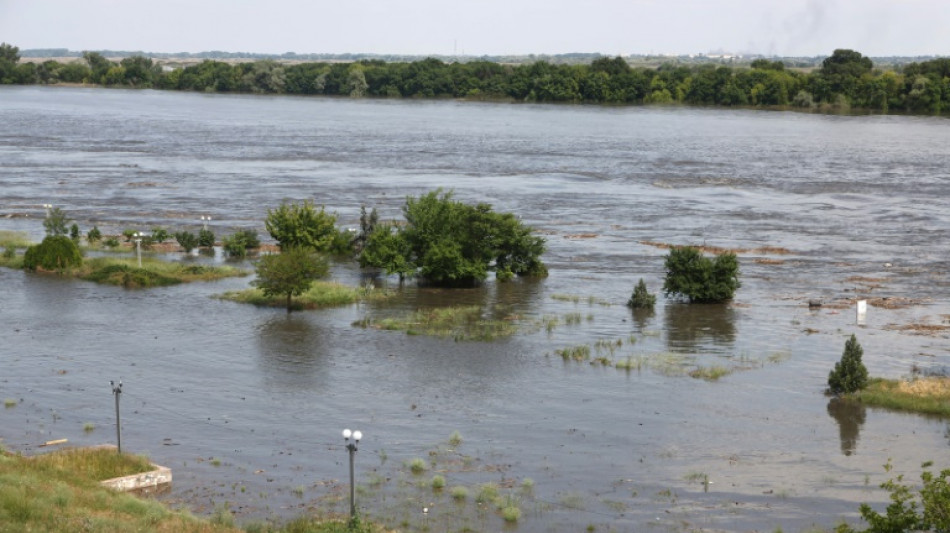
Destroyed dam likely to hinder Ukraine before Russia / Photo: © AFP

 Strasbourg hit Troyes for six as Amo-Ameyaw sparkles

 German far-right AfD landslide winner in eastern state vote

 Carrick defends Man Utd start despite defensive concerns

 More than 140 killed in latest Yemen clashes: military sources

 Van Aert claims shortened Vuelta stage 15 win in high heat

 Everton shrug off transfer window woes to hold Man Utd

 'Nothing has changed': FIFA confirms Infantino to run for re-election

 UN's Nepal chief makes emotional plea for flood-ravaged country

 Italian GP red-flagged after massive Leclerc crash

 US envoys hold talks with Zelensky on first Kyiv visit

 'Truly scared': Blazes outpace firefighters in Indonesian Borneo

 German director Wenders clarifies views on film and politics

 Nepali rescuers buoyed by miracle finds but tough conditions persist

 At last: Straight sets win over Tabilo puts Zverev in US Open last 16

 Jovic 'loses sanity five times over' to oust friend Eala in US Open epic
 China's memories of Mao fade to nostalgia 50 years after his death

 US envoys discuss with Putin 'substantive' plans for steps to end Ukraine war

 Zheng stuns Keys as US Open upsets dim American hopes

 Jovic 'loses sanity five times over' to oust Eala and book Gauff clash

 'Like a jewel': Japan's luxury ice revered by bars worldwide

 'The flood is coming': How a Nepal principal saved 900 students

 Kiss's winning run ends as Argentina hold Australia to draw
 Alcaraz excited to face 'dangerous' Paul for US Open quarter-final berth

 Prince William to represent King Charles III at Norway late King Harald's funeral

 Inter and Roma roar back to win thrillers and share top spot

The gaping hole blasted into a key hydroelectric dam in southern Ukraine on Tuesday will severely impede Kyiv's efforts to reconquer territory lost to Russia, even if Moscow risks seeing its defensive lines submerged.
Moscow and Kyiv traded blame for the damage to the Kakhovka dam, which is designed to supply water to the Crimean Peninsula, annexed by Moscow in 2014, which could now be facing serious water supply problems.
But Western observers believe the sabotage is a Russian attempt to harm Kyiv in the short term, just as Ukraine prepares to launch a counteroffensive to regain areas in the east.
Kyiv shares the same view, having accused Russia of having "blown up" the dam in order to "slow down" its operation.
Floods have already forced thousands to evacuate and risks interrupting ongoing Ukrainian military operations.
The rising water in the Kherson region will make it very difficult for Ukraine forces to carry out any operation involving crossing the river to reclaim the eastern bank, in the direction of Crimea.
"Following the logic of cui bono [who benefits], Russia would be the obvious culprit, since by causing floods downstream of Nova Kakhovka, the Russians would complicate Ukraine's efforts to cross, winning time, which would allow them to focus on other sections of the front," said Sergey Radchenko, a history professor at Johns Hopkins School of Advanced International Studies, in a Twitter post.
"I can't see anything near beneficial to Ukraine in this case. More destroyed infrastructure, more downed electricity production facilities, more suffering for Ukrainian civilians, a limitation of Ukrainian offensive and logistics options," said Stephane Audrand, an independent consultant on international risks.
- Floods as a weapon of war -
The risk of strikes on the strategic Kakhovka facility, located in the Russian-occupied areas of the Kherson region, has been brandished since October by both Ukrainians and Russians.
Ukraine President Volodymyr Zelensky accused Moscow of having "undermined the dam", one of the largest in Ukraine. Russian authorities retorted: "lies".
Destruction of this magnitude, likely to cause considerable harm to civilians, is considered a war crime under the 1949 Additional Protocols to the Geneva Convention.
"Dams, dykes and nuclear electrical generating stations, shall not be made the object of attack, even where these objects are military objectives, if such attack may cause the release of dangerous forces and consequent severe losses among the civilian population," according to Article 56.
Contemporary history offers many examples of the destruction of dams and floods in Europe for defensive and offensive purposes.
In 1941, the Soviet Union blew up a huge dam in Ukraine's Zaporizhzhia to slow the German advance.
In May 1943, the British Royal Air Force bombed German dams in the Ruhr valley, the country's industrial heartland.
Carried out by the RAF squadron 617 -- which earned the nickname "Dambusters" -- this operation destroyed two of three dams and damaged the third.
The effort was immortalised in the 1955 film "The Dam Busters".
The flooding tactic was also practised in the First World War.
In the autumn of 1914, during the Battle of Yser, French and Belgian forces unleashed floods to slow the advance of German troops who were attempted in cross the Yser River toward Dunkirk.
The flooding was orchestrated by tampering with the system of locks in Nieuwpoort, which regulates the influx of seawater and drainage to flood plains.
K.Brown--BTB