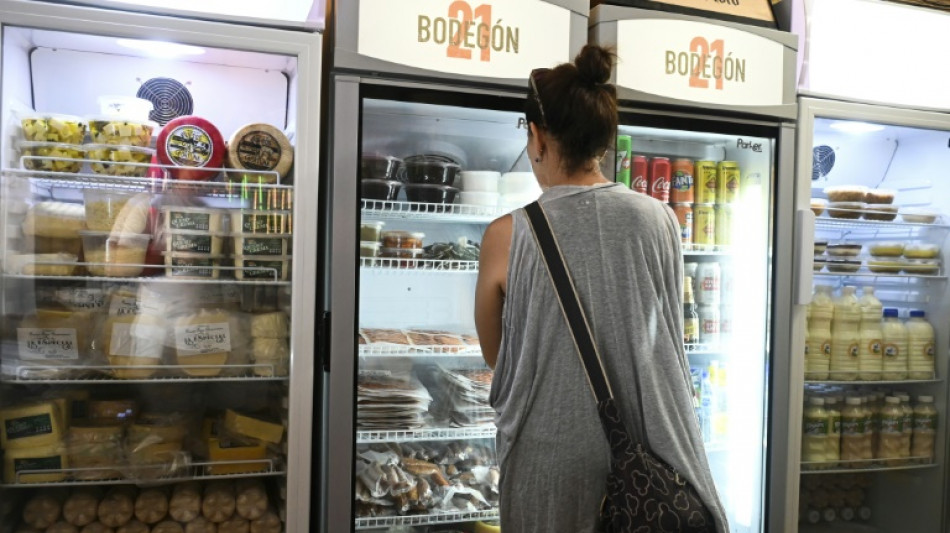
Small shops boom as Cuban private sector takes hold / Photo: © AFP

 Zelensky warns war likely to continue into winter after US talks

 Arsenal deliver statement fightback to end Chelsea's flying start

 Leclerc accepts blame as Hamilton laments Ferrari approach

 Sabalenka surges past Townsend to reach US Open quarter-finals

 Smiling face of Germany's far-right AfD: Ulrich Siegmund

 Lebanon president calls for US help as Israeli strikes kill 7

 Yamal hits double as perfect Barca thrash Valencia

 Venice festival turns gaze on war reporters, media industry

 Sensational Antonelli wins Italian GP from back of grid
 Susan Sarandon says still losing roles over Gaza stance

 US envoys hold 'important' talks in first trip to Kyiv

 Championship leader Antonelli wins Italian Grand Prix

 Vardy signs for Championship strugglers Burnley

 FIFA confirms Infantino will run in presidential election

 With joy and grief, Palestinian football marks return

 Iran threatens greater force if US launches more attacks

 Vandals uproot Berlin tree commemorating Pride attack victims

 Trump envoys arrive in Kyiv for first Ukraine visit
 Indonesia's main airport suspends operations after volcanic eruption

 US aircraft carrier departs Thailand after port call

 Haze emergency grips Malaysian Borneo town
 Messi creates both Miami goals in 2-2 draw with Atlanta

 Rybakina books US Open fourth-round berth, inches closer to No. 1

 Sobering reality: Curbs on alcohol in northeast Syria cause discontent

 Wobbly Osaka 'shocked' to battle past Mertens and reach last 16

Like mushrooms after the rain, small stores are springing up all over Havana, many run from homes or garages as the private sector finally gains a foothold in communist Cuba.
Small businesses, only authorized in 2021, are mounting a challenge to companies run by the one-party state which are emptier every day as Cuba battles a shortage of foreign currency and sky-high inflation amidst its worst economic crisis in 30 years.
From garages, porches or small rented shops, Cubans sell anything from beers and sweets, meat, dairy and groceries that are becoming increasingly difficult to find elsewhere.
"If you need something you can't find (in the state-run stores), they have it! They have the things you need," client Maria Leonor, 73, told AFP as she emerged from one of the new private outlets.
After six decades of exclusively state-owned commerce, in August 2021 the government approved a law approving small and medium enterprises.
The sea change came as Cuba reeled from the after-effects of the Covid-19 pandemic, which flattened its critical tourism industry, and the tightening of US sanctions.
- Yogurt on the menu -
At the neighborhood store "El Bodegon 21," a colorful array of products are arranged prettily on wooden shelves -- a stark contrast to the monotony of indistinguishable cans and empty refrigerators in grey-hued state shops.
For customers like Leonor, these new stores offer a chance to find products, like yogurt, missing from the official market.
An added benefit: Cubans can buy at the private stores with the local peso while government stores require payment in foreign currency, which is hard to come by.
But the downside, prices are "quite high," said Leonor.
A kilogram of milk powder sells in a small private store for about 2,000 pesos (some $16) -- just less than half the average monthly salary.
Before, it was only available on the black market, long absent from government shops or the "bodegas," outlets where Cubans have access to a limited selection of subsidized products through ration books.
In May 2022, US President Joe Biden had pledged to "increase support for independent Cuban entrepreneurs" and help the private sector grow.
A year later, last month, hundreds of Cuban tradespeople sent the American leader a letter urging him to follow through on this promise.
They asked him for non-immigrant visas to permit them to travel and acquire supplies, to allow access to payment platforms like PayPal, the right to set up US bank accounts, and the reopening of US tourist travel to Cuba.
- Mission: 'generate wealth' -
Omar Bouso, 27, is among those trying to make a living under the new rules that have given rise to some 7,800 private SMEs in almost two years.
He lost his work in a restaurant that closed during the pandemic, then opened a Hawaiian fast-food restaurant with two friends, which they run from a private home.
"We found a niche in the market to do something different," he told AFP.
Entrepreneurs like Bouso get their goods from private import companies that did not exist until recently.
According to a recent UN report, about 22 percent of Cuban small enterprises are in construction, 19 percent in gastronomy and tourist accommodation, 12 percent in industrial food production and under three percent in trade.
Inflation, which the government estimates will reach 39 percent in 2023 but analysts say will surpass 100 percent, hits the public and private sectors alike.
Economy Minister Alejandro Gil recently sought to clear the government of blame for high prices.
In a parliamentary session, he pointed the finger at the private sector, saying: "We are not expecting of anyone to work at a loss, but it is not possible to make a fivefold profit so fast."
Gil also defended state-owned companies, which he said "are not making a profit and pay minimum salaries so as not to increase prices to the population."
The state sector continues to carry the economy and employ almost two-thirds of workers, according to a regional UN commission.
Oniel Diaz, founder of private business consultancy Auge, said many of Cuba's problems can be addressed with responsible regulation, but stressed that the very purpose of small business will always be to "generate wealth."
J.Fankhauser--BTB