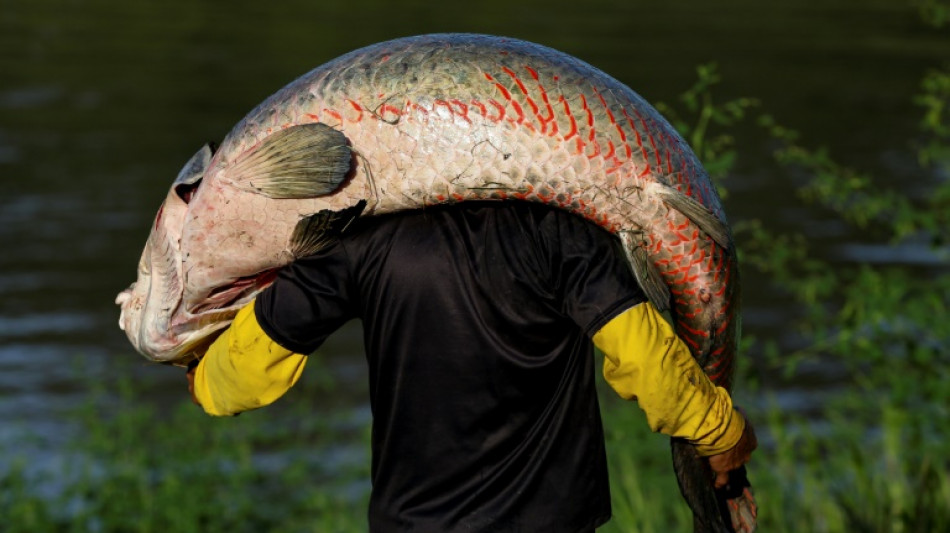
Pirarucu: Amazon's giant air-breathing fish in poachers' sights / Photo: © AFP

 Zelensky warns war likely to continue into winter after US talks

 Arsenal deliver statement fightback to end Chelsea's flying start

 Leclerc accepts blame as Hamilton laments Ferrari approach

 Sabalenka surges past Townsend to reach US Open quarter-finals

 Smiling face of Germany's far-right AfD: Ulrich Siegmund

 Lebanon president calls for US help as Israeli strikes kill 7

 Yamal hits double as perfect Barca thrash Valencia

 Venice festival turns gaze on war reporters, media industry

 Sensational Antonelli wins Italian GP from back of grid
 Susan Sarandon says still losing roles over Gaza stance

 US envoys hold 'important' talks in first trip to Kyiv

 Championship leader Antonelli wins Italian Grand Prix

 Vardy signs for Championship strugglers Burnley

 FIFA confirms Infantino will run in presidential election

 With joy and grief, Palestinian football marks return

 Iran threatens greater force if US launches more attacks
 Vandals uproot Berlin tree commemorating Pride attack victims

 Trump envoys arrive in Kyiv for first Ukraine visit

 Indonesia's main airport suspends operations after volcanic eruption

 US aircraft carrier departs Thailand after port call

 Haze emergency grips Malaysian Borneo town

 Messi creates both Miami goals in 2-2 draw with Atlanta

 Rybakina books US Open fourth-round berth, inches closer to No. 1

 Sobering reality: Curbs on alcohol in northeast Syria cause discontent

 Wobbly Osaka 'shocked' to battle past Mertens and reach last 16

A fish larger than a man, tasty as well as beautiful, the freshwater pirarucu is a favorite with poachers in a lawless part of the Amazon jungle where Brazil, Peru and Colombia meet.
Prized for its skin as much as its flesh, the pirarucu has long been a staple for Indigenous people who hunt the air-breathing fish in lakes in the Javari Valley.
But it has also become a much sought-after protein on the menus of gastronomic and fusion restaurants in Rio, Bogota and Lima -- its rising popularity pushing up prices and raising the stakes for Amazon dwellers.
The growing appetite for pirarucu is blamed for the deaths last year of Indigenous rights defender Bruno Pereira and British journalist Dom Phillips at the hands of fish poachers who hacked up the pair's bodies and hid the remains in the jungle.
In Brazil's Amazonas province, pirarucu harvesting is strictly regulated.
In the Javari Valley which holds the country's second-largest protected Indigenous reserve -- home to seven tribes including the Kanamari -- only residents may hunt it.
Yet, "they are stealing from us!" said Joao Filho Kanamari, an Amazon resident who takes his last name from his tribe which comes into regular conflict with intruders in pursuit of the prized fish.
- 'Cow of the Amazon' -
For the Kanamari, the story of the pirarucu is that of "a tree leaf that fell into the water and became a giant fish," tribal chief Mauro da Silva Kanamari told AFP.
"Arapaima gigas" by its scientific name, the pirarucu is one of the largest freshwater fish on the planet.
It is a weird-looking creature with a pink, tapered tail, awkwardly-flattened head and globular eyes reminiscent of a prehistoric monster.
An omnivore, the pirarucu can grow up to three meters (9.8 feet) long and weigh over 200 kilograms (440 pounds.)
Caught with nets and harpoons, the giant fish is relatively easy to spot and kill as it needs to surface to breathe about every 20 minutes.
Known lovingly to locals as "the cow of the Amazon," presumably for its ability to feed many at a time, the pirarucu is also versatile: its skin is used for exotic leather products -- shoes, bags or wallets.
Pirarucu scales, reputedly resistant to piranha teeth, are sold to tourists as key chains.
Subject to overfishing in the Brazilian Amazon, the pirarucu all but disappeared in the 1990s until the government introduced fishing restrictions.
- 'Fished like crazy' -
In 2017, a project was started in the Javari Valley with the help of an Indigenous NGO called CTI to ensure the community will be able to continue harvesting pirarucu for a long time to come. Sustainably.
The project is managed by the Kanamari themselves, who have voluntarily limited their own catches of pirarucu and agreed not to sell any for five years.
"The idea is that the natives can feed themselves, provide for their needs, all while protecting their territory," said CTI spokesman Thiago Arruda.
The project also involves patrols to spot and report poachers -- a risky endeavor that can bring the tribespeople in contact with illegal fishermen, often armed.
"The project is very important for us," said Bushe Matis, coordinator of the Union of Indigenous Peoples of the Javari Valley (Univaja.)
"Before people fished like crazy. From now on we will take care of the lakes and fishing areas, so that we will always have fish in the future."
A stocktake will occur within weeks, and if fish numbers have recovered sufficiently, the Kanamari will be able to start selling again.
But there are obstacles ahead: the community still has to set up a cold chain to get the fish safely to clients from all the way inside the bowels of the jungle, and decide how to split the proceeds.
Some fear the opening to sales could expose the Indigenous jungle dwellers to a whole new kind of risk.
According to one project promoter, who asked not to be named, there is a danger of local politicians or businessmen "not necessarily well-intentioned and probably involved in illegal fishing networks" working their way into the system.
J.Fankhauser--BTB