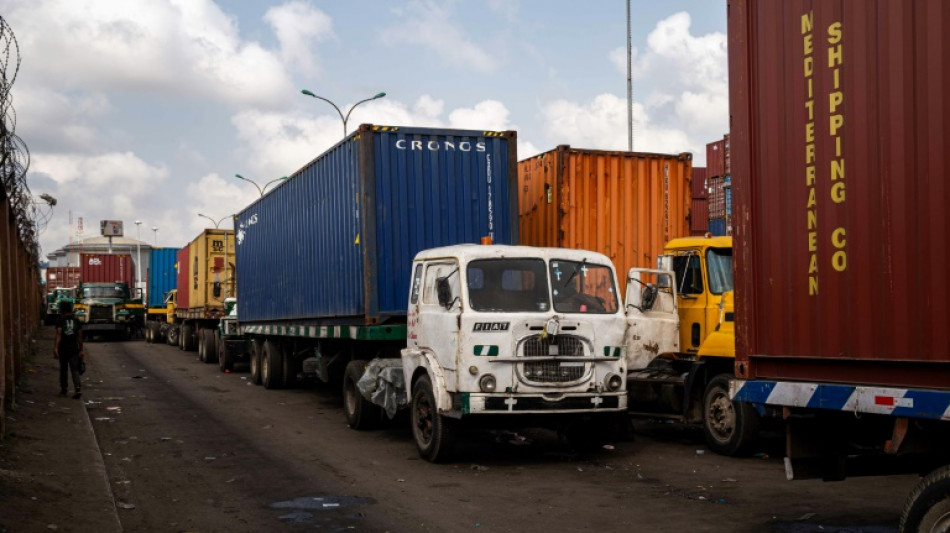
African business leaders chafe at obstacles to trade / Photo: © AFP/File

 Zelensky warns war likely to continue into winter after US talks

 Arsenal deliver statement fightback to end Chelsea's flying start

 Leclerc accepts blame as Hamilton laments Ferrari approach

 Sabalenka surges past Townsend to reach US Open quarter-finals

 Smiling face of Germany's far-right AfD: Ulrich Siegmund

 Lebanon president calls for US help as Israeli strikes kill 7

 Yamal hits double as perfect Barca thrash Valencia

 Venice festival turns gaze on war reporters, media industry

 Sensational Antonelli wins Italian GP from back of grid
 Susan Sarandon says still losing roles over Gaza stance

 US envoys hold 'important' talks in first trip to Kyiv

 Championship leader Antonelli wins Italian Grand Prix
 Vardy signs for Championship strugglers Burnley
 FIFA confirms Infantino will run in presidential election

 With joy and grief, Palestinian football marks return

 Iran threatens greater force if US launches more attacks
 Vandals uproot Berlin tree commemorating Pride attack victims

 Trump envoys arrive in Kyiv for first Ukraine visit
 Indonesia's main airport suspends operations after volcanic eruption

 US aircraft carrier departs Thailand after port call

 Haze emergency grips Malaysian Borneo town
 Messi creates both Miami goals in 2-2 draw with Atlanta
 Rybakina books US Open fourth-round berth, inches closer to No. 1

 Sobering reality: Curbs on alcohol in northeast Syria cause discontent

 Wobbly Osaka 'shocked' to battle past Mertens and reach last 16

More than four years ago, African countries gave the ceremonial push to a deal to scrap internal trade barriers -- a historic scheme that would create a continent-wide single market worth trillions of dollars.
But African business leaders say cross-border trade remains entangled in customs duties, administrative hurdles and varying national regulations.
Costs and delays are hampering African corporations fighting to compete with low-cost rivals, they say.
"Each country has its own laws -- it's very complex," Jeremy Awori, head of Ecobank, a bank that operates in 30 countries, said at a business conference in Abidjan this week.
The African Continental Free Trade Area (AfCFTA) was signed in 2019 by 54 out of the African Union (AU)'s 55 states, who together accounted for GDP last year of $3 trillion.
It formally began operations on January 1, 2021 with the goal of achieving 90 percent cuts in tariffs within five to 10 years.
The International Monetary Fund (IMF) says this would unlock a real increase of 10 percent in per-capita GDP and a 50-percent rise in intra-African commerce.
To give one example of the potential gains, an AU study in 2014 found that sending a vehicle from Japan to Ivory Coast was three times cheaper than sending the same vehicle from Ivory Coast to Ethiopia.
But AfCFTA faces an uphill task.
Its secretary-general, South African trade expert Wamkele Mene, told the Africa CEO Forum that "fragmentation" in the continent's market had worsened in the past decades.
"Every African activity has been negatively impacted by this fragmentation," he said.
He gave the example of a company that had subsidiaries in Rwanda and neighbouring eastern Democratic Republic of Congo.
The subsidiaries are separated by just 20 kilometres (12 miles) but have to use a bank in New York for transferring money.
- Costly barriers -
Customs duties, which for many countries account for a huge chunk of government income, can sometimes exceed 50 percent.
Non-tariff barriers such as lengthy waits at borders or filling out forms are other major, but hidden, costs for corporations.
The problems are having an impact on African companies competing with developing-country counterparts facing lower or even zero hurdles.
Around 350 African companies today have turnover of more than a billion dollars, a fall of six percent since 2015, compared to 210 in Latin America and 170 in India, tallies that have risen by almost a third over the same period.
"By 2050, 40 percent of the (world's) population will be African. We have to help our future champions find their place in global value chains," said Ivorian Prime Minister Patrick Achi.
"Infra-African trade has to develop -- it only accounts for 20 percent of trade volume today. The single market is a very important tool," said Olivier de Noray, director for ports and terminals in freight and transportation company Africa Global Logistics.
The Covid pandemic highlighted Africa's dependence on Western-made vaccines and Asian-made protective gear.
It was followed by the Ukraine war, which demonstrated Africa's need to import Russian and Ukrainian grain.
"If we don't learn from polycrises like this, shame on us," said Awori.
"We could be self-sufficient in food, in fertilisers, and not to worry about where we are getting our wheat from."
C.Kovalenko--BTB