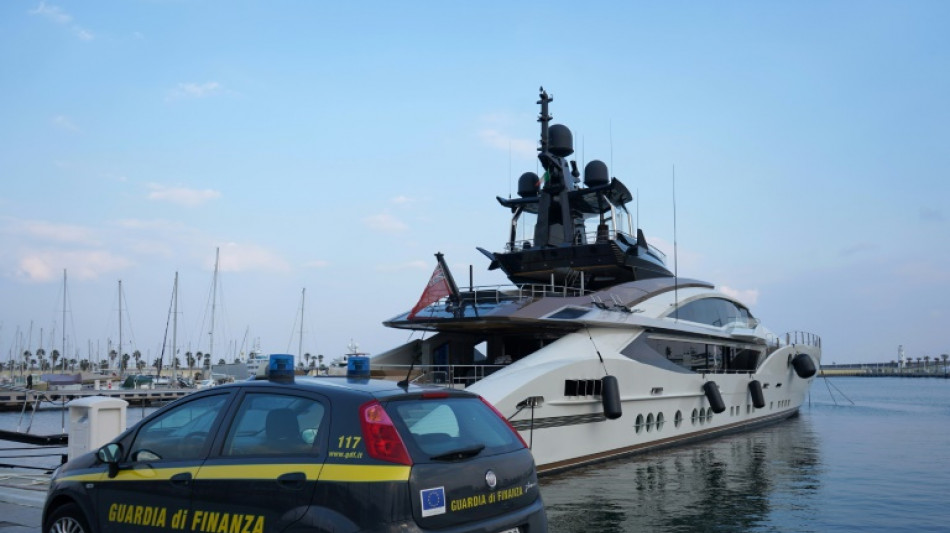
The quest to seize Western assets of Russian oligarchs / Photo: ©

 Israel blames Turkey after strike on Syria air base
 Trump, Carney talk as Canada seeks to hold off new US tariffs
 NASA images reveal crater left by SpaceX rocket's Moon crash
 UN atomic watchdog says found tons of nuclear material at Syria site
 Ecuadoran diplomat enters race to be next UN chief
 US sanctions ICC chief Tomoko Akane of Japan
 US moves to open vast tracts of pristine forests to logging
 US sanctions International Criminal Court chief Tomoko Akane of Japan
 Meta hooked children and misled public: prosecutors
 France's first women's rights minister Yvette Roudy dies, aged 97
 French producer Nicolas Altmayer, Dior PR chief Favier die in car crash
 Bezos consortium bought nearly 40 percent of Liverpool: report
 Trump says no Iran talks planned, claims Hormuz 'new US territory'
 Canada seeks to avert new US tariffs as deadline looms
 US primaries test Democrat comeback hopes in Trump stronghold
 Scientists discover how narwhals grow nature's only straight tusk
 DR Congo Ebola outbreak 'far from being under control': WHO chief
 Firefighters in 'decisive' push to encircle Belgian wildfire
 Tribal Partners with ServiceNow to Empower Enterprise Teams to Build and Deploy Apps & Agents

 Fusion Markets Extends Negative Balance Protection to Clients Globally
 India close on victory in first Test against Sri Lanka
 Three lightly injured as new quake hits Spain's Granada
 Syria, US say Israel struck military air base in Idlib province
 France probes Russian disinfo campaign against centrist candidates
 Stocks mostly drop as Mideast hopes dim, interest rates rise
Western seizures of super-yachts owned by Russian oligarchs have made headlines as Vladimir Putin's inner circle is targeted over the invasion of Ukraine, but experts warn identifying and blocking further cash and assets will prove difficult.
The European Union, UK and US have all trumpeted unprecedented sanctions against key figures in the Moscow elite.
Even countries long known for harbouring assets with few questions asked, such as Switzerland and Monaco, have joined in with the measures.
On the still-growing sanctions lists, hundreds of people including lawmakers, high-ranking military officers, prominent journalists, tycoons and finance chiefs have been targeted.
As well as asset freezes, the measures can sometimes include bans from sanctioning nations' territory.
High-profile individuals affected include Nikolay Tokarev, the president of oil and gas giant Transneft, Rostec defence firm chief Sergei Chemezov or VEB development bank head Igor Shuvalov.
Washington would "find and seize their yachts, their luxury apartments, their private jets," US President Joe Biden warned in last week's State of the Union address.
"We're coming for your ill-begotten gains."
French Finance Minister Bruno Le Maire said that oligarchs' "partners, their children, their property holding companies" would be affected, "such that they won't be able to hide behind financial constructs".
Many wealthy individuals use complex ownership structures to minimise tax bills or obfuscate the true owner of an asset.
Besides the very richest oligarchs close to Putin, "there's a sort of hinterland of maybe two to three thousand individuals... they are also very, very rich financially... and they are all related and supported by the Putin regime," said Robert Barrington, Professor of Anti-Corruption Practice at Britain's University of Sussex.
- Hidden billions -
The UK has been one of the Western nations most favoured by Russians stashing away their wealth in financial assets or real estate, earning the capital the derogatory nickname "Londongrad".
On top of high-end residential property, London also offers facilities like the vast legal and wealth management resources of the City and world-renowned boarding schools and universities for the scions of the rich.
Barrington said that around 1.5 billion pounds ($1.9 billion, 1.8 billion euros) of London property ownership in desirable areas like Kensington, Chelsea and Hampstead had been traced to oligarchs, likely only a fraction of the total.
"Luxury property is a preferred means of laundering money stemming from corruption or embezzlement of public funds," said Sara Brimbeuf of Transparency International France.
A short hop from Britain, France too "hosts these ill-gotten gains", piling up on the sun-soaked southern coast and in high-end districts of western Paris or Alpine resorts.
Properties in Mediterranean spots like Nice and St Tropez have been traced to oligarchs close to Putin and already targeted by sanctions.
But none of the experts AFP spoke to was able to estimate the scale of the Russian elite's Western holdings.
- Wealth industry -
When it comes to managing their money, oligarchs "don't actually do the stuff themselves," said Jodi Vittori, a professor specialising in corruption at the University of Georgetown in the US.
"They have a team of enablers that does this for them. They're the lawyers, the accountants and art dealers."
Transparency's Brimbeuf said that "not all of them do what they're supposed to" when it comes to reporting suspect assets or transactions to the authorities -- "even though they're subject to anti-money laundering requirements" in the laws of many Western nations.
Last month, a consortium of investigative journalists alleged that Swiss bank Credit Suisse had for decades held billions of euros of money in accounts of criminals, dictators and rights abusers and failed to meet its reporting obligations.
The bank itself rejected the claims.
Identifying the real origin and ownership of assets can be arduous, painstaking work picking through shell companies and complex structures.
"It would need a significant mobilisation by intelligence services" to identify much of the hidden wealth, said Julien Martinet, a lawyer at French firm Swiftlitigation.
In France, only one major seizure has made headlines since sanctions were imposed -- the super-yacht Amore Vero linked to Rosneft boss Igor Sechin, believed to be worth up to 120 million euros.
Meanwhile Italy on Saturday said it had seized yachts belonging to steel magnate Alexei Mordashov and Putin confidant Gennady Timchenko, worth 95 million and 50 million euros respectively.
But experts recall that it has only been days since the sanctions have been imposed, with wealth probes sometimes requiring years to complete.
- Task force -
US Attorney General Merrick Garland has already announced the creation of a task force to pursue oligarchs' assets dubbed "KleptoCapture", numbering 10 prosecutors as well as federal investigators and tax specialists.
Similar operations have been mounted in other Western countries including France, while online amateurs are also pitching in.
US teenager Jack Sweeney has set up the Russian Oligarch Jets Twitter account to track the elite's private planes.
Beyond identifying and freezing assets, seizing them outright presents even higher legal hurdles.
For example, in France "infringing on property law requires a law, not just a regulation or a decree" from the government, lawyer Martinet said.
A senior official in France's own oligarch task force said that they were able to seize the Amore Vero super-yacht only because its crew attempted to depart for Turkey, "placing themselves outside the law".
- Scramble for safety -
Many Russian billionaires have already moved their floating palaces to safer waters, with rumours coursing about upcoming moves away from the Cote d'Azur, according to a source familiar with the industry.
The source mentioned Dubai as one possible destination, while the Maldives -- which have no extradition treaty with the US -- are also now hosting several yachts, including those belonging to aluminium magnate Oleg Deripaska and steel tycoon Alexander Abramov.
On land, there has been little sign of a sudden flight from property in southern France.
But in London, billionaire Roman Abramovich has put his stake in Chelsea football club up for sale, promising to put the profits towards helping victims of the war in Ukraine.
Abramovich, the co-founder of aluminium giant Rusal, grew rich in the 1990s as Russia privatised former Soviet state industries and his wealth is now estimated at over $12 billion by Forbes.
He is close to Putin but has yet to be targeted with sanctions.
Also in Britain, financier Mikhail Fridman withdrew from the LetterOne investment firm that he co-founded and from all the European firms where he holds a stake.
Both he and his partner Petr Aven have been targeted by sanctions, but deny any "financial or political relationship" with Putin.
In a letter to his LetterOne employees, Fridman told staff last week that "war can never be the answer" and called for the "bloodshed" to end.
O.Bulka--BTB