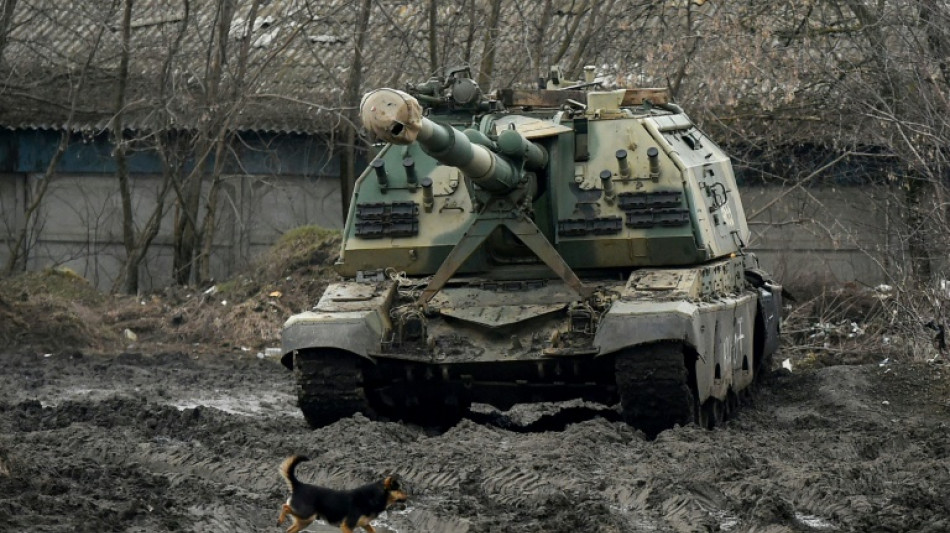
Ukraine thaw could slow Russian advance in mud / Photo: ©

 'American Doctor' shows brutality of conflict in Gaza

 New Zealand blocks lawsuits against firms over climate harm

 Aussie Rules club suspends five players amid police probe
 No.1 Sabalenka slams Wang to power ahead in Cincinnati
 Israel blames Turkey after strike on Syria air base
 Trump, Carney talk as Canada seeks to hold off new US tariffs
 NASA images reveal crater left by SpaceX rocket's Moon crash
 UN atomic watchdog says found tons of nuclear material at Syria site
 Ecuadoran diplomat enters race to be next UN chief

 US sanctions ICC chief Tomoko Akane of Japan
 US moves to open vast tracts of pristine forests to logging
 US sanctions International Criminal Court chief Tomoko Akane of Japan
 Meta hooked children and misled public: prosecutors

 France's first women's rights minister Yvette Roudy dies, aged 97

 French producer Nicolas Altmayer, Dior PR chief Favier die in car crash
 Bezos consortium bought nearly 40 percent of Liverpool: report
 Trump says no Iran talks planned, claims Hormuz 'new US territory'
 Canada seeks to avert new US tariffs as deadline looms

 US primaries test Democrat comeback hopes in Trump stronghold
 Scientists discover how narwhals grow nature's only straight tusk

 DR Congo Ebola outbreak 'far from being under control': WHO chief

 Firefighters in 'decisive' push to encircle Belgian wildfire
 Tribal Partners with ServiceNow to Empower Enterprise Teams to Build and Deploy Apps & Agents

 Fusion Markets Extends Negative Balance Protection to Clients Globally
 India close on victory in first Test against Sri Lanka

Having failed to make a decisive advance in the early phase of its Ukraine campaign, the Russian army is now facing a thaw that could make progression on key routes problematic due to mud.
Like the armies of Napoleon and Hitler before them, Russian mechanised divisions are likely to be slowed down or halted as unpaved roads become treacherous quagmires.
Locals have a word for the twice-yearly season of mudbound roads in the region: Rasputitsa, a term that refers to both to the seasons themselves, and the resulting muddy conditions on the roads created by thawing snow in the spring combined with wet weather, or heavy rains in the autumn.
As President Vladimir Putin massed his army at the Ukrainian border, many Western experts expected him to abstain from marching in as the weeks passed, because time was running out before the great thaw.
"Early spring is a bad time to invade Ukraine if the main roads have been destroyed, a task well within Ukraine's irregular warfare toolkit," wrote Spencer Meredith, a professor at the US National Defence University, in an article published a week before Putin gave the order for the invasion.
While some experts may have misread Putin's intentions, their assessment of weather conditions has been spot-on, as pictures of Russian tanks stuck in the mud have begun to appear frequently on social media.
"There were already numerous episodes when Russian tanks and other equipment drove into the fields and got stuck. So the soldiers had to leave the equipment and go on foot," said Mykola Beleskov, an Ukrainian military analyst.
He added: "The situation will worsen as the weather warms up and the rains start, it'll just chain them to the ground."
- 'Not in Putin's favour' -
Military historians have always known that Rasputitsa -- sometimes called "General Mud" -- can thwart even the mightiest armies.
In 1812, the retreat by French emperor Napoleon's troops could not be completed in time before the harsh winter because it was severely slowed down by mud.
More than a century later, the heavy Ukrainian soil got in the way of Hitler's march on Moscow, and later of Russia's counter-offensive of 1943.
"The weather is not in Putin's favour," tweeted military historian Cedric Mas at the weekend.
Like during those historic campaigns, the Rasputitsa is expected by the second half of March and to last for three to four weeks.
Worsening conditions will leave Russian generals little choice but to order tanks and armoured vehicles to stick to the main roads, making them more vulnerable to attack, according to Michel Goya, a military historian.
That Putin launched the offensive regardless of those dangers could support the analysis by several Western experts that the Russian president underestimated Ukraine's resistance, and overestimated his own army's capacities.
Either way, the mud is fast turning into one of Ukraine's major assets as it fights the Russian invasion, along with Western supplies of anti-tank Javelin missiles, ground-to-air Stinger missiles and Ukraine's own astute use of social media, according to Jason Lyle, a professor in government at Dartmouth College in the US.
"The Four Horsemen of the Ukrainian Army: Javelin, Stinger, Rasputitsa, TikTok," Lyle tweeted.
D.Schneider--BTB