Freedom's choice for Afghans: Over the wall or through the desert / Photo: ©

 'American Doctor' shows brutality of conflict in Gaza

 New Zealand blocks lawsuits against firms over climate harm

 Aussie Rules club suspends five players amid police probe

 No.1 Sabalenka slams Wang to power ahead in Cincinnati
 Israel blames Turkey after strike on Syria air base
 Trump, Carney talk as Canada seeks to hold off new US tariffs

 NASA images reveal crater left by SpaceX rocket's Moon crash

 UN atomic watchdog says found tons of nuclear material at Syria site

 Ecuadoran diplomat enters race to be next UN chief

 US sanctions ICC chief Tomoko Akane of Japan

 US moves to open vast tracts of pristine forests to logging

 US sanctions International Criminal Court chief Tomoko Akane of Japan

 Meta hooked children and misled public: prosecutors

 France's first women's rights minister Yvette Roudy dies, aged 97

 French producer Nicolas Altmayer, Dior PR chief Favier die in car crash

 Bezos consortium bought nearly 40 percent of Liverpool: report

 Trump says no Iran talks planned, claims Hormuz 'new US territory'
 Canada seeks to avert new US tariffs as deadline looms

 US primaries test Democrat comeback hopes in Trump stronghold
 Scientists discover how narwhals grow nature's only straight tusk

 DR Congo Ebola outbreak 'far from being under control': WHO chief

 Firefighters in 'decisive' push to encircle Belgian wildfire

 Tribal Partners with ServiceNow to Empower Enterprise Teams to Build and Deploy Apps & Agents

 Fusion Markets Extends Negative Balance Protection to Clients Globally

 India close on victory in first Test against Sri Lanka
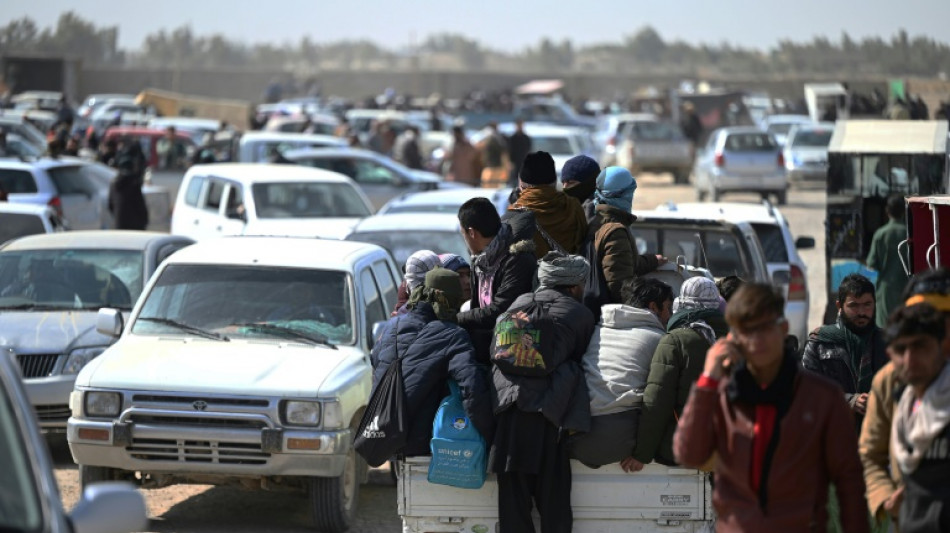
Amid a roar of engines and clouds of dust, Sattar Amiri clambers into a pickup truck with his wife and infant son in a remote Afghan frontier town, ready for a perilous drive through the desert.
Like the thousands of desperate migrants around him, he has only one goal -- to reach Iran.
"I have no choice," says 25-year-old Sattar.
"There is no future in Afghanistan."
In Zaranj, a border town in southwestern Afghanistan, people smugglers say the flow of would-be exiles now reaches 5,000 to 6,000 a day -- four times more than before the Taliban's return to power in August.
At night, the most daring try to scale the imposing wall that separates this arid city from Iran, despite the risk of being shot by border guards.
But when the sun comes up, thousands of men, women and children pile into old four-wheel-drive vehicles on a longer journey through mountains and deserts via Pakistan.
Afghanistan has been plunged into financial crisis following the Taliban takeover six months ago, worsening an already dire humanitarian situation after decades of war.
Many Afghans are scrambling to leave the country for Iran or beyond in search of work to send money back to their families.
Others fear being targeted by the Taliban because of their association with the previous Western-backed regime or the US-led foreign forces who finally withdrew on August 31.
Sattar lost his job as an army mechanic when Afghanistan's military collapsed six months ago and since then says he has "not even managed to earn 1,000 Afghanis" -- about $10.
In desperation, he sold his house in Mazar-e-Sharif to finance his family's escape to Iran, where he plans to take any job he can get.
Nearly a million Afghans left their homes between August and December last year in an attempt to flee, according to a recent report by the International Organization for Migration (IOM).
This exodus has transformed Zaranj into a people-smuggling den of misery.
- 'They will really kill me' -
In the city's dilapidated hotels, migrants sleep on carpets while waiting their turn to cross, despair and fear etched into their faces.
Mohammad, a former policeman, is trying to reach Iran after having twice been beaten by the Taliban, who demanded a service weapon he had already handed in.
"If they come a third time, they will really kill me," says the 25-year-old from Daikundi province, declining to reveal his full name.
While widespread retaliations have so far not been reliably reported, the UN says more than 100 people with links to the former regime -- mostly security personnel -- have been killed by the Taliban.
The city's smugglers are rubbing their hands with glee at the steady stream of clients -- which could become a flood with the arrival of spring and more favourable weather.
Behind the wheel of his 4x4 pick-up, Hamidullah has doubled the price for driving migrants across the desert.
"We used to take three million (Iranian) tomans (about $120), now it's six million," says the grinning 22-year-old, who pays the Taliban a cut to operate.
Every day, hundreds of drivers park their vehicles in a Zaranj lot, where they pile the men into the bed of the pickup, and cram women and children into the cab.
The gathering is carried out in full view of the Taliban, who charge each vehicle 1,000 Afghanis ($10) -- even providing an "official" stamped receipt.
AFP counted around 300 trucks in the lot one day last month, each filled with about 20 people -- or about 6,000 migrants a single day.
The Taliban denied people were leaving in those numbers, and called such reports "propaganda".
"The claims that 6,000 Afghans are leaving (daily) for other countries only through one border on one day is propaganda," said Mohammad Arsala Kharutai, Deputy Minister for Refugees and Repatriations.
"This many Afghans are not leaving," he told AFP in response to a direct question at a news conference, adding "neither are there exact numbers that anyone can prove".
Still, AFP filmed the battered vehicles making their way for hours along rutted desert tracks -- sometimes reaching speeds of up to 120 kilometres per hour (75 miles per hour).
When they reach the Pakistan border, the migrants are handed over to smugglers on the other side, and a treacherous journey by foot begins to the Iranian border.
For Maihan Rezai, the longer journey in unthinkable.
As a member of the minority Shiite Hazara ethnic group, the 20-year-old design student would be easy prey for fighters from Jundallah, a radical Sunni operation responsible for numerous kidnappings in the desert.
"Before, they used to behead people, but now they hold people and demand a ransom," he says.
So Rezai and his friends aim to climb the border wall, which stretches from Zaranj as far as the eye can see.
- Turn a blind eye -
It is a formidable barrier -- a five-metre (16-foot) concrete wall topped with barbed wire and dotted with watchtowers manned by armed guards.
The people smugglers who know the best place to cross are supposed to bribe the guards to turn a blind eye to those scaling the walls at night, but sometimes they cut corners to save money.
"The smugglers lie to us," says Maihan, who has already made several failed attempts.
In the last six months between 70 and 80 people have been killed by Iranian bullets, several Taliban fighters guarding the area told AFP on condition of anonymity.
But even if you make it over, the euphoria is often short-lived.
Iran, already hosting 3.4 million Afghans in 2020 -- mostly illegal migrants rather than genuine refugees -- has been expelling more than 2,000 people a day recently, according to the Taliban.
Still, Sadat Qatal and Waheed Ahmad plot their attempt from their spartan Zaranj hotel room, their four children alongside them.
Waheed's brother made it across in January -- one of only a handful among 80 who tried that night, he said -- and phoned from Iran to tell of his success.
"He told me that many died," the 30-year-old shudders.
"All this is because of hunger... if we still had hope, we would never leave the country."
O.Krause--BTB