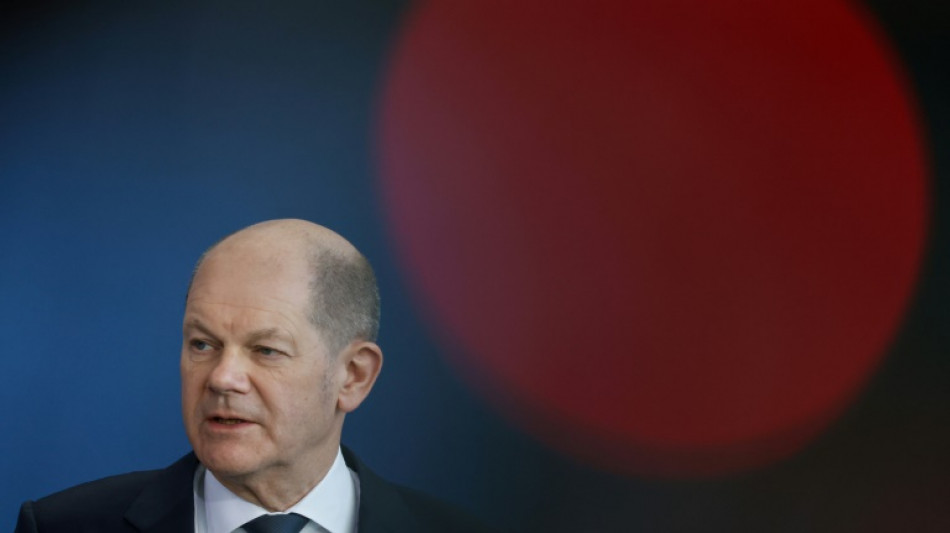
Germany in a quandary over Russian energy / Photo: ©

 Trump pauses 50% tariffs on Canadian goods for three days

 Five Premier League stars to watch this season
 China's robots open to opportunities in search of commercial breakthrough
 Tech leads losses as Asian stocks track Wall St selloff

 US, South Korea cut drills short after Trump criticism
 Italian scientists bet on octopus to fight crab invasion
 New 'Insidious' reflects anxiety of being a new parent: director

 No.1 Sabalenka slams Wang to advance at Cincinnati

 Turkey rejects Israeli claims after strike on Syria air base
 Climate change main driver of European ocean warming: study
 Gauff finds a way into the Cincinnati fourth round

 ZZ Top drummer Frank Beard dies at age 77
 Bayern's Musiala reveals 'neurological disorder' after on-field collapse

 Angelique Kidjo immortalised on Hollywood Walk of Fame
 France to expel two Iranian diplomats: foreign minister

 Spain's Granada closes iconic Alhambra as new quake hits
 Venus, Stephens, Monfils named among US Open wild cards
 Rodri joins La Liga champions Barcelona from Manchester City

 Disney, ABC sue US regulator over threat to broadcast licenses

 Trump, Carney hold talks as new US tariffs on Canada loom

 Germany opens new drone research centre as security threats mount
 How only a few tree species drive Amazon forest recovery
 Ivonne A-Baki enters race to be next UN chief
 Ukraine says Russian strike kills 10 in northeast region
 Meta in court over child social media addiction

Germany has rejected a complete ban on Russian gas and oil imports over Russia invading Ukraine, but voices are growing louder for Berlin to ditch its economic imperative to take a moral stand.
After the United States and Britain imposed a ban on Russian oil, pressure has mounted on German Chancellor Olaf Scholz's government and other G7 members to follow suit.
A group of climate activists, academics, authors and scientists published an open letter to the German government on Wednesday demanding a complete ban on Russian energy, reasoning that "we are all financing this war".
In a newspaper opinion piece this week, conservative lawmaker and foreign policy expert Norbert Roettgen also said the only correct course of action was to "stop Russia's oil and gas business now".
"Nearly a billion euros ($1.1 billion) are being poured into (Russian President Vladimir) Putin's war chests every day, thwarting our sanctions against the Russian central bank" and "for many Ukrainians, it will be too late if we hesitate now," he wrote.
So far, Scholz's government has remained unmoved, reasoning that sanctions should not risk destabilising the countries imposing them.
Since Germany imports more than half its gas and coal and about a third of its oil from Russia, experts say a transition period would be needed to avoid the lights going out.
"If we end up in a situation where nurses and teachers are not coming to work, where we have no electricity for several days... Putin will have won part of the battle, because he will have plunged other countries into chaos," Foreign Minister Annalena Baerbock warned on Tuesday.
Underlining the precariousness of Germany's situation, Baerbock also admitted in a separate interview that Economy Minister Robert Habeck, also of the ecologist Green party, was "urgently trying to buy hard coal worldwide".
Experts say a complete embargo would be painful, but not impossible.
- 'Whatever it takes' -
In a study published this week, nine economists argued that oil and coal from Russia could easily be replaced by imports from other countries, though this could be a little trickier for gas.
If Russian gas cannot be fully compensated for by other suppliers, households and businesses "would have to accept a 30 percent drop in supply", and Germany's total energy consumption would dip by around eight percent, the study said.
According to the economists, GDP could fall by 0.2 to 3 percent and the sanctions could cost each German between 80 and 1,000 euros a year, depending on how much Russian gas can be replaced.
The Leopoldina National Academy of Sciences has also said that temporarily stopping Russian gas supplies would be tough but manageable for the German economy, "even if energy bottlenecks could occur in the coming winter".
But, to protect consumers against price hikes and to encourage the transition to renewable energy, significant government support would likely be needed.
For the Sueddeutsche Zeitung newspaper, a war in Europe is an "emergency" that justifies continuing with the "whatever it takes" mentality spawned by the coronavirus pandemic.
"Germany can borrow money for this," it said, arguing that a "rich" country like Germany "can and must afford" to step away from Russian energy.
Observers have also noted that Germany has the option of delaying its nuclear exit -- planned for the end of the year.
Conservative Christoph Heusgen, a former adviser to Angela Merkel, told the ARD broadcaster that Germans are ready to turn down the heating to help.
"People in Germany have shown such solidarity with the Ukrainians that they wouldn't mind if it was a bit colder in their living rooms," he said.
According to a YouGov poll published this week, the majority of Germans would support a boycott of Russian oil and gas, with 54 percent of respondents saying they were strongly or somewhat in favour.
N.Fournier--BTB