Rising food prices shake North Africa as Ukraine war rages / Photo: ©

 STARPRIME Completes Beta Testing of Market-Maker Model for Retail Brokers

 Campaigns kick off in Nigerian presidential race

 Aussie Rules club suspends five players for drinking, bringing women to hotel

 Trump pauses 50% tariffs on Canadian goods for three days

 Five Premier League stars to watch this season

 China's robots open to opportunities in search of commercial breakthrough
 Tech leads losses as Asian stocks track Wall St selloff

 US, South Korea cut drills short after Trump criticism
 Italian scientists bet on octopus to fight crab invasion

 New 'Insidious' reflects anxiety of being a new parent: director

 No.1 Sabalenka slams Wang to advance at Cincinnati

 Turkey rejects Israeli claims after strike on Syria air base
 Climate change main driver of European ocean warming: study
 Gauff finds a way into the Cincinnati fourth round

 ZZ Top drummer Frank Beard dies at age 77
 Bayern's Musiala reveals 'neurological disorder' after on-field collapse

 Angelique Kidjo immortalised on Hollywood Walk of Fame

 France to expel two Iranian diplomats: foreign minister

 Spain's Granada closes iconic Alhambra as new quake hits

 Venus, Stephens, Monfils named among US Open wild cards

 Rodri joins La Liga champions Barcelona from Manchester City

 Disney, ABC sue US regulator over threat to broadcast licenses

 Trump, Carney hold talks as new US tariffs on Canada loom

 Germany opens new drone research centre as security threats mount

 How only a few tree species drive Amazon forest recovery
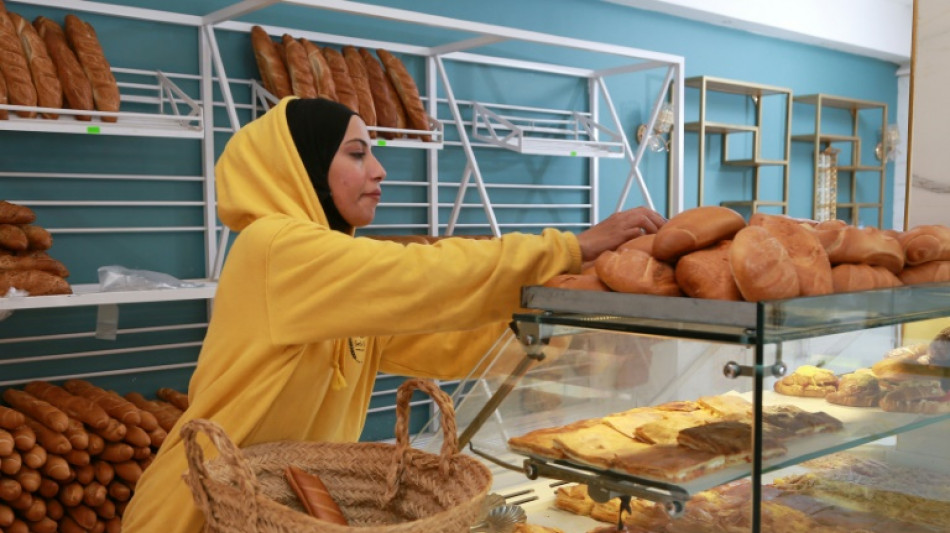
Households across North Africa are rushing to stock up on flour, semolina and other staples as food prices rise following Russia's invasion of Ukraine, both key wheat exporters to the region.
The scramble is worse coming just weeks before the start of the holy month of Ramadan, when Muslims traditionally break a dawn-to-dusk fast with lavish family meals.
Tunisia, Morocco and Libya, along with several other Arab countries, import much of their wheat from Ukraine and Russia.
Some fear the Russian invasion could lead to hunger and unrest, with memories of how rising food prices played a role in several Arab uprisings last decade.
In one supermarket in the Tunisian capital, the shelves were bare of flour or semolina, and only three packs of sugar sat on a shelf near a sign that read: "One kilo per customer, please".
Store managers said the problem was "panic buying", not shortages.
Shopper Houda Hjeij, who said she hadn't been able to find rice or flour for two weeks, blamed the authorities.
"With the war in Ukraine, they did not think ahead," the 52-year-old housewife in Tunis said.
Bulk-buying ahead of Ramadan, which is expected to start in early April this year, is common in Muslim countries.
But some say the war in Ukraine has sparked a shopping frenzy.
- Fear of war -
Hedi Baccour, of Tunisia's union of supermarket owners, said daily sales of semolina -- a staple across North Africa used in dishes of couscous -- have jumped by "700 percent" in recent days.
Sugar sales are up threefold as Tunisians stockpile basic foodstuffs, said Baccour, who insisted there were no food shortages.
Each day pensioner Hedi Bouallegue, 66, makes the round of grocery shops in his Tunis neighbourhood to stock up on products like cooking oil and semolina.
"I am even ready to pay double the price," he told AFP.
Baker Slim Talbi said he had been paying three times as much for flour than in the past, "although the real effects of the (Russia-Ukraine) war have not hit us yet".
"I am worried" about the future, Talbi added, citing Tunisia's dependence on Ukrainian wheat.
Tunisia imports almost half of the soft wheat used to make bread from Ukraine. Authorities say the North African country has enough supplies to last three months.
Oil-rich Libya gets about 75 percent of its wheat from Russia and Ukraine. Morocco also relies heavily on the same source for supplies.
Algeria -- Africa's second-largest wheat consumer after Egypt -- does not import any from the two warring eastern European countries, instead sourcing it from Argentina or France, according to the bureau of cereals.
"There won't be any shortages -- wheat shipments regularly arrive at Algiers port," said harbour official Mustapha, who declined to give his full name.
Despite reassurances, panicked citizens recently ransacked semolina stocks in Algeria's eastern Kabylie region.
"War in Ukraine and all the semolina warehouses have been stormed," Mouh Benameur, who lives in the area, posted on Facebook.
- Recession, pandemic, recovery -
Food prices were on the rise in North Africa before Russia invaded Ukraine more than two weeks ago.
Moroccan official Fouzi Lekjaa pointed to a global economic pick-up following a pandemic-induced slump.
"With the recovery, the market price of cereals and oil products rose," he said.
Mourad, 37, a shopper in the Moroccan capital Rabat, said climate change and drought -- the worst in his country in decades -- were also to blame.
To keep prices affordable and avoid a repeat of bread riots that erupted in the 1980s, Tunisia subsidises staples like sugar, semolina and pasta.
For the past decade, it has set the price of a baguette loaf of bread at six US cents.
Algeria plans to scrap subsidies on basic goods, but has not yet done so.
After a truck drivers' strike this week, Morocco said it was mulling fuel subsidies for the sector "to protect citizens' purchasing power and keep prices at a reasonable level," according to government spokesman Mustapha Baitas.
In Libya, which found itself with two rival prime ministers this month, sparking fears of renewed violence, food prices are also hitting the roof.
At a Tripoli wholesale market, shopper Saleh Mosbah blamed "unscrupulous merchants".
"They always want to take advantage when there is a conflict," he said.
Summaya, a shopper in her 30s who declined to give her full name, blamed the government.
"They reassure people by saying there is enough wheat," she said, carrying two five-kilo (11-pound) bags of flour. "I don't believe them."
M.Furrer--BTB