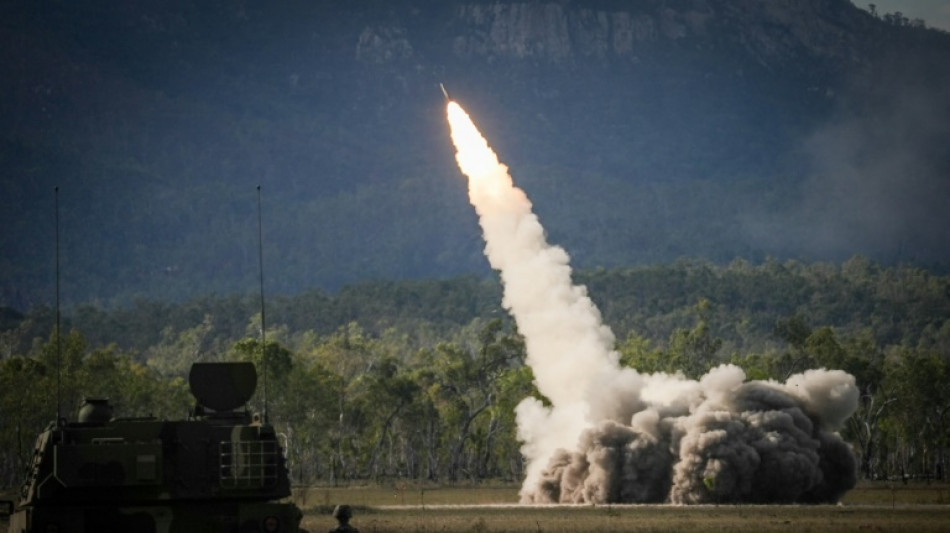
Pentagon eyes missile testing role for Australia / Photo: © AFP/File

 'Hopeless, stuck, afraid': US deportees in limbo in Cameroon

 Mount Fuji ends hiking season with landslide, two rescues

 Seahawks beat Patriots again in NFL opener
 Asian Games begin with Qatar basketball win, nine days before opening ceremony

 Stocks sink as oil rally fans inflation and rate hike fears
 Argentine industry reels from Milei's free-market revolution

 Women quit South Korea's grind for diving tradition
 Bayeux Tapestry 'mania' sweeps UK as sold-out exhibition opens
 August hottest month ever recorded globally: EU monitor

 Duplantis leads creme de la creme at 'game-changing' Ultimate Championship

 Sjobo, cradle of Sweden's now-mainstream anti-migrant sentiment

 Israeli-made film about Gaza civilian deaths to debut in Venice
 Stars ready for busy Toronto International Film Festival

 Rubio defends anti-drug boat strikes, warns of cartel 'cancer'

 Rybakina books US Open semi against Gauff, secures No.1 ranking

 Pegula aiming to thwart Sabalenka three-peat in US Open semis

 'Not normal' US Open scheduling under-fire after late-night finishes

 Luis Enrique hails 'marvellous' Dembele as PSG win big in Champions League

 Liverpool's Iraola 'lucky' after first taste of Champions League

 Resurgent Zheng takes positives from storming US Open run

 Odegaard gives Arsenal winning Champions League start at Napoli

 Bond yields jump despite $6 bn US government intervention

 Mac Allister caps Liverpool comeback to beat Atletico Madrid

 Ferran Torres hits hat-trick as PSG wallop Slovan in Champions League

 New CEO unveils Apple's first foldable iPhone

Australia could be a testing ground for US hypersonic and other long-range precision weapons under the AUKUS pact, a top Pentagon official told AFP on Wednesday.
US Secretary of the Army Christine Wormuth said Australia's contribution to the three-way AUKUS agreement, which includes Britain, "doesn't always have to be dollars".
The pact was signed in late 2021 and is seen as a way of countering China's growing clout in the Asia-Pacific region.
Work under AUKUS has so far focused on supplying Australia with nuclear-powered submarines, a fleet capable of travelling stealthily over vast distances and striking foes at long range.
But the pact is increasingly focused on developing advanced capabilities such as long-range precision firing, artificial intelligence and hypersonic weapons.
Wormuth said Australia could be a proving ground for these weapons.
"One thing Australia has in spades is long distances and relatively unpopulated land," she told AFP in a telephone interview from Washington.
"A challenge for us in the United States when it comes to hypersonics or even some of our things like the precision strike missile -- which is not a hypersonic weapon but has very long ranges in some of its increments -- for us to find open spaces in the United States where we can actually test these weapons, it's a challenge.
"Australia obviously has a tremendous amount of territory where that testing is a little bit more doable -- so I think that's a unique thing, as an example, that the Australians bring to the table."
China has denounced the AUKUS pact as undermining peace in the region -- a charge that Washington, Canberra and London reject.
But critics have also asked whether it is truly cooperative, or whether the United States, because of its size and overwhelming military power, will dominate.
Wormuth said she expected the two smaller partners to pitch in and "have skin in this game -- and they do".
"The sense I got certainly from talking to senior Australian officials is they're not doing this to make us happy, they're not doing this just for fun," said the Pentagon official, who visited Australia last week for the Talisman Sabre multinational military exercise.
"They're doing this because they see it as in their own national interest in terms of being able to meet the different challenges that they see in the theatre."
- 'Prohibitively expensive' -
Facing Russia's war in Europe, threats from North Korea and a more bellicose China, the United States has sought to bolster its defence alliances and put more advanced capabilities into the hands of allies like Australia, Ukraine and Taiwan.
For much of the Cold War, it was Washington's policy to be able to fight two major wars at once.
Wormuth admitted that today, budget constraints, US public opinion and the relative strength of Russia and China make such a doctrine impossible.
"I think there is a recognition that when you look at the size of our military, when you look at the size of the defence budget that the American taxpayer is willing to pay for, we... don't plan to fight more than one major war at a time," she said.
Instead, the United States hopes its alliance and nuclear arsenal will "discourage opportunistic aggression".
"Given the sophistication of the Russian military and the Chinese military today, to try to size our military to hypothetically handle two wars at a time would be prohibitively expensive".
K.Thomson--BTB