US ratchets up sanctions pressure against Moscow / Photo: ©

 Marchand 'stressed' about racing Japanese rivals at LA Olympics
 Mobile boat clinics bring healthcare to India's remote islands
 Former India paceman Zaheer Khan named Chennai coach in IPL

 Six-year-old Chinese girl sets world record with Rubik's Cube

 Swimming prodigy Yu, 13, says 'interviews way harder than racing'

 Star coaches make their bows as Nations League returns

 Rams bounce back as Giants reel from Dart injury

 In Bangladesh, Pakistan's Jinnah photo stirs anger

 Two New Zealand naval ships transit Taiwan Strait

 Zidane gets down to work as France start new era

 Inside the Venezuelan prison meant to 'drive you insane'

 UK king braces as memoir by Diana's brother goes on sale

 Akkodis and Hamburg Public Transport Association Showcase hvv mia at InnoTrans 2026, Demonstrating the Future of AI-Powered Mobility

 Macron says talks with Trump on Red Sea, Ukraine 'constructive'

 Green policies just good politics, says UK minister

 Bardot auction in Paris fetches nearly one million euros

 No timeline on Daniels injury return, says Commanders coach

 British Columbia sues OpenAI in US court over Canada school shooting

 French star Batum retires after 18-year NBA career

 Zidane leads first France training session

 Man shot by ICE agent in Texas detained with bullet inside him: lawyer

 California declares state of emergency ahead of El Nino

 South Africa arrests three more suspects, after nine women murdered

 Carse needs time away from England, says captain Brook

 NOWPayments Releases Cross-Chain Payout Data Revealing Key Performance Benchmarks Across TRON, BNB Chain, and Solana

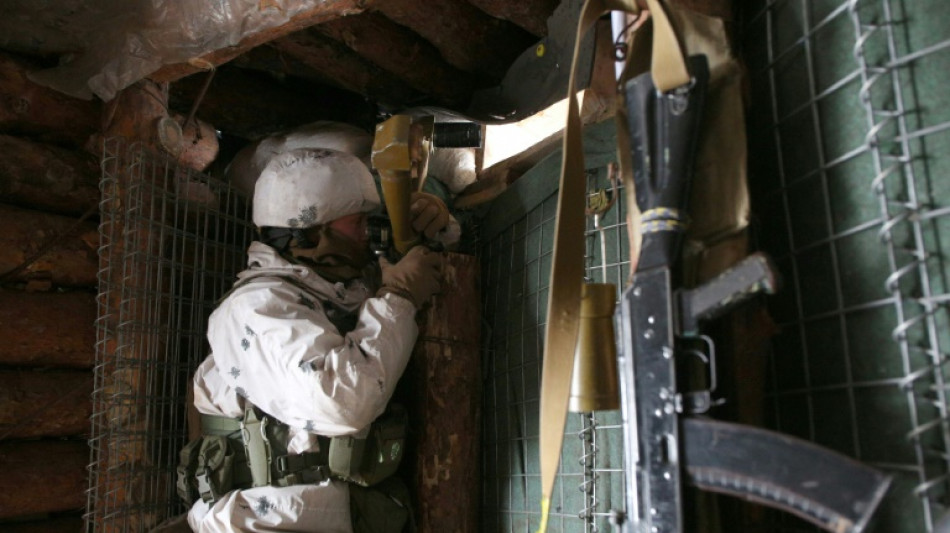
The United States on Tuesday warned Moscow of damaging sanctions, including high-tech export curbs, as Russian combat troops massing around Ukraine launched new exercises.
Unveiling ways that Western allies intend to inflict "massive consequences" on Russia's economy in the event of a Ukraine invasion, a senior US official also warned Moscow against using energy exports as a weapon.
"We are prepared to implement sanctions with massive consequences" that go far beyond previous measures implemented in 2014 after Russia invaded Ukraine's Crimea region, the official said.
"The gradualism of the past is out," the official told reporters, speaking on condition of anonymity.
British Prime Minister Boris Johnson echoed the threat, saying sanctions would be "heavier than anything we've ever done before."
New measures would include restrictions on exports of high-tech US equipment in the artificial intelligence, quantum computing and aerospace sectors, the US official said.
"What we're talking about are sophisticated technologies that we design and produce" and cutting them off would hit President Vladimir Putin's "strategic ambitions to industrialize his economy quite hard," the official told reporters.
- New Russian military exercises -
A day after Washington said it was putting 8,500 US troops on alert for possible deployment to bolster NATO forces in Europe, the Russian military announced it was conducting new drills involving 6,000 troops near Ukraine and within the Crimea region.
The drills included firing exercises with fighter jets, bombers, anti-aircraft systems and ships from the Black Sea and Caspian fleets, the defense ministry said.
According to Western officials, the Kremlin has already deployed more than 100,000 troops on Ukraine's borders, with reinforcements arriving from all over Russia.
The United States and its EU allies accuse Russia of seeking to upend European stability by threatening invasion of Ukraine, a former Soviet republic striving to join NATO and other Western institutions.
"Russia has placed a gun to Ukraine's head," Johnson told parliament.
Moscow denies plans to invade the country, where in addition to seizing Crimea it backs separatist forces controling a swath of eastern Ukraine.
Russia blames the West for the tension and has put forward a list of demands, including a guarantee that Ukraine never join NATO and that NATO forces already in the former Soviet bloc pull back.
- Energy threats -
Addressing concerns in Europe that Russia could curb energy exports to heavily dependent Europe, the senior US official said Russia would also be hurting itself.
"If Russia decides to weaponize its supply of natural gas or crude oil, it wouldn't be without consequences to the Russian economy," a senior US official told reporters.
Although the European Union sources about 40 percent of its supply from Russia, Moscow also relies heavily on sales of energy for its national budget, meaning "it's an interdependency," the official said.
The United States and its European allies are scouring global markets for alternative energy sources to mitigate fallout from any conflict, as Europe already finds itself struggling with soaring mid-winter energy prices.
- Divisions in the West -
Negotiations in European cities this month have failed to ease tensions, though US Secretary of State Antony Blinken and Russian Foreign Minister Sergei Lavrov agreed at a meeting in Geneva on Friday to keep talking.
The French government said Russian and Ukrainian officials would meet, along with French and German counterparts, in Paris on Wednesday.
Washington has promised to provide written answers to Moscow's demands this week, while already making clear that it rejects giving Russia a veto on Ukraine's aspirations to join NATO.
After a call with European leaders on Monday, US President Joe Biden said there was "total unanimity" on how to deal with Russia.
But the crisis has laid bare divisions in the West.
The new government in EU economic powerhouse Germany in particular has faced criticism from Kyiv over its refusal to send defensive weapons to Ukraine, as well as hesitating over one of the harshest economic sanctions under discussion -- cutting Moscow from the global SWIFT payments system.
- 'False flag' jitters -
Ukraine's military is heavily outgunned by Russia and no Western country is considering deploying troops to help repel any attack by Moscow.
However, the United States has stepped up deliveries of weapons, with Blinken on a visit to Kyiv last week confirming another $200 million in aid. A shipment arrived on Saturday and another batch was due Tuesday.
The United States warns that Moscow could manufacture a "false flag" incident in Ukraine to justify an attack of its own.
Russia denies this, but Ukraine claimed Tuesday it had dismantled a group of saboteurs "coordinated by Russian special services" who had planned a "series of armed attacks" aimed at destabilizing the country.
burs-sms/mlm
I.Meyer--BTB