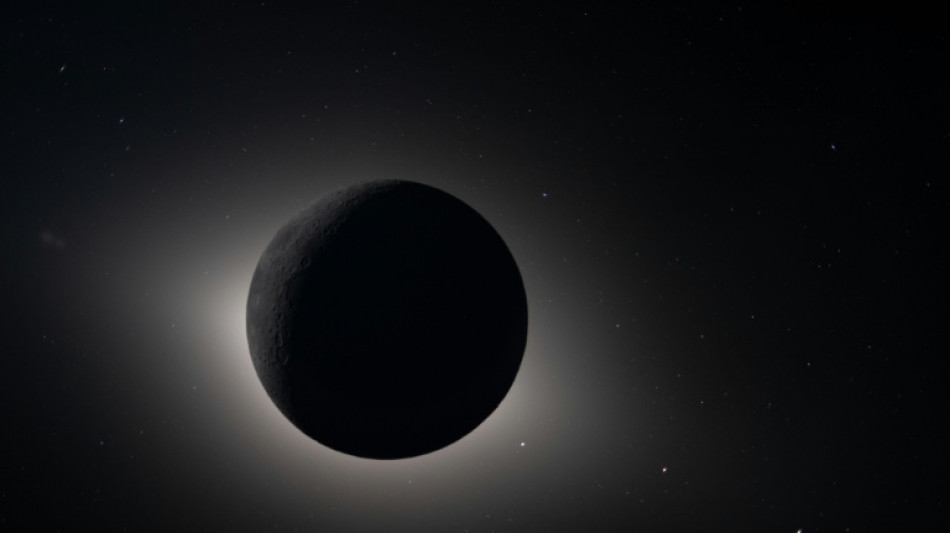
'Pinprick of light': Artemis crew witnesses meteorite impacts on Moon / Photo: © NASA/AFP

 Macron welcomes Canada's Carney to French Atlantic territory

 Fiorentina frustrate Napoli with Serie A draw, Como upset

 Five-star Man City top Premier League after Sunderland thriller

 Ukrainian drones hit Moscow on last day of Russian elections

 Multi-Asset Trading Venue Monochrome Exchange Announces IEO of Its Native Token, $MCR

 South Korea break Japan hearts to win Asian Games basketball gold

 Acosta takes first victory at Austrian MotoGP

 PSG president Nasser al-Khelaifi under investigation in France for conflict of interest

 China swim sensation, 13, sets Games record after Japan win early

 Drones hit Moscow as Russians go to the polls

 New England boss Fleming says 'wrong' to ask Stokes to end retirement

 Germans vote in elections threatening fresh blow to Merz

 US fears rapid escalation in Mideast after Houthis attack Riyadh

 Japan triathlete Hojo wins first gold of Asian Games
 IOC president impressed by 'beautiful' Asian Games wooden huts

 First Asian Games gold goes to Japan as China's 13-year-old Yu lights up pool

 Data centre command hub keeps AI up and running

 Pope Leo in France: the issues on the table

 Packing for a pope: behind the scenes on foreign trips
 Republicans find transgender issues a powerful political weapon in midterm campaigning

 German state elections threaten new shock waves for Merz
 Chile's Bachelet quits race to be next UN chief

 Raphinha treble fires perfect Barca to win at Sevilla

 Thiam makes winning heptathlon return at Decastar meet

 Czechs beat USA to qualify for Davis Cup finals

During their historic lunar flyby, astronauts on NASA's Artemis II mission witnessed meteorites striking the rugged surface of the Moon, a sight that has piqued scientists' curiosity.
"That was definitely impact flashes on the moon. And Jeremy (Hansen) just saw another one," mission commander Reid Wiseman reported on Monday while flying around the Moon -- the first such journey by humans in more than half a century.
"Amazed," replied Kelsey Young, the mission's lunar science lead, as she followed the spacecraft from more than 250,000 miles (400,000 kilometers) away on Earth.
"I don't know if I expected to have the crew see any on this mission, so you probably saw the surprise and shock on my face," she said, recounting the strikes at a press briefing the next day.
Among NASA's team in Houston, there were "audible screams of delight" from scientists when the crew described flashes of light caused by meteorite impact, Young said.
The phenomenon is "something that we have not witnessed often," the mission's backup astronaut Jenni Gibbons told AFP.
"They were really high priority science for us, so the fact that they saw four or five was just outstanding."
- 'No doubt' -
As the astronauts hurtled towards home, NASA asked them on Tuesday about the meteorite strikes they saw during their nearly seven-hour observation period.
"Were they prolonged? And did you notice any color?" Young asked.
"It's a pinprick of light," replied Canadian crew member Hansen. "I would suspect there were a lot more of them."
"I would say they were a millisecond, like the fastest a camera shutter can open and close," added Wiseman, who said the flashes were "white to bluish white."
"To me there was no doubt we were seeing it, and we were all seeing it," he added.
According to NASA's tally, the team -- which broke the record for the furthest distance from Earth during their flyby -- reported a total of six meteorite impacts on the lunar surface.
Ground crews are now working to match these observations with data from a satellite orbiting the Moon, said Young, adding that the majority of the sightings took place during a solar eclipse, when the Moon passed in front of the Sun.
- 'Challenge' -
"I'm personally... surprised they would see that many, although they (had) been trained to look for them," said Bruce Betts, chief scientist at the Planetary Society.
According to Betts, the descriptions will allow scientists to "get some idea of the frequency of impact" as well as the size of the projectiles.
One question was what size an object needed to be to create a flash visible to the astronauts, Betts said.
"It's not a piece of dust, but it's not a meter-size boulder, either."
The observations raise questions and show that the "daily flux of meteors should be monitored more closely in the future before a lunar base is established," said Peter Schultz, Professor Emeritus of Geological Sciences at Brown University.
On Earth, smaller objects "burn up high in the... atmosphere due to friction" before they reach the ground, noted Betts, which is not the case on Earth's natural satellite.
"There is more of a challenge on the Moon," he said.
D.Schneider--BTB