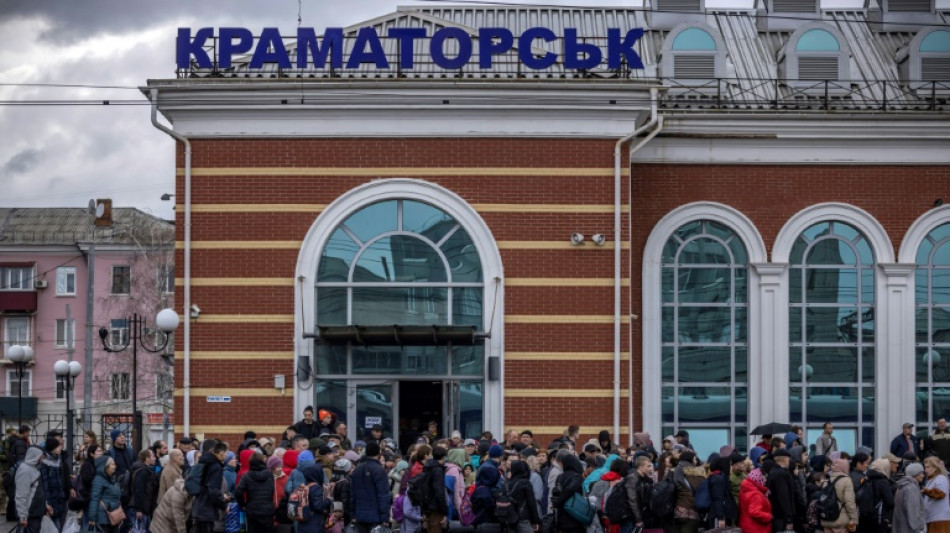
More Ukrainians move west as Russia turns focus to Donbas / Photo: ©

 PSG start Ligue 1 defence with eye on Champions League hat-trick
 Arsenal can become world's best club: Arteta
 Japan's King Kazu, 59, scores twice from spot to make cup history

 Kyiv's desperate vendors persevere outside obliterated flea market
 Australia races to shield little penguins from H5N1 bird flu

 Messi scores first goal since father's death
 US national debt exceeds $40 trillion for first time
 Brazilian narco violence spills over into tranquil Bolivia

 Trump's devoted 'human printer' in media glare

 Top seed Zverev bundled out by Paul in rain-hit Cincinnati upset

 WADA pledges vigilance on Russian athletes ahead of 2028 Olympics

 NASA satellite rescue mission fails

 Cobolli halts Jodar to reach Cincinnati quarter-finals

 As election looms, Netanyahu puts Turkey in Israel's crosshairs

 McIlroy questions LIV stars 'value' as talk of PGA return builds
 'Breakthrough' mRNA cancer drug curbs melanoma in large trial

 Many US Fed policymakers back interest rate hikes if inflation stays high
 Robinson and Tongue star as Pakistan collapse in England opener
 All Blacks must get 'everything right' to beat Springboks, says legend Fitzpatrick
 Robinson and Tongue star as Pakistan all out for 171 in England opener

 Lake Zurich sees water level hit record low amid drought

 Merck and Moderna's tailored cancer drug curbs melanoma recurrence in trial

 Referees chief Webb wants clamp-down on Premier League set-piece grappling

 Robinson makes history as Pakistan collapse against England

 Alvarez can win back Atletico fans in two games: club chief

Hundreds wait for a train to take them west out of the path of the Russian advance at the station in Kramatorsk, the de facto capital of Ukrainian-controlled territory in Donbas.
"It's been like this since the end of last week. Almost 2,000 people a day are boarding trains west for Lviv or elsewhere," says Nasir, a humanitarian volunteer helping with the operation.
"It used to be two trains a day. Now it's four," he adds.
"The situation is bad. Lots of people have already left. The men are staying, our families are leaving," says Andriy, whose wife and two children are taking shelter from the rain under the awning of a fast-food hut with their bags at their feet.
Sofia, his teenage daughter standing around with three friends also making their way west, admits she is "a bit sad" to be leaving.
"I'm sending my children to the west like everyone else, to my brother-in-law's village" away from the frontline, says Andriy, holding on to his youngest child's hand.
- Next Mariupol? -
Since Russia announced its intention to concentrate its efforts on the "liberation" of Donbas, the traditional mining region in the east of Ukraine, residents have lived in fear of a major military offensive.
Authorities in Kyiv say they expect the situation to get worse as Russian troops seek to encircle Ukrainian forces arranged since 2014 along the frontline between Donetsk to the south and Lugansk in the east, the capitals of the two pro-Russian, breakaway "republics" of the same name.
The de facto capital of the rump region still under Ukrainian control, Kramatorsk sits between the pincers of the Russian army, which has just taken the city of Izyum, to the north-west of the city.
"According to the latest reports, Russia is moving its troops to the east and we will soon be surrounded," says Viktoria, a medic.
"We hope our army will hold out. This could be the next Mariupol," she says, a reference to the southern Ukrainian port, which has been pounded by the Russian army.
"Frankly, there has not really been a war in Kramatorsk so far," Viktoria says.
Sat in the Don river basin, more than 150,000 people lived in Kramatorsk before the war. Relatively spread out, the city has so far only been targeted sparingly by Russian attacks.
The roads in the city are deserted and the situation calm, for now.
"The bombing could start at any moment," says Andriy.
"People say something terrible is coming here," says Svetlana, who has accompanied a friend to the station. Her children have left, she says.
But she has to stay behind with her husband, she adds, to look after the grandmother of the family.
- 'Time to go' -
On the right of the platform, are the families with young children.
On the other end are older people and single women, including another Svetlana, sports bag over one shoulder and holding her Fox Terrier on a leash in the other hand.
The dog's paws tremble. "She is nervous. She knows something is happening," says Svetlana.
"Friends have found me an apartment in Rivne (in western Ukraine). We're really scared now. I waited until the last moment but now it's time to go."
A policeman in a black uniform with his gun by his side squeezes his daughter in his arms. "Our children are our treasures," he says.
The Rybalko family is waiting on a bench with their baggage on their laps. The boy is nibbling on some chocolate while their eldest daughter runs around their feet.
"Up until the very last moment, we wanted to stay, but with the kids it's too risky," says Tamara, one of the two grandmothers travelling with the family.
"They're saying the front will reach here. I can't quite believe it. My husband is staying here. He loves his home, his dogs and his garden too much."
The departure proceeds in an orderly fashion, the mood among the travellers caught between anxiety, sadness and resignation.
The train arrives, bound for Khmelnytsky, 14 hours and 800 km (497 miles) to the west, and passengers are helped on.
"In normal times it's four people per compartment. At the moment, it's eight, so 700 passengers in total," says the train conductor Sergiy Popatienko.
Within a few minutes, everyone is on board, leaving just enough time for a hug and a quick kiss goodbye.
"Why am I staying?" says Ivan, Tamara's husband. "My city will probably need me. I was born here. I've lived here. We're going to wait for these bad times to pass."
W.Lapointe--BTB