US-China economic flashpoints at a glance / Photo: © GETTY IMAGES NORTH AMERICA/AFP/File

 STARPRIME Responds to Diverging Gold Market Demand with AM/PM Fixing and XAU24/7

 Ukrainian fashion designer debuts art between air raids

 Gambian businesses struggle under prolonged blackouts

 Fiji declares national HIV crisis
 Australia to cut migration to fix housing crisis: minister

 NASA scan discovers new, 'once in a century' Moon crater
 Most stocks rise as Fed hikes and indicates drive to curb inflation

 US again denies Palestinian leader Abbas visa to attend UN assembly

 Lula says he will go to UN to tell Trump to 'stay out' of Brazil's elections

 Messi heads Inter Miami to Campeones Cup triumph

 AI looms large ahead of Xi, Trump summit

 Smith still haunted by 'Sandpapergate' as he prepares for South Africa Tests

 UK-Sudanese author pens book to give children 'African history of Africa'

 Boehly and Walter sell Chelsea stake to Clearlake Capital
 US House backs data center power cost bill amid midterm backlash

 US Congress passes sweeping Russia sanctions bill

 Barca hit Racing for seven as Atletico crush Osasuna

 US Fed raises rates to tackle 'too high' inflation, irking Trump

 Man Utd misery mounts after League Cup collapse against Brighton
 Turkey releases 106 protesters, jails more LGBTQ activists

 US Fed raises rates to tackle 'too high' inflation in move sure to rile Trump

 England were 'waiting for death' in World Cup semi-final defeat: Tuchel

 NFL star fined for displaying name of slain Palestinian girl

 Witsel retires from internationals after 18-year Belgium career

 US Fed raises rates to battle inflation in move likely to rile Trump

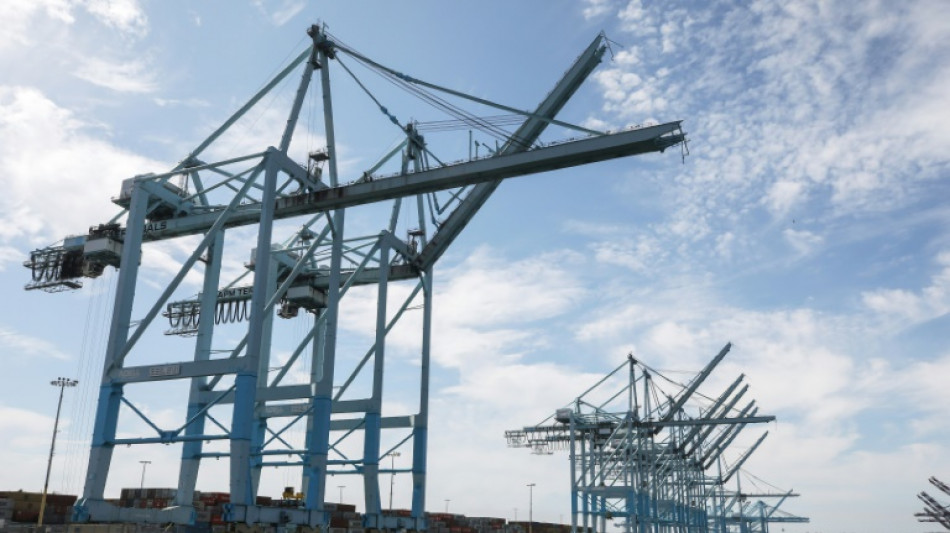
From a trade imbalance to technological competition, a host of economic flashpoints are boosting tensions between Washington and Beijing -- and these are among areas in which both Republicans and Democrats can agree.
What's behind these concerns?
- American debt -
Republicans in particular are worried about this issue, concerned that China holds too much American debt.
The fear is that Beijing could use this to pressure Washington by threatening to resell its bonds, bringing down the value of holdings.
While the American debt exceeds $34 trillion, only around $8 trillion is held abroad.
China is a key holder of US debt, accounting for $816 billion and just over $1 trillion when Hong Kong is included, according to Treasury Department figures.
But it is the second biggest foreign holder behind Japan -- which holds $1.1 trillion -- and ahead of Britain.
- Tech race -
US President Joe Biden has focused on tech, noting its importance to ensuring national security.
Be it in semiconductors, artificial intelligence or electric vehicles, Washington is seeking to stay ahead or catch up with Beijing in various areas -- including to prevent advanced tools from falling into the hands of the Chinese military.
A major target during former president Donald Trump's term was telecoms giant Huawei, which the United States sought to keep out of its 5G networks and those of allies.
Restrictions grew under the Joe Biden administration, especially involving cutting-edge semiconductors necessary in AI development.
The goal, said Commerce Secretary Gina Raimondo in October, is to limit Chinese access to advanced chips that could fuel breakthroughs in AI and sophisticated computers that are critical to military applications.
In the field of critical minerals, of which Beijing has ample supplies, Washington has also been seeking to circumvent China.
- Trade -
While China is no longer the top source from which the United States imports goods, the perceived trade imbalance between the world's two biggest economies remains a concern.
Trump's tariffs on Chinese goods and attempts to secure a deal to rebalance trade has failed to turn the tide, and the Biden administration has largely maintained levies while pursuing efforts in "friendshoring" -- or diversifying supply chains across allies and partners.
There appears to be some impact with US-China trade growing less quickly, although a deeper look shows that some Chinese products are simply routed through other countries.
- Currency war? -
The question of exchange rates and the use of currency for political and commercial purposes has been a recurring issue, too.
For years, Washington has accused Beijing of maintaining the yuan at a deliberately lower rate against the dollar in order to promote exports.
In November, the US Treasury flagged China's "lack of transparency" in its exchange rate mechanism, saying this warranted monitoring.
The concern now centers on the internationalization of the yuan, with the Chinese currency still little present in commercial exchanges.
As of end-2023, fewer than 3.5 percent of payments via the SWIFT international electronic transfer system were made in yuan -- compared with nearly 19 percent in euros and more than 50 percent in dollars.
China wants the yuan to establish itself, especially in trade, as a safeguard against potential US sanctions. Beijing in turn believes that Washington is weaponizing the dollar.
O.Krause--BTB