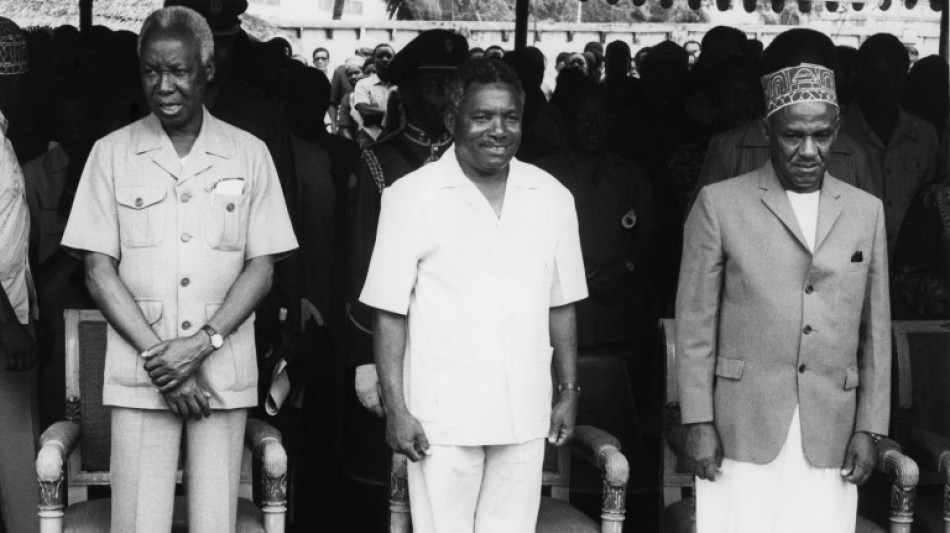
Former Tanzanian president Ali Hassan Mwinyi dies aged 98 / Photo: © AFP/File

 Beyond Investment Returns: Families Are Measuring Wealth by Freedom, Continuity, and Legacy, According to Nour Private Wealth
 King Charles disputes claims in book by Princess Diana's brother

 Real Madrid fan group wants Mbappe apology over Ceuta shirt snub

 Nepal floods among 'most challenging' disasters: WFP
 Doubts as Italy eyes electric future for steel plant
 'One of the kindest people': Taraneh, 21, facing execution in Iran

 Japan eyes changing prostitution law to punish sex buyers

 After record rain, typhoon threatens new challenge to Asian Games

 Kids and social media: what would change under new EU law
 Modi pitches India as global chipmaking hub
 Ukraine plans record defence spending in 2027
 Klopp calls up 44 players in huge first Germany squad
 STARPRIME Responds to Diverging Gold Market Demand with AM/PM Fixing and XAU24/7

 Ukrainian fashion designer debuts art between air raids

 Gambian businesses struggle under prolonged blackouts
 Fiji declares national HIV crisis
 Australia to cut migration to fix housing crisis: minister
 NASA scan discovers new, 'once in a century' Moon crater
 Most stocks rise as Fed hikes and indicates drive to curb inflation
 US again denies Palestinian leader Abbas visa to attend UN assembly
 Lula says he will go to UN to tell Trump to 'stay out' of Brazil's elections
 Messi heads Inter Miami to Campeones Cup triumph

 AI looms large ahead of Xi, Trump summit

 Smith still haunted by 'Sandpapergate' as he prepares for South Africa Tests

 UK-Sudanese author pens book to give children 'African history of Africa'

Former Tanzanian president Ali Hassan Mwinyi, who introduced multi-party democracy to the East African nation, died on Thursday aged 98, the presidency said.
"I'm saddened to announce the death... around 5:30 in the evening," President Samia Suluhu Hassan said on state television TBC1, adding that he had been receiving treatment for lung cancer.
Mwinyi had been hospitalised in London in November last year before returning to continue treatment in the main Tanzanian city of Dar es Salaam, Hassan said.
Tanzania will observe seven days of mourning with national flags flown at half-mast.
Hand-picked by independence hero Julius Nyerere to succeed him, Mwinyi inherited a country in the grip of an economic crisis, following years of failed socialist experiments.
Tanzania's founding father Nyerere's pet project "ujamaa" ("fraternity" in Swahili) sought to bring people together by promoting a socialist economic vision, but his collectivist experiments left the country in a precarious condition.
Mwinyi removed restrictions on private enterprise and eased bottlenecks on imports, earning the nickname Mzee Rukhsa, a Swahili phrase which loosely translates to Mr Permission.
Born on May 8, 1925 in the former British colony known as Tanganyika, Mwinyi moved to Zanzibar to study Islam.
His father hoped he would become a spiritual leader, but the young Mwinyi took up teaching instead, before entering politics in the 1960s after Tanganyika won its freedom.
Following the 1964 merger between independent Tanganyika and Zanzibar to form Tanzania, he rose through the ranks to serve as ambassador to Egypt as well as the minister of health, home affairs and natural resources during the 1970s and early 1980s.
In 1984, he became the president of Zanzibar, before Nyerere chose him to lead Tanzania.
- Corruption scandals -
He was hailed for opening the door to multi-party democracy in 1992 and allowing opposition parties to contest elections three years later, when he stepped down.
But his tenure was also peppered with controversies.
He faced criticism for allegedly favouring Muslims while appointing officials to top government jobs, allegations he conceded hit him hard.
The economic liberalisation he presided over was accompanied by corruption scandals, which became so endemic during his reign that some donors froze aid in 1994.
The grey-haired leader had kept a low profile since retiring from politics in 1995.
At his book launch in 2021, President Samia Suluhu Hassan showered him with accolades, describing him as a leader worthy of emulation.
In the memoir, Mwinyi criticised the "ujamaa" project, saying it deprived small-scale traders of income.
L.Janezki--BTB