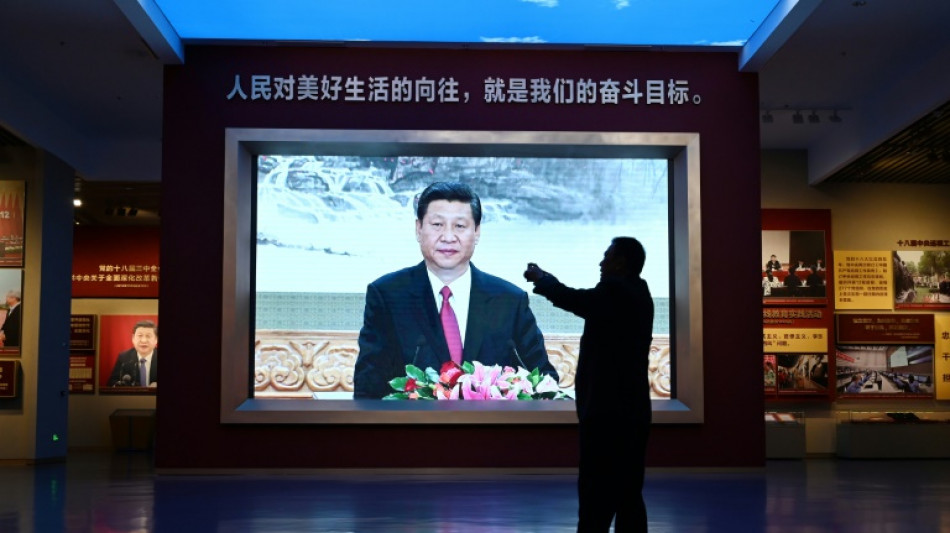
Security, economy in focus at key China meetings / Photo: © AFP

 Beyond Investment Returns: Families Are Measuring Wealth by Freedom, Continuity, and Legacy, According to Nour Private Wealth
 King Charles disputes claims in book by Princess Diana's brother

 Real Madrid fan group wants Mbappe apology over Ceuta shirt snub

 Nepal floods among 'most challenging' disasters: WFP
 Doubts as Italy eyes electric future for steel plant
 'One of the kindest people': Taraneh, 21, facing execution in Iran

 Japan eyes changing prostitution law to punish sex buyers

 After record rain, typhoon threatens new challenge to Asian Games
 Kids and social media: what would change under new EU law
 Modi pitches India as global chipmaking hub
 Ukraine plans record defence spending in 2027

 Klopp calls up 44 players in huge first Germany squad
 STARPRIME Responds to Diverging Gold Market Demand with AM/PM Fixing and XAU24/7

 Ukrainian fashion designer debuts art between air raids

 Gambian businesses struggle under prolonged blackouts
 Fiji declares national HIV crisis
 Australia to cut migration to fix housing crisis: minister

 NASA scan discovers new, 'once in a century' Moon crater
 Most stocks rise as Fed hikes and indicates drive to curb inflation

 US again denies Palestinian leader Abbas visa to attend UN assembly

 Lula says he will go to UN to tell Trump to 'stay out' of Brazil's elections

 Messi heads Inter Miami to Campeones Cup triumph

 AI looms large ahead of Xi, Trump summit

 Smith still haunted by 'Sandpapergate' as he prepares for South Africa Tests

 UK-Sudanese author pens book to give children 'African history of Africa'

China's top officials hold an annual gathering next week, offering a rare window into the ruling Communist Party's thinking as it tightens its grip in the face of dire economic headwinds.
From a protracted property crisis to waning domestic spending, China's lawmakers face a litany of challenges as they hold their "Two Sessions".
The meetings are not expected to see the unveiling of big-ticket bailouts that experts say are needed to get the economy back on track.
Instead, they will continue a path of "elevating national security measures on all fronts", Ho-fung Hung, a professor of Political Economy at Johns Hopkins University, told AFP.
"It will not help the economy but could help the party-state weather the storm of the economic crisis," he said.
Smaller-scale investments in science and technology, as well as steps to lift China's debt-battered property market, could be on the agenda.
However, Neil Thomas, an analyst on Chinese politics at the Asia Society, said President Xi Jinping "seems relatively unfazed by his country's recent growth struggles".
"I do not expect major shifts on core economic issues," he told AFP.
Meticulously choreographed and staged over more than a week, the most important of the "Two Sessions" is the National People's Congress (NPC), China's legislature, beginning Tuesday in Beijing's Great Hall of the People.
The Chinese People's Political Consultative Conference, the first of the sessions, begins on Monday but is generally overshadowed by the NPC.
Thousands of delegates from across the country convene for the sessions to approve bills, budgets and personnel moves every year.
First on the agenda will be Premier Li Qiang's announcement of China's GDP growth goal for 2024 -- broadly expected to remain around five percent.
"The GDP target will likely err on the side of caution without conceding how large the pressures on the economy are," Diana Choyleva, chief economist at Enodo Economics, told AFP.
Beijing has for years been reluctant to confront those pressures head-on with a major bailout, fearful of putting too much pressure on fragile state coffers.
Analysts don't see any reason to think that will change soon.
"Investors and consumers are looking for measures that can restore their confidence," Choyleva said.
"But the government's focus on preventing increased economic risk and improving security will not allow for the kind of measures that will immediately increase positivity," she said.
- Limited powers -
The NPC serves as a "crucial networking event, where thousands of powerful individuals from around China meet and discuss politics", according to analyst Nis Grunberg.
On paper, it wields little actual power.
All major decisions will have been made weeks before in closed-door meetings of the Communist Party, far from the international media's cameras.
"It has never rejected any bill, budget, report, or nomination put before it," Changhao Wei, a Fellow at the Paul Tsai China Center of Yale Law School and founder of the NPC Observer website, said of the congress.
However, the topics that are up for discussion and the tone of the speeches allow for key insights into what's keeping China's rulers up at night.
High among those worries are national defence and security. An increase in China's military budget, which is second only to the United States, is also expected on Tuesday.
Beijing revised a law dramatically expanding its definition of espionage last year and conducted raids on a string of big-name consulting, research and due diligence firms.
The legislature's top body approved a broad and vaguely worded revision to China's state secrets law in the run-up to the NPC that was "a clear signal of security's importance for this year's governance agenda", Choyleva of Enodo Economics said.
Given the choice between deep reforms to restart economic growth and efforts to strengthen the state's power, analysts say China's policymakers have little room for manoeuvre.
"Beijing will not budge on its control and security-first approach," analyst Grunberg said.
"Everyone should ask themselves: when did Xi last compromise on control in favour of economic growth, let alone liberal reform?"
J.Fankhauser--BTB