Syrians aid Ukrainians in ties forged by war / Photo: ©

 Rain delays start of second day's play in England-Pakistan opener

 Russian strikes kill 16 in Kyiv, surrounding region
 'It is tough': Indonesia battles wildfires, bracing for worse to come

 Seoul detects North Korean missile launches after Trump says to meet Kim

 Thai, Myanmar military chiefs meet as post-coup thaw progresses
 Asian stocks rally as US Treasury steps in to ease bond fears

 Verstappen signs new Red Bull contract until 2030: team

 What property giant Evergrande's sentence means for China's economy
 Australian prosecutors demand life in prison for mushroom killer
 Fallout far-reaching for Australian Rules after latest scandal
 Rafts on Rome's Tiber River cool down overheated tourists
 Top seeds Sabalenka, Zverev stunned in Cincinnati fourth round
 Australia says relations with Israel 'difficult' after aid worker death

 PSG start Ligue 1 defence with eye on Champions League hat-trick

 Arsenal can become world's best club: Arteta
 Japan's King Kazu, 59, scores twice from spot to make cup history
 Kyiv's desperate vendors persevere outside obliterated flea market
 Australia races to shield little penguins from H5N1 bird flu

 Messi scores first goal since father's death
 US national debt exceeds $40 trillion for first time

 Brazilian narco violence spills over into tranquil Bolivia

 Trump's devoted 'human printer' in media glare
 Top seed Zverev bundled out by Paul in rain-hit Cincinnati upset

 WADA pledges vigilance on Russian athletes ahead of 2028 Olympics

 NASA satellite rescue mission fails
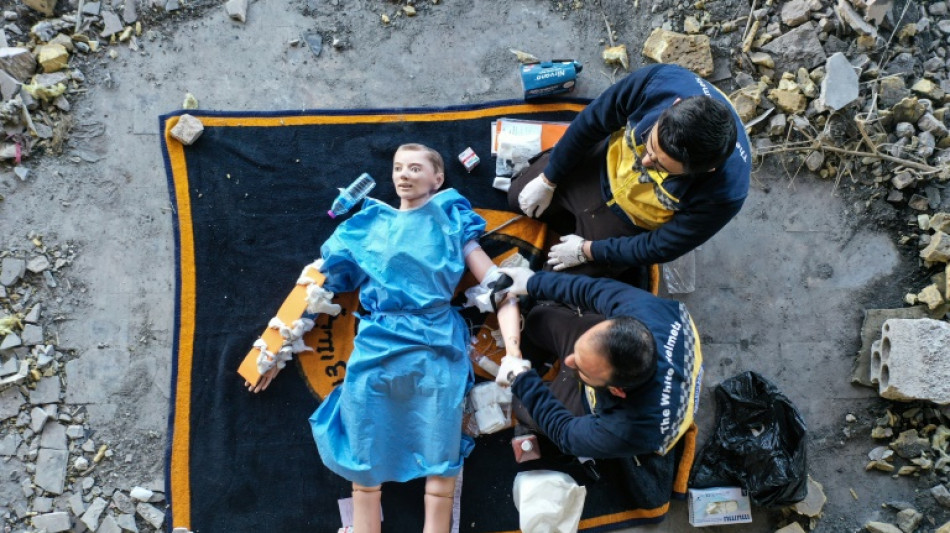
Syrians are mobilising to support Ukrainians, sharing hard-earned knowledge gleaned from years of war involving Russian forces, such as surviving shelling, helping refugees and responding to chemical attacks.
With both Ukrainians and Syrians seeking accountability for the ravages inflicted by Russian forces in their countries, they feel a unique bond is growing between them.
Syrian President Bashar al-Assad's grip on power had appeared to be hanging by a thread after the civil war erupted in 2011, until Russian forces stepped in four years later turning the conflict in the regime's favour.
"From our experiences in Syria, we might be among those most able of understanding the pain of the people of Ukraine," said Raed al-Saleh, head of the Syria Civil Defence force, known as the White Helmets.
"Syrians have lived the shelling, killing, and displacement brought on them by Russian forces.
"The time and place have changed, but the victim is the same -- civilians -- and the killer is the same -- the Russian regime," he told AFP.
During the fighting in Syria, which has claimed over 500,000 lives, the White Helmets have worked as first responders, rescuing thousands from under the rubble of homes shelled by Russian and regime forces in rebel-held areas of Syria.
The fate of Ukraine's besieged southeastern port of Mariupol, the scene of some of Moscow's fiercest assaults, has drawn comparisons with the eastern districts of Syria's northwestern city of Aleppo.
The former rebel stronghold was levelled by air strikes in 2016, during a months-long siege.
"Look at the city of Mariupol. This is exactly what we've seen in the city of Aleppo in Syria," Ukrainian President Volodymyr Zelensky told an international forum last month.
He wanted to convey a message that "'Russia was always a bad actor, Aleppo is proof of that and now it is our turn to suffer'," Emile Hokayem, analyst at the London-based International Institute for Strategic Studies, told AFP.
- 'We warned you' -
This shared suffering has prompted a series of initiatives.
A coalition of groups has launched the Syria Ukraine Network (SUN) that has helped Syrian doctors travel to Ukraine, said coordinator Olga Lautman, a Ukrainian living in Washington.
"We will be coordinating (with) Syrian experts on war crimes documentation and chemical attacks," Lautman told AFP.
It came from "the desire of Syrians to use their expertise to help", she said, describing the "bond" forming between the two peoples.
In northwestern Idlib, one of the last remaining rebel areas in Syria, doctors at the Academy of Health Sciences are training Ukrainian doctors and nurses online, its president Abdullah Abdulaziz Alhaji said.
Ukrainians are mainly asking to learn about chemical attacks, he said. "They want to benefit from our experience."
Although no chemical weapons use has been confirmed in Ukraine, chlorine or sulphur gas attacks were recorded during the Syrian conflict, according to the Organisation for the Prohibition of Chemical Weapons.
White Helmets rescuers are also filming tutorial videos for Ukrainians on treating casualties.
On the Ukrainian-Romanian border, Syrian Omar Alshakal, founder of Refugee4Refugees association, has been assisting Ukrainians fleeing war.
And Ukrainian and Syrian activists will Wednesday launch a "Freedom and Justice Convoy" from Paris to the Ukrainian-Polish border to show the "Syrian people's solidarity".
"Syrians are keen to embrace the cause of Ukraine because it helps revive fading international attention to their own tragedy and to tell Westerners: 'We warned you but you preferred to look away'," said Hokayem.
- 'Accountability' -
Charles Lister, from the Middle East Institute, noted Syrian activists have "sought to ride this wave of anti-Russian sentiment, to bolster the Syrian cause, but also to foster new, meaningful geopolitical relationships in Ukraine."
Syrian opposition leaders had met Ukrainian leaders on the sidelines of international gatherings, and "their shared experiences have been clear cause for unity," he told AFP.
The most important question for both is whether Moscow -- and in Syria the Kremlin-backed President Assad -- will ever be held accountable.
"If Putin was held accountable for his crimes in Ukraine, this means that he will be held accountable for his crimes in Syria as well. But if Putin gets away with it, then the next crime will only be a matter of time," said the White Helmets' Saleh.
Last month, Amnesty International's Agnes Callamard noted the situation in Ukraine "is a repetition of what we have seen in Syria".
Many have pointed to similarities in Russian tactics in Syria and Ukraine -- from targeting infrastructure to establishing so-called safe corridors and truces aiming to empty cities.
Moscow had shown a "lack of moral principles ... whether in its actions in Syria or Ukraine," said Ivan Cherevychny, 71, a resident of the Ukrainian town of Zaporizhzhia.
He also slammed "the irresponsible attitude of the United Nations and world leaders" faced with the two crises.
Others alleged that several commanders now playing leading roles in the Russian invasion had been involved in the Syrian war, naming among others Alexander Lapin and Alexander Dvornikov, commander of Russia's forces in Syria in 2016.
"Russia used Syria as a training ground for testing the effectiveness of strikes against the residential, social, and economic infrastructure," said a prominent Ukrainian lawyer-turned-fighter from Kyiv, who only wanted to be identified as Oleg.
Destroying the infrastructure makes the country "unsuitable for life," he added.
L.Janezki--BTB