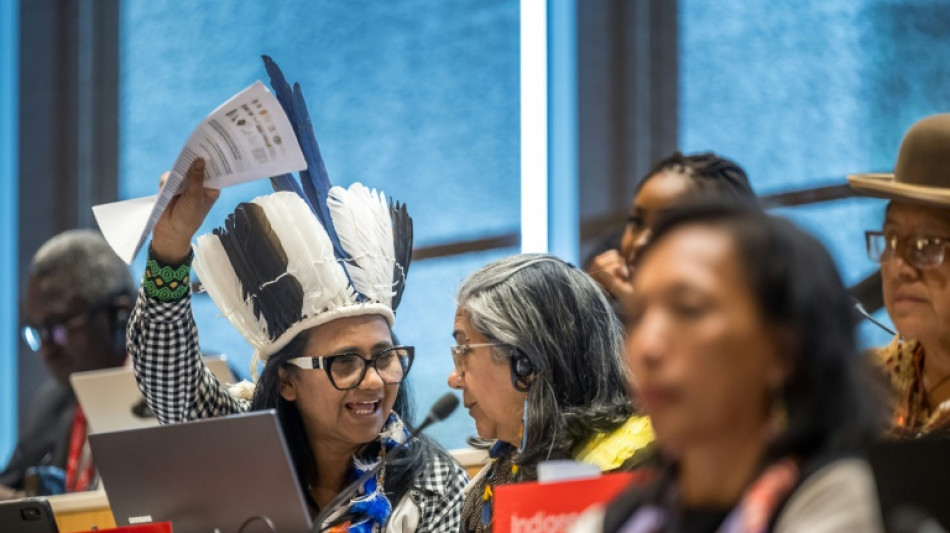
Celebrations as new biopiracy treaty agreed at UN / Photo: © AFP

 New Zealanders pick endangered black robin as Bird of the Year

 Asia stocks rise on AI, US-China trade talks optimism

 Malaysia's 'elephant whisperer' fights to save Borneo's endangered giants

 'I live in fear': 1.5 million Pakistani children sexually exploited online

 Cowboys beat Commanders, Vikings down Bears as star QBs injured

 Braves clinch division title as Red Sox reach MLB playoffs

 Bordeaux-Begles hammer Stade Francais despite Jalibert injury

 Milan and Juventus end blips with home wins

 Bridgeman wins PGA Biltmore title with sizzling 61

 Williams injured as Bears shut down by Vikings

 US warns of rapid escalation in Middle East war

 Germany's far-right AfD celebrates another state election win

 Russia vows revenge for election-day attacks as poll shows ruling party win

 Spaun late shows snatches PGA Championship win

 Conceicao strikes as Juventus beat Atalanta

 Britain, Zverev-inspired Germany, Spain complete Davis Cup finals

 Man Utd salvage Fulham draw as pressure mounts on Carrick

 Spanish civil war drama 'The Black Ball' wins at Toronto festival

 Germany's Merz shaken by far-right and far-left gains in state votes

 Macron welcomes Canada's Carney to French Atlantic territory

 Fiorentina frustrate Napoli with Serie A draw, Como upset

 Five-star Man City top Premier League after Sunderland thriller

 Ukrainian drones hit Moscow on last day of Russian elections

 Multi-Asset Trading Venue Monochrome Exchange Announces IEO of Its Native Token, $MCR

 South Korea break Japan hearts to win Asian Games basketball gold

Representatives of Indigenous peoples celebrated Friday at the United Nations following the agreement of a treaty against the pillaging of their traditional knowledge and genetic resources, like those from medicinal plants.
The new treaty, agreed by more than 190 nations, aims to combat so-called biopiracy by making applicants for patents disclose the origins of such materials used in a new invention.
Genetic resources -- such as those found in medicinal plants, agricultural crops and animal breeds -- are increasingly used by companies in everything from cosmetics to seeds, medicines, biotechnology and food supplements.
The idea is to increase intellectual property transparency on Indigenous people's traditional knowledge about resources, but the treaty does not address potential compensation for those communities.
The treaty is the culmination of more than 20 years of work at the UN's innovation and patenting agency -- the World Intellectual Property Organization (WIPO).
"Here we are not simply making history but the foundation for a sustainable future for all," the Indigenous Caucus group said after the deal was struck.
The treaty "finally recognises the crucial role that Indigenous peoples play in protecting these resources, ensuring their survival by transmitting our traditional knowledge from generation to generation.
WIPO said it was the first treaty to address "the interface between intellectual property, genetic resources and traditional knowledge".
- Sanctions debate -
Genetic resources have enabled considerable progress in health, climate and food security, according to the UN.
While natural genetic resources -- such as those found in medicinal plants -- cannot be directly protected as intellectual property, inventions developed using them can be patented.
But many developing countries were concerned that patents were being granted that circumvented the rights of Indigenous peoples.
The treaty text says patent applicants will be required to disclose where the genetic resources used in an invention came from, and the Indigenous people who provided the associated traditional knowledge.
The goal is to combat biopiracy by ensuring that an invention is genuinely new, and that the countries and local communities concerned agree with the use of their genetic resources, such as plant species cultivated over time, and the traditional knowledge surrounding them.
The treaty establishes sanctions, which would be imposed in accordance with the laws of countries that adopt the agreement
Some developing countries wanted to be able to revoke patents easily, while wealthy countries argued that stiff penalties would hamper innovation.
"We commend the outcome achieved, which strikes a fine balance between fostering innovation and enhancing transparency in the patent system," the Netherlands said on behalf of a group of mostly Western countries.
The treaty will enter into force once 15 countries have ratified it.
- 'Balanced outcome' -
Negotiations to finalise the treaty began at WIPO's Geneva headquarters on May 13.
Brazilian ambassador Guilherme de Aguiar Patriota, who has chaired the talks, hailed the new treaty early Friday as a "very carefully balanced outcome".
More than 30 countries already have disclosure requirements in their national laws.
Most of these are emerging and developing economies, including China, Brazil, India and South Africa, but others are European states, such as France, Germany and Switzerland.
However, those procedures vary and are not always mandatory.
The new treaty text says countries "shall provide an opportunity to rectify a failure to disclose the information required... before implementing sanctions".
However, that opportunity does not need to be extended in "cases where there has been fraudulent conduct or intent as prescribed by national law".
The treaty also says no country "shall revoke, invalidate, or render unenforceable" a patent solely because the applicant failed to disclose the necessary information.
Developing countries have long been calling for greater transparency on the origin of genetic resources.
D.Schneider--BTB